In this guide:
- At a Glance
- Introduction
- Are You Ready to Own a Horse?
- Understanding the True Cost of Horse Ownership
- Deciding What Horse You Actually Need
- Where to Look for Your First Horse
- How to Read a Horse Advert
- Before You Arrange a Viewing
- Questions to Ask the Seller
- Know When Not to Arrange the Viewing
- You’ve Found One Worth Viewing — What Next?
- Viewing a Horse
- Viewing Red Flags
- Should You View a Horse More Than Once?
- Ask Your Experienced Person What They Think
- Don’t Buy With Your Heart Alone
- After the Viewing
- If You Want to Proceed
- You’ve Found the Horse — Before You Buy
- The Pre-Purchase Veterinary Examination
- What Happens During a Five-Stage Vetting?
- What If the Vet Finds Something?
- Don’t Skip the Vetting Because the Horse Is Cheap
- A Vetting Isn’t a Guarantee
- What About Buying a Horse You Already Know?
- Trials and Loan With a View to Buy
- Be Cautious With Deposits
- Once You’ve Bought the Horse
- Prepare for the First Day
- Your Journey Is Just Beginning
- Frequently Asked Questions
- Glossary
At a Glance
- Be realistic about your experience, confidence and ability.
- Think carefully about what you actually want to do with your horse.
- Work out whether you can comfortably afford the ongoing costs, not just the purchase price.
- Decide where your horse will live and what level of support you’ll have.
- Look for a horse suited to the rider you are now, rather than the rider you hope to become.
- Ask plenty of questions before arranging a viewing.
- Never feel pressured into making an immediate decision.
- Take an experienced instructor or knowledgeable horse person with you where possible.
- Consider having a pre-purchase veterinary examination before buying.
- Check the horse’s identification and paperwork carefully.
- Remember that temperament, suitability and soundness are usually far more important than colour, breed or appearance.
- Be prepared to walk away if something doesn’t feel right.
Most importantly:
Your first horse doesn’t need to be your dream horse on paper. They need to be the right horse for you.
Introduction
Buying your first horse is a milestone many riders dream about for years.
Having a horse of your own means building a partnership, making your own decisions about their care and enjoying all those everyday moments that come with horse ownership.
But it’s also a significant commitment.
Unlike buying a new piece of tack or equipment, choosing the wrong horse isn’t simply an inconvenient purchase. A mismatch between horse and owner can affect confidence, safety, finances and the welfare of the horse.
And when you’re buying for the first time, it can be surprisingly difficult to know what you’re looking for.
Horse adverts can sound wonderful. Sellers may use terminology you’ve never encountered before. A horse might behave beautifully during a short viewing but be very different in another environment. And when you’ve finally met a horse you adore, it can be extremely difficult to make an objective decision.
That’s why preparation matters.
This guide will take you through the process from the very beginning — deciding whether you’re ready for ownership and working out what sort of horse you need — through adverts, viewings, vettings and paperwork, right up to preparing for your new horse’s arrival.
The aim isn’t to find the perfect horse.
There probably isn’t one.
The aim is to find a horse whose temperament, experience, abilities and needs are a sensible match for your experience, circumstances and ambitions.
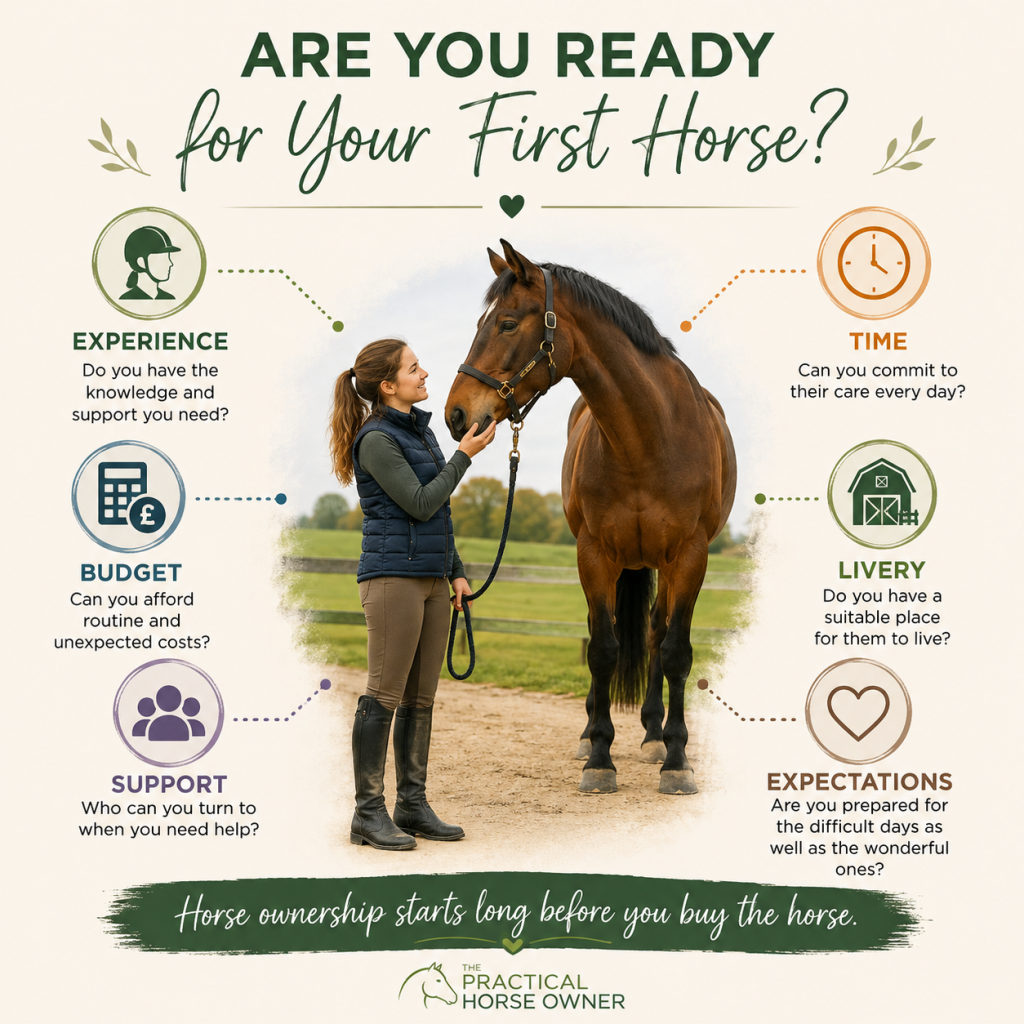
Are You Ready to Own a Horse?
Before you start looking through adverts, there’s a much more important question to answer:
Are you ready to own one?
Being able to ride doesn’t automatically mean you’re ready for horse ownership.
When you own a horse, you’re responsible for their welfare every day — including the days when it’s pouring with rain, you’re exhausted, you’re busy, they’re injured or absolutely nothing seems to be going to plan.
For many people, ownership is incredibly rewarding.
But it’s worth being realistic about what you’re committing to before making the leap.
Consider Your Experience
You certainly don’t need to know everything before buying your first horse. Nobody ever stops learning with horses.
However, you should either have enough practical knowledge to manage your horse’s everyday needs or have reliable support from people who do.
Consider whether you’re comfortable with everyday tasks such as:
- Catching and leading.
- Grooming.
- Picking out hooves.
- Rugging where necessary.
- Recognising basic signs of illness or injury.
- Managing feed, forage and water.
- Understanding routine farrier, dental and veterinary care.
- Handling a horse safely from the ground.
- Recognising when something isn’t normal.
If some of these are new to you, that doesn’t necessarily mean you shouldn’t own a horse.
It may simply mean that the right support system is especially important.
For a first-time owner, a supportive livery yard with experienced people around can be invaluable.
Be Realistic About Your Riding Ability
This is one area where honesty really matters.
Try not to buy for the rider you imagine you’ll be in two years.
Buy for the rider you are today.
A horse described as having “lots of potential” may sound exciting, but potential usually requires somebody with the experience and confidence to develop it.
Likewise, a young or inexperienced horse and an inexperienced owner can sometimes be a difficult combination because both are still learning.
There’s absolutely nothing wrong with choosing an older, experienced horse who already understands their job.
In fact, for many first-time owners, that can be an excellent choice.
A horse that gives you confidence and allows you to enjoy ownership is worth far more than one that looks impressive on paper but leaves you frightened to ride.
Think About What You Actually Want to Do
Before searching for a horse, write down what you genuinely want from ownership.
Perhaps you want to:
- Hack quietly.
- Attend riding club.
- Do low-level dressage.
- Jump.
- Hunt.
- Compete regularly.
- Enjoy fun rides.
- Have lessons.
- Do groundwork.
- Simply enjoy caring for and spending time with your horse.
There’s no right answer.
But your answer should influence the type of horse you look for.
If your dream is peaceful weekend hacking, you probably don’t need an extremely athletic competition horse.
Likewise, if you have serious competitive ambitions, you need a horse physically and mentally suited to that job.
Try separating your requirements into:
Must Have
Things you genuinely need.
For example:
- Safe in traffic.
- Suitable for a novice rider.
- Good to hack alone.
- Comfortable living on your chosen type of livery.
Nice to Have
Things you’d enjoy but could compromise on.
Perhaps:
- Particular breed.
- Certain height.
- Competition record.
- Specific markings.
Doesn’t Matter
Things that shouldn’t influence the decision very much.
And yes — colour probably belongs here!
It’s remarkably easy to start looking for a sensible 15hh cob and somehow convince yourself that the beautiful 16.3hh grey competition horse you’ve found online is exactly what you need.
Having your requirements written down before you browse adverts can help keep your head involved when your heart inevitably takes over.
Do You Have Enough Time?
Horse ownership requires time as well as money.
Exactly how much depends heavily on your management arrangements.
A horse on full livery may require much less daily work from you than one kept on DIY livery or at home.
With DIY care, everyday jobs can include:
- Feeding.
- Turning out and bringing in.
- Mucking out.
- Filling haynets.
- Preparing feeds.
- Filling water.
- Grooming.
- Checking the horse.
- Exercising.
- Field maintenance.
And horses still need caring for when you’re ill, working late or want to go away for the weekend.
Before buying, think about who will look after your horse when you can’t.
Having reliable backup arrangements is an important part of responsible ownership.
Where Will Your Horse Live?
Ideally, you should know where your horse will be kept before you buy them.
For first-time owners, a good livery yard can provide much more than a stable and field.
The right yard may offer:
- Experienced support.
- Help during emergencies.
- Other people to ride with.
- Advice when you’re unsure.
- Facilities appropriate for what you want to do.
- Cover when you’re unavailable.
Think about the type of livery you need, available turnout, hacking, arena facilities, storage, yard rules and travelling distance from home.
A wonderful horse kept somewhere that doesn’t suit either of you can make ownership unnecessarily difficult.
Do You Have a Support Network?
This is one of the things I think first-time buyers can underestimate.
Having knowledgeable people around you can make an enormous difference.
Your support network might include:
- A riding instructor or trainer.
- Experienced yard owner or manager.
- Veterinarian.
- Farrier.
- Equine dental professional.
- Physiotherapist or other appropriately qualified professionals.
- Experienced friends or family.
You won’t necessarily need everyone immediately, but knowing who you can ask when you’re unsure takes enormous pressure off a new owner.
And having an independent, experienced person involved while you’re actually searching for a horse can be particularly valuable.
Are You Ready for Things to Go Wrong?
This isn’t meant to put anyone off ownership.
It’s simply part of being prepared.
At some point, your horse may:
- Lose a shoe the day before an event.
- Develop an abscess.
- Damage a rug.
- Need unexpected veterinary treatment.
- Become lame.
- Injure themselves.
- Require a period of box rest.
- Need additional feed or management.
- Suddenly become unsuitable for the job you originally bought them for.
Horse ownership isn’t always predictable.
Before buying, ask yourself whether you have enough financial flexibility, practical support and emotional resilience to deal with the less enjoyable parts too.
If the answer is yes, then you’re in a much stronger position to begin looking.
A Useful Question to Ask Yourself
Instead of only asking:
“Am I ready to have my own horse?”
also ask:
“Am I ready to be responsible for this horse when ownership isn’t fun?”
If you’re prepared for the winter mornings, unexpected bills, changes of plan and difficult decisions as well as the rides, cuddles and exciting milestones, you’re beginning your search with realistic expectations.
💡Practical Horse Owner Tip
Before looking at a single advert, write down your budget, experience level, intended activities, must-haves and absolute deal-breakers. Keep the list with you throughout your search. It’s much easier to make sensible decisions before you’ve fallen in love with a horse.
Understanding the True Cost of Horse Ownership
The purchase price of a horse is only the beginning.
In fact, over the lifetime of the horse, the amount you initially pay for them may become a relatively small part of the overall cost of ownership.
Before you start looking at horses for sale, it’s important to create a realistic monthly and annual budget — including some room for unexpected expenses.
Exactly how much horse ownership costs varies enormously depending on where you live, the type of livery you choose, your horse’s individual needs and what you plan to do with them.
Rather than focusing on one estimated figure, consider all the different expenses you’re likely to encounter.
Livery
For many owners, livery will be one of the largest regular expenses.
Costs vary considerably depending on the facilities and level of service provided.
Common arrangements include:
Grass Livery
Your horse primarily lives at pasture, although facilities and management arrangements vary between yards.
DIY Livery
You rent the facilities but carry out most or all of your horse’s daily care yourself.
Part Livery
Some daily jobs are completed by the yard, while you remain responsible for others.
Full Livery
Most routine daily care is provided by the yard.
Before comparing prices, find out exactly what is included.
A cheaper monthly livery fee isn’t necessarily cheaper overall if hay, bedding, turnout, bringing in or other services are charged separately.
Feed, Forage & Bedding
Depending on your livery arrangement, you may need to budget separately for:
- Hay or haylage.
- Hard feed.
- Supplements where genuinely required.
- Bedding.
These costs can fluctuate throughout the year.
For example, a horse living out during summer may require less supplementary forage than during winter, while a stabled horse may require considerably more bedding and forage.
Your horse’s individual requirements matter too.
A good-doing native pony may have very different feeding needs from an older Thoroughbred who struggles to maintain weight.
Farrier or Hoof Care
Your horse will require regular professional hoof care throughout their life.
How frequently they’re seen and the cost involved will depend on factors including:
- Whether they’re barefoot or shod.
- The type of shoes used.
- Hoof condition.
- Workload.
- Individual hoof growth.
- Any remedial or specialist requirements.
Don’t assume that buying a barefoot horse means there will be no hoof-care costs. Barefoot horses still require appropriate regular trimming and monitoring.
Routine Veterinary Care
Even a healthy horse has routine healthcare costs.
These may include:
- Vaccinations.
- Veterinary examinations.
- Parasite-control testing and treatment where required.
- Other preventative healthcare appropriate to the individual horse.
It’s worth finding out the approximate cost of routine veterinary care in your area before buying.
Dental Care
Horses require regular dental assessment by an appropriately qualified professional. If no issues arise, they should at minimum receive a general check up every 6-12 months.
Dental problems can affect eating, comfort, condition, ridden behaviour and overall welfare, so this isn’t an expense to overlook when budgeting.
Insurance
Horse insurance can cover different things depending on the policy.
Depending on your circumstances, you may want or need to consider cover for areas such as:
- Veterinary fees.
- Mortality.
- Theft or straying.
- Permanent loss of use.
- Third-party liability.
Policies vary considerably, so always read the terms, exclusions and limits carefully rather than simply choosing the cheapest premium.
Some owners also choose to put money aside specifically for veterinary emergencies, whether alongside insurance or instead of certain types of cover.
Lessons & Training
Buying your own horse doesn’t mean lessons suddenly stop.
In fact, regular instruction can be especially valuable when you’re building a partnership with a new horse.
You might need to budget for:
- Riding lessons.
- Groundwork lessons.
- Clinics.
- Professional schooling.
- Behavioural or training support.
If you’re buying your first horse, having professional support available can be money very well spent.
Tack & Equipment
The initial setup costs can quickly add up.
Depending on what you already own and what comes with the horse, you may need:
- Saddle.
- Bridle.
- Saddle pads.
- Girth.
- Rugs.
- Headcollar and lead rope.
- Grooming equipment.
- Feed buckets.
- Haynets.
- First-aid supplies.
- Riding equipment.
- Storage equipment.
A correctly fitting saddle is particularly important, so don’t assume that a saddle sold with the horse will automatically remain suitable.
Transport
Even if you don’t plan to compete, there may be times when your horse needs transporting.
That could include:
- Moving yards.
- Veterinary hospital visits.
- Clinics.
- Lessons.
- Competitions.
- Emergency transport.
If you don’t own suitable transport yourself, find out what professional horse transport is available locally and what it may cost.
It’s also useful to know who you could call in an emergency before you actually need them.
The Unexpected Costs
This is the part of the budget that’s easiest to forget.
Horses have an unfortunate ability to produce an unexpected expense at precisely the wrong moment.
You may suddenly need to pay for:
- Veterinary treatment.
- Additional diagnostic investigations.
- Medication.
- Emergency transport.
- Replacement rugs.
- Lost shoes.
- Specialist farriery.
- Rehabilitation.
- Additional livery or box rest.
- Professional help.
Having an emergency fund can make these situations considerably easier to manage.
Create a Realistic Budget
Before buying, divide your budget into three areas:
Initial Costs
The horse itself, vetting, transport, tack and equipment.
Regular Costs
Livery, feed, forage, bedding, hoof care, insurance and routine healthcare.
Unexpected Costs
Veterinary emergencies, damaged equipment, rehabilitation and anything else that doesn’t fit neatly into the monthly budget.
Then ask yourself an important question:
Could I still afford my horse if their needs changed?
A horse that is inexpensive to maintain today could require medication, specialist shoeing, additional feed or different management in the future.
It’s much safer to budget with some breathing room than to calculate the absolute maximum you can afford each month.
Deciding What Horse You Actually Need
Once you’re confident that ownership fits your lifestyle and budget, it’s finally time to think about the horse.
And this is where first-time buyers can easily get distracted.
Colour, breed, impressive movement and beautiful photographs can all catch your attention.
But your priorities should be:
Suitability. Temperament. Experience. Health.
The right horse for somebody else isn’t necessarily the right horse for you.
Start With Your Experience Level
Be realistic about your riding and handling ability.
Think about:
- How confidently you ride independently.
- What types of horses you’re accustomed to riding.
- How you cope when a horse becomes nervous or excitable.
- Your experience handling horses from the ground.
- Whether you’ve dealt with common behavioural challenges.
- How confident you are hacking, jumping or competing, if relevant.
If you’re relatively inexperienced, look for a horse capable of helping you learn, rather than one that needs you to teach them everything.
An experienced horse can be an invaluable first partner.
Temperament
For a first horse, temperament should be very high on your priority list.
Ask yourself what kind of horse you enjoy.
Would you prefer one who is:
- Quiet and steady?
- Responsive but sensible?
- Forward-going?
- Independent?
- Affectionate?
- Confident hacking?
- Comfortable in busy environments?
Don’t confuse quiet with suitable, either.
An extremely unresponsive horse may frustrate a rider who enjoys something forward-going, while a very sensitive horse may overwhelm somebody who wants a relaxing hack.
You’re looking for compatibility.
Age
There is no perfect age for a first horse.
However, younger horses generally have less life and training experience and may require more knowledgeable handling and education.
An older, experienced horse can often make an excellent first horse because they may already have experience of:
- Hacking.
- Traffic.
- Competitions.
- Travelling.
- Farrier visits.
- Veterinary treatment.
- Different environments.
Older doesn’t automatically mean safe, just as young doesn’t automatically mean difficult.
Temperament, training and individual history matter more than the number in the passport.
Height
Many buyers start their search with a very specific height in mind.
Height matters to an extent — the horse needs to be physically suitable for the rider — but don’t become so focused on a particular number that you overlook an otherwise ideal horse.
Build, weight-carrying ability, rider proportions and the horse’s overall type can be just as important.
A well-built 14.3hh horse may suit a particular rider better than a narrow 16hh horse.
Breed and Type
Different breeds and types can have tendencies towards particular physical characteristics or temperaments, but every horse is an individual.
Breed alone cannot tell you whether a horse will be suitable.
Rather than deciding:
“I need a cob.”
or
“I want a Thoroughbred.”
think about the characteristics you actually want.
For example:
- Sensible.
- Comfortable to ride.
- Capable of your intended workload.
- Suitable for your management system.
- Appropriate for your experience.
Then consider individual horses that meet those requirements.
Mare or Gelding?
There’s no universal answer to whether a mare or gelding makes a better first horse.
Both can make wonderful partners.
Individual temperament, training, health and suitability are far more important than sex.
Choosing a horse simply because you’ve heard that geldings are easier or mares are more difficult could cause you to overlook an excellent match.
Schoolmaster or Project?
For most first-time owners, I’d strongly favour experience over potential.
A schoolmaster is an experienced horse who understands their job and can often help their rider learn.
A project horse may need:
- Further schooling.
- Confidence building.
- Behavioural work.
- Experience away from home.
- Training in basic situations.
Projects can be incredibly rewarding for the right person.
But owning your first horse already involves a huge amount of learning. Taking on a horse who is also inexperienced or requires significant retraining can make that learning curve considerably steeper.
There’s no shame whatsoever in wanting a horse that’s already been there and done it.
Think About Their Current Lifestyle
Suitability isn’t only about riding.
Consider how the horse currently lives.
Are they:
- Stabled overnight?
- Living out 24/7?
- Turned out individually?
- Living in a herd?
- Used to a busy yard?
- Used to a quiet private home?
A significant management change isn’t necessarily a problem, but it’s something you need to understand.
For example, a horse accustomed to living outside with companions may struggle if suddenly expected to spend long periods stabled alone.
Try to choose a horse whose needs can realistically be met by the environment you’re able to provide.
Match the Horse to the Job
Be clear about what you’re buying the horse to do.
If You Mainly Want to Hack
Prioritise experience in traffic, hacking alone and in company, open spaces and different environments.
If You Want to Jump
Look at the horse’s experience, confidence, suitability and whether their ability matches your ambitions.
If You Want to Compete
Consider temperament away from home, travelling experience and performance in the discipline you’re interested in.
If You Want an All-Rounder
Look for a horse with genuine experience across the activities you’d like to enjoy.
And if your main ambition is simply:
“I want a horse I can enjoy.”
That’s a perfectly valid requirement too.
Be Careful With the Word “Potential”
You’ll see this word frequently in horse adverts.
“Lots of potential.”
“Potential to go far.”
“Exciting prospect.”
Potential can be valuable — but it isn’t the same as experience.
If you’re buying your first horse, ask yourself:
Do I have the experience, confidence, time and professional support required to turn that potential into the horse I want?
If not, buying a horse that already does the job you want may be a much better investment.
Create Your Horse Shopping List
Before you begin searching, write down your ideal horse under three headings.
Non-Negotiables
Requirements the horse genuinely must meet.
For example:
- Appropriate for your experience.
- Safe in traffic.
- Hacks alone.
- Suitable for your chosen discipline.
- Manageable from the ground.
- Comfortable with your planned living arrangements.
Preferences
Things you’d like but could compromise on.
For example:
- Height range.
- Breed/type.
- Competition experience.
- Age range.
- Colour.
Deal-Breakers
Things you know you’re not equipped or willing to manage.
These will be different for everybody.
Being clear about them before viewing horses makes it much easier to make sensible decisions later.
💡Practical Horse Owner Tip
Give your horse-shopping list to your instructor or another experienced person you trust. Ask them whether it realistically matches your current ability and circumstances. They may spot something you’ve overlooked — or gently talk you out of the completely unsuitable horse you’ve already fallen in love with online!
Where to Look for Your First Horse
Once you’ve decided what sort of horse you’re looking for, it’s time to start the search.
Horses are advertised in many different places, including:
- Specialist horse-sale websites.
- Social media.
- Local equestrian groups.
- Riding clubs and Pony Clubs.
- Livery yards.
- Riding schools.
- Dealers.
- Trainers and instructors.
- Word of mouth.
For a first-time buyer, word of mouth can be particularly valuable.
Tell your instructor, yard owner and other experienced horse people exactly what you’re looking for. They may know of a suitable horse before it is ever publicly advertised.
Buying through somebody you know doesn’t guarantee that the horse will be right for you, but having reliable information about their history can be extremely useful.
Buying Privately or From a Dealer?
You’ll find horses offered by both private sellers and professional dealers.
Neither option automatically guarantees a good or bad experience.
A reputable dealer may have several horses available and can potentially help match you with something suitable. A genuine private seller may know their horse extremely well and be able to give you years of history.
Whichever route you choose, do your own checks.
Don’t rely solely on the seller’s description of the horse, and don’t skip sensible precautions simply because somebody seems trustworthy.
If buying from a business or dealer, your legal rights may also differ from those that apply to a private sale, so it’s worth understanding your position before handing over any money.
How to Read a Horse Advert
Horse adverts can tell you a surprising amount — including through what they don’t say.
Start by looking for basic information such as:
- Age.
- Height.
- Breed or type.
- Sex.
- Experience.
- Current workload.
- Temperament.
- Hacking experience.
- Competition history where relevant.
- Behaviour for the farrier, vet and dentist.
- Travelling and loading.
- Known health issues.
- Reason for sale.
An advert doesn’t need to contain every detail, but you should be able to build a reasonable picture of the horse.
If important information is missing, make a note to ask about it.
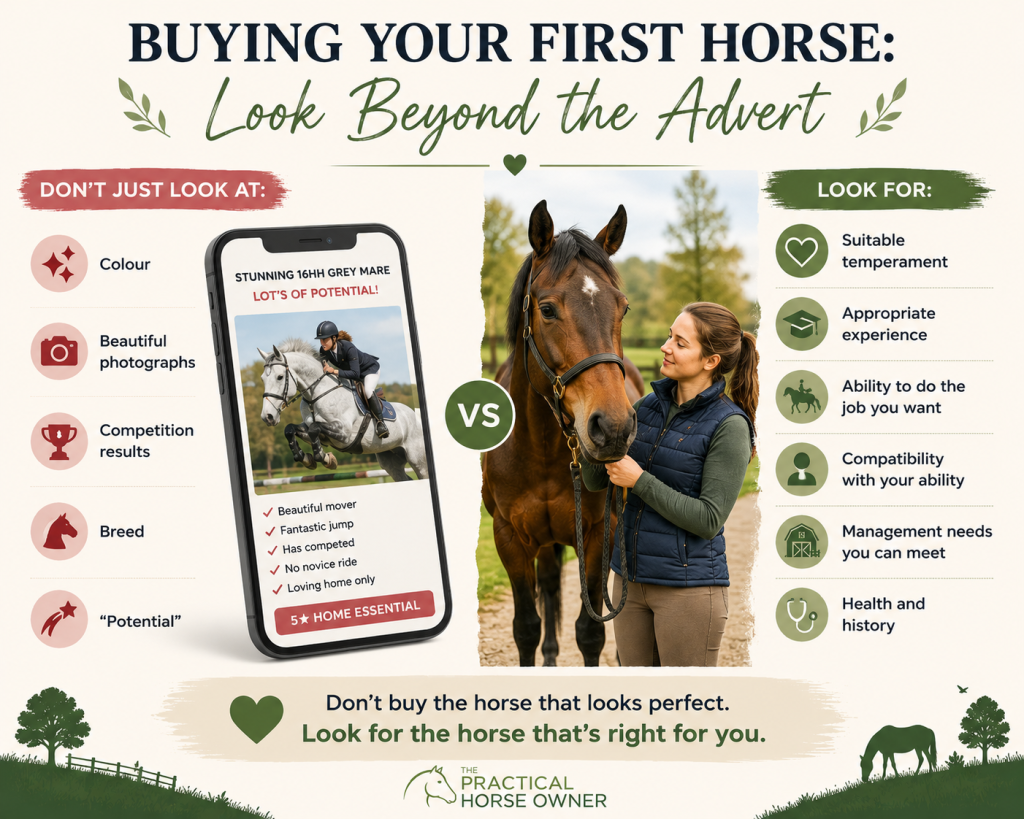
Look Beyond the Photographs
Beautiful photographs can make it very easy to fall in love with a horse before you’ve even spoken to the owner.
Try not to.
Photographs show you moments, not the horse’s everyday behaviour.
Ideally, look for recent photographs and videos that show the horse:
- Standing naturally.
- Walking and trotting.
- Being ridden.
- Performing the activities they’re advertised as doing.
- Hacking if hacking experience is important to you.
A heavily edited photograph or impressive jumping picture may look fantastic, but neither tells you whether the horse will quietly stand while you open a gate on a windy Tuesday morning.
For a first horse, those ordinary details can matter far more.
Learn to Question Advert Language
Horse adverts often contain phrases that sound positive but need further explanation.
That doesn’t mean the seller is necessarily hiding anything. Horse people simply use a lot of shorthand.
But never assume you know what a phrase means to that particular seller.
“Not a Novice Ride”
Take this literally.
If you’re inexperienced or lacking confidence, don’t convince yourself that you’ll somehow be the exception.
Ask exactly why the horse isn’t considered suitable for a novice.
“Needs a Confident Rider”
Ask what happens when the rider isn’t confident.
Does the horse stop?
Nap?
Spook?
Rush?
Become strong?
Refuse to leave other horses?
The phrase itself doesn’t tell you enough.
“Forward Going”
This could describe a pleasantly responsive horse that enjoys their work.
It could also describe a horse that is much faster or stronger than you’re comfortable riding.
Ask for clarification.
“Can Be Sharp”
Find out exactly what “sharp” means.
Ask:
What does the horse actually do?
One person’s mildly spooky horse may be another person’s terrifying ride.
“Green”
Usually, this means the horse is inexperienced or still learning.
Find out what they have and haven’t done.
A green horse may be perfectly suitable for an experienced rider but could be inappropriate for somebody buying their first horse.
“Needs Bringing Back Into Work”
Find out why the horse has been out of work, for how long, and what they were doing beforehand.
A horse returning from a quiet winter is very different from one returning after an injury.
“Sold From the Field”
This generally means the horse is being sold without being brought into work for prospective buyers.
Ask why.
There may be a perfectly reasonable explanation, but buying a horse you cannot properly assess under saddle carries additional uncertainty.
“Project”
For a first-time owner, treat this word with caution.
A project may require significant schooling, rehabilitation, behavioural work or experience.
Unless you’re specifically equipped for that, it probably isn’t what you’re looking for.
“Experienced Home Only”
Again, believe the advert.
If the seller believes the horse requires an experienced home, a first-time owner shouldn’t assume they’ll be fine simply because they like the horse.
“No Time Wasters”
This is common advert wording and doesn’t mean you need to rush.
A genuine buyer asking sensible questions, arranging an appropriate viewing and considering the decision carefully is not wasting anyone’s time.
Don’t allow advert wording to pressure you into skipping important checks.
Don’t Be Afraid to Ask What Words Mean
This deserves emphasising.
If an advert says:
“Can nap occasionally.”
Ask:
“What exactly does the horse do when they nap?”
If it says:
“Can be quirky.”
Ask:
“What behaviours are you describing as quirky?”
If it says:
“Needs a competent rider.”
Ask:
“What happens if the rider makes a mistake?”
Specific questions produce much more useful answers than labels.
Warning Signs in an Advert
No single advert feature automatically means something is wrong, but certain things should encourage you to ask more questions.
Be cautious if:
- The description is extremely vague.
- Basic information is missing.
- The seller avoids answering straightforward questions.
- Only old photographs or videos are available.
- The horse’s story repeatedly changes.
- You’re pressured to pay a deposit immediately.
- The horse appears dramatically underpriced without a clear explanation.
- The seller refuses reasonable requests to see the horse performing activities they’re supposedly experienced in.
- You’re discouraged from arranging an independent veterinary examination.
Most importantly, don’t let the fear of somebody else buying the horse force you into a decision you’re uncomfortable with.
There will always be another horse.
Before You Arrange a Viewing
You don’t need to drive three hours across the country before discovering that the horse doesn’t hack alone when hacking alone was one of your absolute requirements.
Have a proper conversation with the seller first.
Tell them honestly:
- Your riding experience.
- Your confidence level.
- What you want to do.
- Where the horse will live.
- What type of horse you’re looking for.
Don’t try to make yourself sound more experienced than you are.
A responsible seller should want to know whether their horse is suitable for you too.
Then start asking questions.
Questions to Ask the Seller
You don’t necessarily need to interrogate somebody with fifty questions in one breath, but there are some important areas to cover.
Why Are You Selling?
Ask why the horse is for sale.
There are countless genuine reasons:
- Rider giving up.
- Owner’s circumstances changing.
- Horse and rider no longer suited.
- Rider progressing to a different level.
- Lack of time.
- Financial circumstances.
The answer itself isn’t necessarily important — you’re trying to understand the horse’s situation and history.
How Long Have You Owned the Horse?
Someone who has owned a horse for six years may be able to give you much more detailed history than somebody who bought them six weeks ago.
If ownership has been short, ask where the horse came from and what is known about their previous home.
What Does the Horse Currently Do?
Ask about their actual current routine, not simply what they’ve done at some point in their life.
For example:
- How many times a week are they ridden?
- Do they hack?
- Do they school?
- Do they jump?
- Are they competing?
- When were they last doing these things?
A horse that competed regularly three years ago but hasn’t left the field since is different from one currently doing that job every week.
What Are They Like to Hack?
If you plan to hack, get specific.
Ask:
- Do they hack alone?
- Do they hack in company?
- Are they different at the front or back?
- What are they like in traffic?
- Have they encountered larger vehicles?
- What are they like in open spaces?
- Can they be separated from other horses?
- Do they nap or become reluctant to leave home?
“Good to hack” can mean very different things to different people.
What Are They Like to Handle?
Ask about everyday life.
What are they like to:
- Catch?
- Lead?
- Groom?
- Tie up?
- Pick up their hooves?
- Rug?
- Bath?
- Clip?
- Tack up?
- Mount?
A horse might be wonderful to ride but challenging on the ground.
You need to know whether you’re comfortable managing the whole horse, not just riding them.
What Are They Like for Professionals?
Ask what the horse is like for:
- The farrier.
- Veterinarian.
- Equine dental professional.
- Physiotherapist or other professionals where relevant.
If sedation is normally required for certain procedures, that’s useful to know beforehand.
Do They Load and Travel?
Ask:
- Do they load into a trailer?
- Horsebox?
- Both?
- Do they travel alone?
- With company?
- How do they behave during the journey?
- Are they easy to unload?
If regular travelling is important to you, this information matters.
And later at the viewing, you may want to see the horse load rather than simply being told they do.
Have They Ever Shown Any Difficult or Dangerous Behaviour?
Ask this question clearly.
For example, has the horse ever:
- Reared?
- Bucked?
- Bolted?
- Kicked?
- Bitten?
- Napped significantly?
- Become difficult to catch?
- Been difficult to load?
- Become dangerous in traffic?
A “yes” doesn’t automatically mean you shouldn’t buy the horse.
You need to understand what happened, why it happened, how frequently it occurs and whether you have the experience to manage it.
Ask About Health
Ask whether the horse has any known:
- Previous injuries.
- Lameness.
- Colic history.
- Respiratory problems.
- Skin conditions.
- Allergies.
- Ongoing medication.
- Previous operations.
- Current health concerns.
You can also ask whether there are previous veterinary records that may be available with the appropriate permissions.
Remember that a seller’s answers are not a substitute for an independent pre-purchase veterinary examination.
We’ll cover vetting properly later in the guide.
Ask About Current Management
Find out:
- What they’re fed.
- How much turnout they receive.
- Whether they’re stabled.
- Whether they live alone or with other horses.
- Whether they wear shoes.
- When they were last seen by the farrier.
- Their vaccination status.
- Their usual parasite-control programme.
- Their dental-care routine.
This helps you understand both their current needs and how different your intended management might be.
Ask About Tack
If tack is included in the sale, find out exactly what’s included.
Don’t assume that:
“Tack available separately”
means everything fits correctly or should automatically be purchased.
Saddles in particular should be assessed for suitability rather than simply transferred with the horse because they’ve previously been used together.
Ask for Recent Videos
Before travelling a long distance, it’s reasonable to ask for recent video showing the horse doing the activities that matter to you.
Depending on what you’re buying them for, that might include:
- Walking and trotting in hand.
- Schooling.
- Hacking.
- Jumping.
- Loading.
- Being handled.
Videos still can’t tell you everything, but they may prevent an unnecessary journey if you immediately realise the horse isn’t what you’re looking for.
Be Honest With the Seller
This works both ways.
If you tell a seller:
“I’ve been riding for twenty years.”
they may assume you’re highly experienced.
But perhaps you’ve ridden once a week in a riding school for twenty years and have never owned, competed, hacked alone or dealt with a difficult horse.
That’s important context.
Give the seller a realistic picture of your ability.
A good seller should want their horse to go to a suitable home.
Know When Not to Arrange the Viewing
Sometimes the best decision happens before you ever meet the horse.
If the conversation reveals that the horse:
- Doesn’t meet one of your non-negotiables.
- Requires substantially more experience than you have.
- Has behaviours you’re uncomfortable managing.
- Cannot do the job you need.
- Has management needs you cannot provide.
…you don’t need to view them anyway.
It’s very easy to think:
“I’ll just go and have a look.”
And that’s how you end up emotionally attached to a horse you’ve already established isn’t suitable!
Thank the seller for their time and continue searching.
💡 Practical Horse Owner Tip
Keep notes for every horse you enquire about. Record the advert, seller’s answers, videos you’ve received and your initial thoughts. Once you’ve spoken to several sellers, it’s surprisingly easy to forget which horse was the good loader, which one didn’t hack alone and which one hadn’t been ridden for six months.
You’ve Found One Worth Viewing — What Next?
If the horse appears to match your requirements, you’ve had a good conversation with the seller and nothing you’ve learned has ruled them out, it’s time to arrange a viewing.
This is where things become much more interesting.
You’re no longer assessing an advert.
You’re assessing the actual horse.
And the goal of the viewing isn’t simply to decide:
“Do I like this horse?”
It’s to answer:
“Is this horse genuinely suitable for me?”
Those are two very different questions.
Viewing a Horse
You’ve found an advert that looks promising, spoken to the seller, asked your initial questions and arranged a viewing.
Now comes the exciting part — actually meeting the horse.
It’s completely natural to feel excited, but try to approach the viewing as an opportunity to gather information, rather than expecting to make a decision there and then.
Your aim isn’t simply to decide whether you like the horse.
You’re trying to establish whether this particular horse is safe, suitable and appropriate for you, your experience and what you want to do.
Take Someone Experienced With You
For a first-time buyer, one of the best things you can do is take an experienced, independent person with you.
Ideally, this might be:
- Your regular instructor.
- A trainer who knows your riding.
- An experienced horse person whose judgement you trust.
Someone who knows you well can assess both sides of the partnership.
They know whether you’re genuinely comfortable riding a particular type of horse and may notice things you miss.
They’re also less likely to be influenced by the fact that you’ve already fallen completely in love with the horse!
If possible, choose somebody who doesn’t have a financial interest in whether you buy the horse.
Don’t Arrive Too Early — But Don’t Expect the Horse to Be Ready
Agree a viewing time with the seller and arrive when expected.
However, where practical, ask beforehand if you can see the horse before they’re groomed and tacked up.
Seeing the horse during normal handling can tell you a great deal.
You may get to see them:
- Caught from the field.
- Led.
- Tied up.
- Groomed.
- Having their hooves handled.
- Tacked up.
If you arrive to find the horse already fully tacked and exercised, you lose the opportunity to observe some of those everyday behaviours.
There may be an entirely innocent reason, but it’s reasonable to ask to see the horse from the beginning of the process.
Observe Before You Touch
When you first see the horse, take a moment to simply observe them.
Look at:
- General condition.
- Body condition.
- Coat.
- Hooves.
- Legs.
- Overall posture.
- Behaviour.
- Interaction with the handler.
- Alertness and demeanour.
You’re not trying to perform a veterinary examination — that’s what the pre-purchase vetting is for.
You’re simply taking in the whole picture.
Does what you’re seeing broadly match the horse that was described to you?
Watch the Horse Being Handled
Everyday handling matters.
A horse that is wonderful to ride but extremely difficult to manage on the ground may not be appropriate for a first-time owner.
Where appropriate, watch the horse:
- Being caught.
- Led.
- Tied up.
- Groomed.
- Having all four hooves picked up.
- Being rugged or unrugged if relevant.
- Having tack put on.
Watch how the horse responds and how the handler behaves around them.
Does everything look relaxed and routine?
Or does the handler appear to be carefully avoiding particular situations?
Don’t be afraid to ask questions.
Watch the Horse Move Before Riding
It’s useful to see the horse move before anyone gets on.
Where circumstances allow, watch them walk and trot in hand on a suitable surface.
You’re looking at their general movement rather than attempting to diagnose soundness yourself.
If something concerns you, make a note of it and discuss it with the veterinarian if you proceed to a pre-purchase examination.
The Seller or Their Rider Should Ride First
This is an important safety rule.
Do not be the first person to get on an unfamiliar horse at a viewing.
Ask the seller or their regular rider to ride first.
Watch:
- How the horse stands for mounting.
- How they walk, trot and canter.
- Transitions.
- Steering.
- Responsiveness.
- General relaxation.
- Behaviour when asked to work.
- How the rider manages them.
If you’re buying a horse to jump, watch them jump.
If they’re advertised as doing particular schooling movements that matter to you, ask to see them.
And if the seller refuses to ride the horse without a clear and reasonable explanation, you don’t need to get on either.
Your safety comes first.
You Don’t Have to Ride
Just because you’ve travelled to a viewing doesn’t mean you’re obliged to ride the horse.
If you’ve watched the horse and decided they’re unsuitable, it’s perfectly acceptable to stop the viewing.
Likewise, if you feel unsafe or uncomfortable, don’t get on simply because you feel embarrassed about saying no.
You can politely say that you don’t think the horse is the right match.
Walking away is always an option.
If You Do Ride, Take Your Time
If you’re happy with what you’ve seen and feel comfortable riding the horse, take things gradually.
Start with the basics.
Get a feel for:
- Walk.
- Halt.
- Steering.
- Transitions.
- Trot.
- Canter, when appropriate.
- How responsive the horse feels.
- Whether you feel secure and comfortable.
You don’t need to prove anything.
This isn’t an audition.
If you usually jump 70cm, there’s absolutely no reason to suddenly jump 1.10m because the horse can.
Assess the horse doing the things you actually want to do with them.
How Do You Feel?
This is incredibly important.
Don’t only analyse the horse.
Analyse yourself.
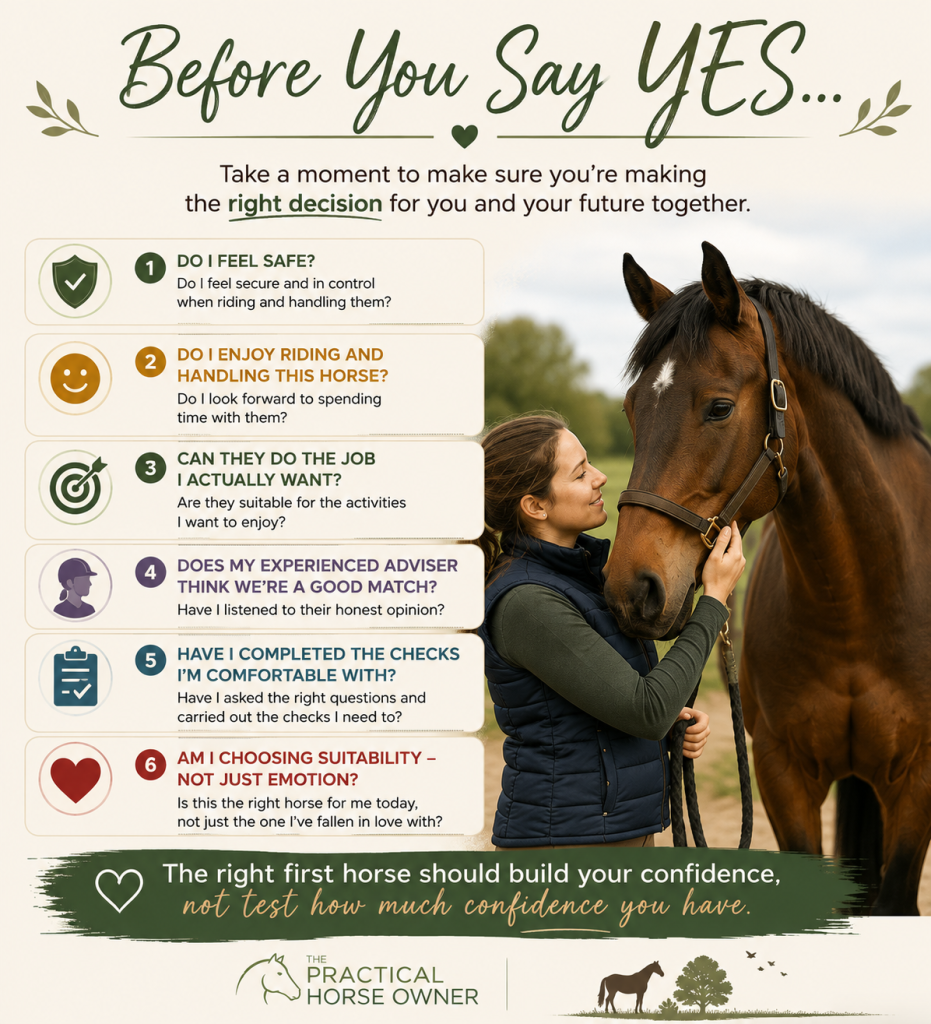
Ask:
- Do I feel safe?
- Am I relaxed?
- Do I feel in control?
- Am I enjoying riding this horse?
- Do I feel able to correct a mistake?
- Would I be comfortable riding this horse without the seller standing nearby?
- Would I look forward to riding them tomorrow?
A horse can be talented, beautiful and perfectly well behaved and still not feel right for you.
That’s okay.
Test What Matters to You
A viewing should reflect the job you’re buying the horse to do.
If you want a hacking horse, seeing them beautifully schooled in an arena isn’t enough.
Where safe and practical, you may want to see or experience them:
- Hacking alone.
- Hacking in company.
- Passing traffic.
- Going in front and behind.
- Leaving other horses.
- Riding in open spaces.
If you want to compete, you may want to know how they behave away from home.
If travelling regularly matters, ask to see them load.
If you’re buying an all-rounder, try to assess as many of the relevant areas as reasonably possible.
You may not be able to test everything at the first viewing, which is one reason a second viewing can be so useful.
Ask to See the Horse Load
If the horse has been advertised as good to load and travelling is important to you, consider asking to see it.
Ideally, the horse should be demonstrated loading into an appropriate vehicle rather than you being expected to test an unfamiliar horse yourself.
Remember that loading behaviour can vary between vehicles and circumstances, so a successful demonstration isn’t a guarantee that the horse will always load perfectly.
But it gives you useful information.
Don’t Deliberately Provoke the Horse
There’s a difference between assessing a horse appropriately and deliberately trying to make them react.
You don’t need to frighten the horse, ride dangerously or manufacture difficult situations to “test” them.
A sensible viewing should assess the horse in realistic situations relevant to your intended use.
You’re trying to understand them, not catch them out.
Viewing Red Flags
A red flag doesn’t always prove that something dishonest is happening, but certain situations should make you stop and ask questions.
Be cautious if:
- The horse is already sweaty or appears to have been heavily exercised before you arrive.
- You’re prevented from seeing normal handling.
- The seller refuses to ride first.
- You’re told not to perform something the horse was advertised as comfortably doing.
- The explanation of the horse’s history changes.
- Behaviour you see is very different from what was described.
- You’re discouraged from bringing your instructor.
- You’re discouraged from arranging an independent vetting.
- You’re pressured to make an immediate decision.
- You’re asked for substantial money before you’re comfortable proceeding.
- Questions about health or behaviour are repeatedly avoided.
One concern may have a perfectly reasonable explanation.
Several concerns together deserve particular caution.
Listen to the Seller — But Watch the Horse
If the seller says:
“He’s never normally like this.”
don’t immediately assume they’re being dishonest.
Horses are living animals, and they can behave differently from one day to another.
But equally, don’t ignore what you’re actually seeing.
If a horse is repeatedly displaying behaviour that concerns you, that behaviour forms part of your assessment on that day.
You don’t have to explain it away simply because you’re told it’s unusual.
Don’t Let Yourself Be Pressured
You may hear:
“I’ve got another viewing this afternoon.”
“Someone else is ready to pay a deposit.”
“You’ll lose him if you don’t decide today.”
Any of those statements could be completely true.
They still don’t mean you should rush.
Buying the wrong horse because you were frightened of missing out can be considerably more costly than losing the right one.
If somebody else buys the horse while you’re carrying out sensible checks, disappointing though it may be, continue your search.
Don’t Be Afraid to Walk Away
You don’t need a dramatic reason to decide against a horse.
You might walk away because:
- They’re too forward.
- They’re quieter than you’d like.
- They’re bigger than you feel comfortable with.
- You don’t enjoy riding them.
- Their management needs don’t suit your circumstances.
- Your instructor doesn’t think they’re suitable.
- Something simply doesn’t feel right.
You’re potentially choosing a partner you’ll care for for many years.
“They’re not right for me” is enough.
Should You View a Horse More Than Once?
Where practical, a second viewing can be extremely valuable — particularly for a first-time buyer.
The excitement of the first viewing has settled, and you can return with a clearer head.
You may also be able to assess things you didn’t see the first time.
For example:
First Viewing
General handling and ridden assessment.
Second Viewing
Hacking, jumping, loading or another activity particularly important to you.
You might also bring your instructor to the second viewing if they couldn’t attend the first.
A genuine seller may have other interested buyers and cannot necessarily hold a horse indefinitely, but you should still be allowed to make a sensible purchasing decision.
Ask Your Experienced Person What They Think
And ideally, let them answer before telling them how much you love the horse!
Ask:
- Did I look comfortable?
- Did the horse look suitable for my ability?
- Did you notice anything that concerned you?
- Do you think this horse will help me achieve what I want?
- Am I overlooking anything because I like them?
Listen carefully to the answer.
Your instructor may notice that you spent the entire ride tense, that the horse required more riding than you realised or that a behaviour you’re dismissing could become difficult for you at home.
Their job isn’t to choose your horse for you.
It’s to help you make an informed decision.
Don’t Buy With Your Heart Alone
This may be one of the hardest pieces of advice in the entire guide.
Of course emotion matters.
You’re buying a horse because you want to enjoy having them, and feeling a connection is wonderful.
But attraction shouldn’t override suitability.
Try to separate:
“I love this horse.”
from:
“This horse is right for me.”
The best outcome is finding both.
But if you have to choose between the beautiful horse that frightens you and the less flashy horse that makes you feel confident, safe and excited about riding…
Choose suitability.
Confidence is precious.
After the Viewing
Once you’ve left, give yourself time to think.
Write down what you remember while it’s fresh.
Consider:
What Did I Like?
Be specific.
What Concerned Me?
Don’t minimise concerns because you want the horse.
Did the Horse Meet My Non-Negotiables?
Go back to the list you made before beginning your search.
How Did I Feel Riding and Handling Them?
Safe? Confident? Nervous? Overhorsed?
What Does My Instructor Think?
Take their opinion seriously.
Are There Questions I Still Need Answered?
Write them down and contact the seller.
Then ask yourself one final question:
If this horse looked completely ordinary, would I still want to buy them?
That’s quite a useful test!
If You Want to Proceed
If you’ve found a horse that appears genuinely suitable, it’s incredibly tempting to think:
“That’s it — I’ve found my horse!”
And hopefully you have.
But there are still some important checks to complete before the horse officially becomes yours.
This is the point where we move away from whether you like the horse and start verifying what you’re actually buying.
That includes:
- The horse’s identity and history.
- Their passport and microchip.
- Veterinary history where available and appropriately disclosed.
- The pre-purchase veterinary examination.
- Understanding what a vetting can — and cannot — tell you.
- Trials or loan-with-a-view-to-buy arrangements.
- Sale agreements and paperwork.
You’ve Found the Horse — Before You Buy
You’ve viewed the horse, perhaps more than once.
Your instructor thinks they’re suitable.
You’ve asked the questions.
You’ve ridden them.
And you’re starting to imagine their name on the stable door.
This is probably the point where you’ll feel most tempted to rush.
But before money changes hands, there are still some important checks to make.
Think of this stage as confirming that the horse you’ve fallen for is genuinely the horse you believe you’re buying.
Check the Horse’s Identity
Before completing the purchase, make sure you know exactly which horse you’re buying.
In the UK, horses require an equine passport, and microchipping is also a legal requirement, although the detailed rules differ across the UK nations.
Ask to see the horse’s original passport.
Check details such as:
- Registered name.
- Age/date of birth.
- Sex.
- Colour.
- Markings.
- Passport number.
- Microchip number.
- Vaccination records.
- Passport Issuing Organisation.
The description and markings should correspond with the horse standing in front of you.
The horse’s microchip can also be scanned to confirm that the number matches the passport.
A pre-purchase examination will normally include identification checks; BEVA guidance states that the horse should be identified using markings, microchip scanning and available documentation.
Remember: A Passport Isn’t Proof of Ownership
This is an important distinction for first-time buyers.
A horse passport is primarily an identification and health document. Although it records registered ownership details, you shouldn’t rely on possession of the passport alone as definitive proof that someone legally owns the horse.
Make sensible enquiries about ownership, particularly if:
- The person selling the horse isn’t named in the passport.
- The seller says they’re selling on behalf of somebody else.
- The horse has changed homes frequently.
- Anything about the horse’s identity or history doesn’t add up.
If you’re unsure, investigate before paying.
Make Sure You Receive the Passport
When a horse is sold, their passport should accompany them.
Current UK government guidance states that the passport must be provided when the animal is sold or given to somebody else.
If you’re buying a horse in the UK, check the current rules applicable to where you live because administration differs between England, Wales, Scotland and Northern Ireland.
For example, current GOV.UK guidance says that after buying a horse, the new keeper should contact the relevant Passport Issuing Organisation within 30 days to update the ownership details.
Don’t accept:
“I’ll send you the passport later.”
as something to casually sort out after the horse has arrived.
If there’s a problem with the documentation, it’s much better to discover it before completing the purchase.
Ask About the Horse’s History
By now, you’ll hopefully already know quite a lot.
But before purchasing, try to establish as complete a history as reasonably possible.
That might include:
- Previous owners.
- Previous uses.
- Competition history.
- Injuries.
- Lameness.
- Operations.
- Significant illnesses.
- Previous behavioural problems.
- Current or previous medication.
- Reasons for previous changes of home.
Not every horse will come with a perfectly documented history.
Older horses in particular may have passed through several homes.
Missing history doesn’t automatically mean something is wrong.
But unexplained gaps or conflicting stories are worth investigating.
Veterinary History
Ask whether relevant veterinary history can be made available to the veterinarian carrying out your pre-purchase examination, subject to the necessary permissions.
BEVA’s current PPE guidance emphasises the importance of relevant history alongside the clinical examination.
Remember that previous veterinary records don’t guarantee the horse’s future health.
But they may provide valuable context for your vet when assessing whether the horse is appropriate for what you intend to do.
The Pre-Purchase Veterinary Examination
You’ve probably heard this referred to simply as “the vetting.”
A pre-purchase examination (PPE) is an examination carried out by a veterinary surgeon on behalf of a prospective purchaser.
And there’s a very important concept to understand:
The purpose isn’t to declare a horse universally “perfect” or “imperfect”.
The examination considers the horse for that particular buyer and their intended use.
BEVA specifically notes that the same horse could be considered suitable for one purchaser or purpose but not another.
A horse intended for occasional quiet hacking may present a very different risk profile from one being purchased for high-level competition.
Use an Independent Vet
Where possible, arrange the examination through a veterinary surgeon acting independently for you as the purchaser.
In the UK, the prospective purchaser is usually the vet’s client for the PPE. The findings and advice are therefore provided to the buyer.
If there could be a conflict of interest — for example, the veterinary practice already has a relationship with the seller or horse — discuss this when arranging the examination.
The important thing is that you’re comfortable that the veterinarian is able to advise you appropriately and independently.
Tell the Vet What You Want the Horse For
Don’t simply ring and say:
“I’d like a horse vetted.”
Tell the practice what you’re buying the horse to do.
For example:
- Leisure hacking.
- Riding club.
- Dressage.
- Showjumping.
- Eventing.
- Hunting.
- Breeding.
- Higher-level competition.
Also tell them if you’re planning to insure the horse and whether your insurer has particular requirements.
Your intended use is an important part of the veterinarian’s assessment.
What Happens During a Five-Stage Vetting?
The traditional full UK pre-purchase examination consists of five stages.
BEVA currently describes these as follows.
Stage One — Preliminary Examination
The horse is examined at rest.
The vet assesses the horse’s general condition and carries out a clinical examination before exercise.
Stage Two — Walk and Trot in Hand
The horse is observed moving in hand, including at walk and trot, so the veterinarian can assess movement and look for abnormalities.
Stage Three — Exercise
The horse undergoes controlled exercise, commonly ridden or lunged depending on circumstances.
This allows the veterinarian to assess the horse during and following exertion and may reveal findings that weren’t apparent at rest.
Stage Four — Rest and Re-examination
The horse is allowed a period of recovery before being examined again.
Stage Five — Second Trot-Up
The horse is trotted in hand again so movement can be reassessed following exercise and recovery.
Two-Stage vs Five-Stage Vetting
You may also hear about a limited or two-stage pre-purchase examination.
A more limited examination doesn’t provide the same amount of information as the full five-stage process.
Whether a limited examination is appropriate is something to discuss directly with your veterinarian, taking into account the horse, circumstances and intended use.
For a first-time buyer, don’t simply choose the shorter option because it’s cheaper without understanding what information you will and won’t obtain.
BEVA’s current PPE resources specifically address both full and limited examinations and the implications of an incomplete or restricted PPE.
Additional Tests and Imaging
A standard PPE doesn’t automatically mean every possible diagnostic test will be performed.
Depending on factors such as:
- The horse’s age.
- Intended use.
- Clinical findings.
- Previous history.
- Purchase value.
- Insurance requirements.
your veterinarian may discuss additional procedures.
These might include diagnostic imaging or other investigations where appropriate.
This is something to decide with the veterinarian, rather than assuming that every first horse needs the same package of tests.
Blood Sampling
Blood sampling may form part of the PPE process, with samples stored for potential later analysis.
The purpose can include investigating whether certain substances were present around the time of the examination if a concern subsequently arises.
Your veterinarian can explain the current procedure, storage arrangements and circumstances in which testing might be appropriate. BEVA includes specific blood-sampling guidance within its current PPE framework.
What If the Vet Finds Something?
Don’t immediately assume:
Finding = Failed Vetting = Don’t Buy.
The significance of a finding depends on what it is and what you intend to do with the horse.
Talk to the veterinarian.
Ask:
- What exactly have you found?
- How significant is it?
- Could it affect what I want the horse for?
- Is further investigation recommended?
- Could it affect insurance?
- What are the possible future implications?
Your veterinarian can explain the findings and their relevance to your intended use. BEVA’s guidance places particular emphasis on communicating findings and their implications to the purchaser.
You can then decide whether you’re comfortable proceeding.
Don’t Skip the Vetting Because the Horse Is Cheap
It’s easy to think:
“The horse only costs £2,000. There’s no point spending money on a vetting.”
But the purchase price has very little relationship with the potential cost of future veterinary treatment — or the emotional and financial consequences of buying a horse that cannot do what you bought them for.
A less expensive horse can still develop very expensive problems.
Think about the risk you’re accepting, not simply the purchase price.
A Vetting Isn’t a Guarantee
This is perhaps the most important thing to understand about the entire process.
A pre-purchase examination cannot guarantee that your horse will remain healthy or sound.
It’s an assessment of the horse presented to the veterinarian at that particular time, considered in relation to your intended use.
Horses can develop illness, injury and lameness after purchase regardless of how thorough the examination was.
The PPE helps you make a more informed assessment of risk.
It doesn’t remove risk entirely.
What About Buying a Horse You Already Know?
Perhaps you’ve loaned the horse for a year.
Perhaps they belong to your riding school.
Perhaps you’ve ridden them for years.
That familiarity is extremely valuable.
But knowing a horse well doesn’t necessarily tell you everything about their underlying health.
You can still discuss a pre-purchase examination with your veterinarian.
Trials and Loan With a View to Buy
Sometimes a seller may agree to allow a horse to go on trial or on loan with a view to purchase.
This can give you an opportunity to see how the horse settles into your environment and whether the partnership works away from the seller’s yard.
However, don’t treat an informal trial casually.
Before the horse moves, have a clear written agreement covering issues such as:
- Who legally owns the horse.
- How long the trial lasts.
- Where the horse will be kept.
- Who can ride or handle them.
- What activities are permitted.
- Who pays routine expenses.
- Who pays veterinary costs.
- What happens if the horse is injured.
- Insurance responsibilities.
- Whether the horse may be transported.
- How either party can end the arrangement.
- When and how the horse must be returned.
- What happens if you decide to buy.
A handshake and “see how you get on for a fortnight” leaves far too much room for disagreement if something goes wrong.
A Trial Doesn’t Replace a Vetting
Living with a horse for a few weeks can tell you useful things about their temperament, management and suitability.
It doesn’t replace an appropriate veterinary assessment.
The two provide different information.
Be Cautious With Deposits
A seller may reasonably ask for a deposit if you want them to stop advertising the horse while you arrange a vetting.
Before paying one, make sure the terms are clear in writing.
For example:
- How much is the deposit?
- Is it refundable?
- Under exactly what circumstances?
- What happens if the horse has significant findings at the PPE?
- What happens if the seller withdraws?
- How long will the horse be held?
Never assume you’ll automatically get a deposit back simply because you change your mind.
Get the Sale Agreement in Writing
When you’re ready to purchase, use a written sale agreement.
It should clearly identify:
- Buyer.
- Seller.
- Horse.
- Agreed purchase price.
- Date of sale.
- What equipment, if any, is included.
- Any specific representations or agreed conditions.
- Payment arrangements.
Keep copies of:
- The advert.
- Messages with the seller.
- Receipts.
- Veterinary documentation.
- Sale agreement.
- Any other important correspondence.
Hopefully you’ll never need them.
But significant purchases deserve proper records.
Don’t Hand Over Money Until You’re Satisfied
Before completing the purchase, pause one final time.
Have you:
- Confirmed the horse’s identity?
- Seen the passport?
- Checked the microchip/passport information?
- Asked about history?
- Completed the veterinary examination you’ve chosen?
- Discussed any findings with your vet?
- Clarified what’s included in the sale?
- Agreed the price?
- Put the agreement in writing?
- Established when and how the horse will move?
If something important is unresolved, resolve it before paying.
Excitement is not a reason to skip due diligence.
Once You’ve Bought the Horse
Congratulations — they’re yours! 🎉
But there is still some administration to complete.
Make sure you:
- Receive the horse’s passport.
- Keep your purchase documentation.
- Arrange appropriate insurance if required.
- Update relevant records.
- Register with your veterinary practice if necessary.
- Arrange farrier and other routine care.
- Make sure your yard has the necessary information about the horse.
For UK buyers, remember that passport ownership details need to be updated with the relevant Passport Issuing Organisation; current GOV.UK guidance specifies doing this within 30 days of purchase.
UK Government horse passport guidance
Preparing for Your New Horse
You’ve found the right horse, completed your checks and agreed the purchase.
Now there’s just one rather exciting thing left to do:
Get ready to bring them home.
Before your horse arrives, having the essentials organised will make those first few days much easier for both of you.
You don’t need to buy everything in the tack shop.
But you do need somewhere suitable for your horse to live, the basic equipment required to care for them and a plan for their routine, feeding and professional care.
Prepare Their New Home
Whether your horse will live at a livery yard or at home, make sure their accommodation is ready before they arrive.
Depending on your management system, this might include:
- A suitable stable.
- Safe turnout.
- Appropriate fencing.
- Clean drinking water.
- Forage.
- Bedding.
- Somewhere secure to store feed and equipment.
- Safe areas for tying up, grooming and handling.
If you’re keeping your horse at livery, speak to the yard owner or manager beforehand so you understand exactly what is provided and what you’re expected to supply yourself.
It’s much easier to discover you need to buy bedding on Tuesday than when your horse arrives on Friday evening.
Find Out What They’re Currently Eating
One of the most useful things you can ask the seller is:
“What exactly is the horse eating now?”
Find out about:
- Their current forage.
- Hard feed.
- Amounts fed.
- Feeding times.
- Supplements.
- Grazing routine.
Avoid making sudden dietary changes simply because you’ve brought the horse home.
A move is already a significant change in the horse’s life, and changes to feed and forage should generally be made gradually where possible.
If you plan to alter the diet, take time to assess what the horse actually needs and seek appropriate nutritional advice where necessary.
You can find out more about feeds and how to decide what to feed your new horse in our Horse Feeding Guide.
Understand Their Existing Routine
Ask the seller what a normal day currently looks like.
For example:
- What time are they fed?
- When are they turned out?
- How long are they stabled?
- Do they live with other horses?
- Are they accustomed to individual turnout?
- How often are they exercised?
- Are they used to being left alone?
- What rugs are they currently wearing, if any?
You don’t have to replicate their previous routine forever.
But knowing what they’re accustomed to can help you avoid changing everything at once.
Arrange Transport
Decide how your horse will get home well in advance.
If you’re using a professional transporter, use a reputable operator and discuss:
- Collection and delivery arrangements.
- Approximate journey length.
- What you need to provide.
- Whether the horse has any known loading or travelling difficulties.
Make sure the horse’s passport and any necessary documentation will travel appropriately with them.
If you’re transporting the horse yourself, ensure your vehicle or trailer is suitable, roadworthy and appropriate for the horse and journey.
If you’re unfamiliar with transporting horses, our Travelling Horses Safely guide covers preparation, loading, travelling and unloading in much more detail.
Build a Basic Grooming Kit
You don’t need twenty different brushes to care for your first horse.
A practical basic grooming kit might include:
- Hoof pick.
- Dandy brush.
- Body brush.
- Mane and tail brush or comb.
- Curry comb.
- Sponges or cloths.
- Sweat scraper.
Over time, you’ll discover which grooming tools work best for your particular horse.
Keeping your grooming equipment clean and, where practical, avoiding sharing brushes between unfamiliar horses can also form part of good hygiene and biosecurity.
For more information on grooming techniques and what different tools are used for, see our Horse Grooming Guide.
Prepare a First-Aid Kit
Don’t wait for your first minor injury to discover that you don’t own a thermometer.
Have a basic equine first-aid kit ready before your horse arrives.
Useful items may include:
- Digital thermometer.
- Disposable gloves.
- Sterile wound dressings.
- Bandaging materials.
- Clean towels.
- Scissors.
- Saline suitable for wound cleansing.
- Veterinary contact details.
What belongs in an equine first-aid kit — and how different items should be used — deserves much more explanation than we can give here.
Our Equine First Aid Guide covers this in detail.
And remember: having a well-stocked first-aid kit isn’t a substitute for calling your veterinarian when your horse needs professional assessment or treatment.
Tack
If tack isn’t included with your horse, you may need to arrange suitable equipment.
At minimum, ridden horses will usually require an appropriate:
- Saddle.
- Bridle.
- Girth.
- Saddle pad.
But don’t rush out and buy a saddle based purely on the horse’s height or type.
Saddle fit matters.
Even if a saddle comes with the horse, don’t assume that means it will necessarily remain suitable for the horse and their new rider.
Professional assessment can help ensure the tack you’re using is appropriate.
Rugs
Your horse may or may not need rugs depending on factors such as:
- Weather.
- Coat.
- Whether they’re clipped.
- Age.
- Body condition.
- Health.
- Shelter.
- Individual needs.
Don’t assume you need to buy a wardrobe containing every rug weight available before the horse arrives.
Find out what they’re currently wearing and why, then assess what they actually need in their new environment.
Our Horse Rugging Guide explains rug types, fit, choosing appropriate rugs and avoiding over-rugging in much more detail.
Feed and Water Equipment
Depending on your livery arrangements, you may need:
- Feed buckets.
- Water buckets.
- Haynets where appropriate.
- Feed storage containers.
- Measuring scoops.
- Equipment for preparing feeds.
Check with your yard before buying everything.
They may already provide certain equipment or have rules about what can be used.
Don’t Forget Your Own Equipment
It’s remarkably easy to spend hundreds of pounds preparing for the horse and forget about yourself!
Make sure you have suitable riding and yard clothing, including an appropriately fitted riding helmet for ridden activities.
Depending on what you plan to do, you may also need suitable riding boots, gloves, weatherproof clothing and other protective equipment.
Put Together Your Important Contacts
Before your horse arrives, know who you’re going to call when you need them.
Have contact details for:
- Veterinary practice.
- Farrier.
- Yard owner or manager.
- Emergency transport provider where appropriate.
- Riding instructor or trainer.
- Other relevant equine professionals.
Don’t wait until an emergency to start searching for a vet.
If necessary, contact your chosen veterinary practice beforehand and ask about registering your horse.
Keep Important Information Together
Create somewhere to keep your horse’s important records.
That might be a physical folder, digital record or both.
Useful information to organise includes:
- Purchase documentation.
- Insurance information.
- Veterinary records.
- Vaccination information.
- Farrier records.
- Dental records.
- Parasite-control records.
- Important contact numbers.
Your horse’s passport should also be kept safely and remain available when required.
Starting organised is considerably easier than trying to reconstruct years of records later.
Prepare for the First Day
When your horse finally arrives, it’s understandable that you’ll want to spend every possible second with them.
You might have imagined your first ride before they’ve even stepped off the transport.
But remember:
Your horse doesn’t know they’ve just arrived at their wonderful new forever home.
From their perspective, they’ve travelled somewhere unfamiliar and suddenly everything has changed.
New surroundings.
New horses.
New people.
New smells.
New sounds.
Possibly a different routine.
Give them an opportunity to settle and observe how they’re coping.
You don’t need to achieve anything impressive on day one.
Keep the First Few Days Simple
Every horse is different.
Some appear completely relaxed almost immediately.
Others need more time to adjust.
Try not to overwhelm your new horse with dozens of new experiences simply because you’re excited.
Prioritise:
- Meeting their basic needs.
- Establishing a sensible routine.
- Calm handling.
- Monitoring eating and drinking.
- Observing their behaviour.
- Allowing appropriate rest.
- Getting to know one another.
Follow the yard’s appropriate procedures for turnout and introductions to other horses rather than simply putting unfamiliar horses together without a plan.
Don’t Panic if They Seem Different
This is particularly important for first-time owners.
Your new horse might not behave exactly as they did when you viewed them.
A change of environment can affect behaviour.
A horse who was settled and confident in their previous home may initially seem:
- More alert.
- Quieter.
- More vocal.
- More attached to other horses.
- Less focused.
- More hesitant.
That doesn’t automatically mean you’ve bought the wrong horse.
Give yourself and your horse time to learn about one another.
At the same time, don’t dismiss significant changes in behaviour — particularly if you suspect pain, illness or another welfare concern. Seek appropriate professional advice when needed.
You Don’t Have to Ride Immediately
There’s no rule saying you must ride your horse the day they arrive.
Depending on the horse and circumstances, you may prefer to allow them some time to settle first.
Equally, there’s no universal number of days every new horse must wait before being ridden.
Consider the individual horse, their previous routine, how they’ve travelled and how they’re settling.
If you’re unsure, speak to your instructor or another appropriate professional who knows your circumstances.
Don’t Change Everything at Once
You’ve probably spent weeks imagining everything you’re going to do differently once your horse is yours.
New feed.
New tack.
New routine.
New training.
New turnout.
New rugs.
New supplements.
But your horse has already experienced one enormous change:
They’ve moved home.
Where possible and appropriate, keeping some familiar elements initially can make the transition less dramatic.
Once you’ve had time to assess your horse in their new environment, you can gradually make sensible changes according to their individual needs.
Your First Horse Doesn’t Come With an Instruction Manual
Even after all the research, planning, viewings and preparation, there will be moments when you wonder:
“Is this normal?”
That’s part of learning.
Owning a horse teaches you things that riding lessons alone simply can’t.
You’ll gradually learn:
- What’s normal for your horse.
- Their little habits.
- What makes them nervous.
- What helps them relax.
- How their appetite normally looks.
- How they move.
- Their normal behaviour.
- Their preferences and routines.
And you’ll almost certainly keep learning for as long as you own horses.
The important thing isn’t knowing everything.
It’s knowing when you don’t know — and where to find reliable information or professional help.
Your Journey Is Just Beginning
Buying your first horse isn’t the end of the learning process.
It’s really the beginning.
Now you’ll be making decisions about feeding, health, grooming, behaviour, parasite control, travelling, rugging, first aid and everyday management for a horse of your own.
And that’s exactly what The Practical Horse Owner is here to help with.
Explore our other practical guides to learn more about caring for your horse, understanding their behaviour and making informed decisions about their everyday management.
You can also request a guide or ask us a question if there is something specific you need to know! Click here to get in touch.
Most importantly, enjoy getting to know them.
You spent all that time searching for the right horse.
Now you get to build the partnership. 🐴❤️
Common First-Horse Buying Mistakes
Buying your first horse is exciting, emotional and sometimes overwhelming.
Even with plenty of preparation, it’s very easy to let excitement influence decisions that you’d normally approach more cautiously.
Here are some of the most common mistakes worth avoiding.
Buying Too Much Horse
Perhaps the horse is younger, greener, sharper or more powerful than you originally intended — but they’re beautiful, talented and you convince yourself you’ll “grow into them.”
Sometimes people do.
Sometimes their confidence disappears instead.
For your first horse, prioritise a horse you can enjoy and confidently manage now.
You can develop together without deliberately starting with a horse who is beyond your current experience.
Buying for Potential Rather Than Suitability
Potential sounds exciting.
But potential usually requires somebody capable of developing it.
A horse who could become an incredible competition horse isn’t necessarily a better purchase than the experienced all-rounder who already does everything you want.
Ask yourself:
Am I buying the horse they are today, or the horse I’m imagining they might become?
Base your decision primarily on the horse in front of you.
Choosing With Your Heart Alone
There is absolutely nothing wrong with wanting to feel a connection with your horse.
But colour, appearance or an emotional attachment shouldn’t outweigh suitability.
The beautiful horse that makes you nervous isn’t necessarily a better purchase than the ordinary-looking horse who makes you grin every time you ride.
Ideally, you’ll find a horse you both love and feel confident with.
Ignoring the Original Shopping List
Remember those non-negotiables you wrote down before you started?
Use them.
If you specifically wanted a horse that hacks alone and the seller tells you:
“He’ll probably hack alone with some work.”
that’s not the same thing.
Don’t gradually rewrite your requirements to make a particular horse fit them.
Not Asking Enough Questions
There are no prizes for being the easiest buyer to deal with.
Ask about health, behaviour, management, history, ridden work, travelling and anything else that’s important to you.
If you don’t understand an answer, ask for clarification.
It’s much easier to ask an awkward question before buying the horse than discover the answer afterwards.
Taking Advert Descriptions Too Literally
Words such as:
- Safe.
- Bombproof.
- Quiet.
- Forward.
- Sharp.
- Green.
- Quirky.
- Easy.
are subjective.
Rather than asking:
“Is she safe?”
ask:
“What does she do when she’s frightened?”
Specific questions usually provide much more useful information.
Viewing Alone
An experienced independent person can notice things you don’t — particularly when you’re excited.
Whenever possible, take an instructor, trainer or knowledgeable horse person who understands your ability and confidence.
And listen to what they tell you.
Feeling Obliged to Ride
You never have to ride an unfamiliar horse simply because you’ve travelled to see them.
If you’re uncomfortable with what you’ve seen, you can stop the viewing.
Your safety matters more than politeness.
Only Seeing the Horse in One Situation
A beautifully behaved horse in an arena hasn’t necessarily demonstrated that they’re the quiet hacking horse you need.
Where practical, assess the horse doing the activities that actually matter to you.
That might mean arranging a second viewing.
Rushing Because Someone Else Might Buy Them
Another buyer may genuinely be interested.
The horse may genuinely sell while you’re thinking.
That’s disappointing.
But it’s still better than rushing into buying an unsuitable horse because you were frightened of losing them.
There will be other horses.
Skipping the Pre-Purchase Examination Without Understanding the Risk
A pre-purchase veterinary examination cannot guarantee a horse’s future health.
But deciding against one simply to save money means accepting additional uncertainty.
Discuss the options with your veterinarian and make an informed decision based on the individual horse and intended use.
Forgetting About the Ongoing Costs
Being able to afford the purchase price isn’t the same as being able to afford horse ownership.
Budget for routine costs and the unexpected ones.
The cheapest part of owning some horses is buying them!
Changing Everything Immediately
New home.
New people.
New horses.
New feed.
New routine.
New tack.
New training.
That’s a lot of change at once.
Where appropriate, learn about your horse’s existing routine and introduce necessary changes thoughtfully rather than assuming everything needs replacing immediately.
Frequently Asked Questions
How experienced should I be before buying my first horse?
There’s no specific number of years you must have been riding before owning a horse.
What’s more important is whether you have sufficient practical knowledge, realistic expectations and appropriate support.
Someone with less experience but an excellent instructor and supportive livery yard may be better prepared than somebody who has ridden for years but has very little experience of everyday horse care.
What age horse is best for a first-time owner?
There’s no single ideal age.
However, an experienced, established horse can often be a sensible choice for a first-time owner.
Young horses generally require more education and experienced handling, so pairing an inexperienced horse with an inexperienced owner can create unnecessary challenges.
Consider training, temperament and experience, not age alone.
Should my first horse be a schoolmaster?
Not necessarily, but a genuine schoolmaster can be an excellent first horse.
An experienced horse who understands their job can allow you to concentrate on developing your own skills rather than trying to educate the horse at the same time.
Is a mare or gelding better for a first horse?
Neither is automatically better.
Individual temperament, training, health and suitability matter far more than whether the horse is a mare or gelding.
Should I buy a horse that’s slightly beyond my ability so I can improve?
Generally, buying a horse who suits your current ability is a safer approach.
You can still progress enormously with an appropriate horse.
Being consistently frightened or overhorsed isn’t a necessary part of becoming a better rider.
How many horses should I view before buying?
There is no correct number.
The first horse you view could genuinely be right for you, while somebody else may view many before finding a suitable match.
Don’t buy simply because you feel you should have found one by now, and don’t reject a genuinely suitable horse simply because you think you haven’t viewed enough.
Should I view a horse twice?
Where practical, a second viewing can be extremely useful.
It gives you another opportunity to assess the horse with a clearer head and potentially see them in different situations.
For a first-time buyer, bringing an instructor or experienced adviser can also be particularly valuable.
Should the seller ride the horse before me?
You should not feel pressured to be the first person to ride an unfamiliar horse at a viewing.
Seeing the seller or the horse’s regular rider ride first allows you to observe the horse under saddle before deciding whether you feel comfortable getting on.
If you don’t feel safe, don’t ride.
What should I ask before viewing a horse?
Ask about the horse’s:
- Age and history.
- Current workload.
- Temperament.
- Health history.
- Hacking.
- Handling.
- Farrier and veterinary behaviour.
- Loading and travelling.
- Turnout and stable routine.
- Feed.
- Any difficult behaviours.
- Reason for sale.
Most importantly, ask about anything that’s one of your non-negotiables before travelling.
What does “not a novice ride” mean?
It means the seller doesn’t consider the horse suitable for an inexperienced rider.
Ask why.
The horse may be strong, sensitive, spooky, forward-going or have another characteristic requiring more experienced riding.
Don’t assume you’ll be the exception.
What does “green” mean?
Generally, a green horse is inexperienced or relatively early in their education.
The term can cover a wide range of experience levels, so ask exactly what the horse has and hasn’t done.
Should I have my first horse vetted?
A pre-purchase veterinary examination can provide valuable information about a horse before purchase.
The appropriate examination depends on the individual horse, your intended use and circumstances, so discuss this with an independent veterinarian acting for you.
Remember that a vetting is an assessment of risk, not a guarantee of future health.
What happens if a horse has something found during the vetting?
A finding doesn’t necessarily mean you cannot buy the horse.
Its importance depends on what has been identified and whether it could affect the horse’s intended use.
Discuss the finding, possible implications and any recommended further investigation with your veterinarian before deciding whether to proceed.
Should I pay a deposit on a horse?
Deposits are sometimes used to hold a horse while further arrangements, such as a vetting, take place.
If you pay one, make sure you understand the terms in writing, including whether and under what circumstances it is refundable.
Can I take a horse on trial before buying?
Sometimes, if the seller agrees.
A trial can provide useful information about how a horse settles into your environment, but the arrangement should be documented clearly in writing.
Responsibilities for insurance, veterinary treatment, costs, riding, transport, injury and returning the horse should all be agreed beforehand.
Should I change my new horse’s feed when they arrive?
Avoid unnecessary sudden dietary changes.
Find out exactly what the horse currently eats and, where possible, allow dietary changes to be introduced gradually.
Your new horse’s diet should ultimately be based on their individual needs.
How long should I wait before riding my new horse?
There isn’t a universal number of days that suits every horse.
Consider how the horse has travelled, their previous routine, their behaviour and how they’re settling into the new environment.
You don’t need to rush simply because you’re excited to ride your new horse.
What if my new horse behaves differently after I buy them?
A change of environment, routine, companions and handler can influence behaviour.
Some horses settle quickly while others take longer.
Give your horse time to adjust, but don’t automatically dismiss significant behavioural changes — particularly if pain, illness or another welfare concern could be involved.
Seek appropriate professional advice when necessary.
What if I realise a horse isn’t right for me at the viewing?
Walk away.
You don’t need to justify buying a horse simply because you’ve travelled a long way, like the seller or think the horse is beautiful.
Not right for you is a perfectly good reason not to buy.
Glossary
Barefoot – A horse that isn’t wearing horseshoes. Barefoot horses still require appropriate routine hoof care and trimming.
Dealer – A person or business that buys and/or sells horses commercially. The legal position when purchasing from a trader can differ from a private sale.
Equine Passport – An official identification document containing information about an individual horse, including identifying details and other required records. A passport should accompany the horse as required by applicable legislation.
Farrier – A professional specialising in equine hoof care, including trimming and, where applicable, shoeing.
Five-Stage Vetting – A commonly used term for the full five-stage pre-purchase veterinary examination carried out when assessing a horse for a prospective purchaser.
Green – An informal term describing a horse that is relatively inexperienced or still developing its education.
Hacking – Riding outside an arena or enclosed schooling environment, such as on roads, tracks, bridleways or countryside routes.
Livery – An arrangement where a horse is kept at somebody else’s yard or premises. Different types of livery provide different levels of care and services.
Microchip – A small electronic identification device implanted into the horse and carrying a unique number that can be read using an appropriate scanner.
Napping – Behaviour in which a horse becomes reluctant or refuses to travel in the direction requested, often towards or away from a particular place, horse or group.
Non-Negotiable – For the purposes of horse buying, a characteristic or requirement that the prospective owner’s horse genuinely must meet.
Passport Issuing Organisation (PIO) – An organisation authorised to issue and administer equine passports.
Pre-Purchase Examination (PPE) – A veterinary examination performed for a prospective purchaser to help assess a horse in relation to its intended use. Often informally called a vetting.
Private Seller – An individual selling a horse privately rather than as part of a commercial horse-selling business.
Schoolmaster – An experienced, well-educated horse capable of helping a less experienced rider develop their skills. The term is subjective, so buyers should still assess the individual horse carefully.
Sharp – An informal and highly subjective description often used for a horse that reacts quickly or sensitively. Always ask a seller to explain what the horse actually does rather than relying on the label.
Soundness – A general term commonly used in relation to a horse’s ability to move and function without lameness or other problems affecting their intended work.
Trail – An arrangement in which a prospective buyer temporarily cares for or uses a horse before deciding whether to purchase them. The conditions should be clearly agreed in writing.
Vetting – The commonly used term for a pre-purchase veterinary examination (PPE).