Published: 13th July 2026
Last Edited: 13th July 2026
In This Guide
- At a Glance
- Introduction
- Does Every Horse Need a Rug?
- Understanding Rug Weights
- Types of Horse Rugs Explained
- How To Choose the Right Rug For Your Horse
- How to Tell if Your Horse Is Too Hot or Too Cold
- Rugging Through the Seasons
- Common Rugging Mistakes
- Myths vs Facts
- Frequently Asked Questions
- Key Takeaways
- Final Thoughts
- Glossary
- References
At a Glance
✔ Not every horse needs a rug.
✔ Rugging depends on the individual horse, not just the temperature.
✔ Age, breed, body condition, clipping and weather all influence rugging decisions.
✔ A horse that is too warm can be just as uncomfortable as one that is too cold.
✔ Check your horse under their rug every day.
✔ Use your hands—not just the weather forecast—to judge your horse’s comfort.
Introduction
Choosing the right rug for your horse can feel overwhelming, particularly when faced with changing weather, conflicting advice and endless rugging charts. Many horse owners wonder whether their horse needs a rug at all, what weight to choose, or when it’s time to add or remove a layer.
The truth is that there is no single “correct” rug for a particular temperature. Every horse is different, and factors such as breed, age, body condition, workload, clipping, access to shelter and the weather all influence whether a horse needs a rug and, if so, which one is most appropriate.
While rugs can help keep some horses comfortable, wearing the wrong rug can be just as problematic as not wearing one at all. Horses that become too warm may sweat beneath their rugs, while horses that are under-rugged may struggle to maintain their body temperature in certain conditions. Learning how to assess your individual horse is far more valuable than relying on a simple temperature guide.
This guide will explain the different types of horse rugs, what rug weights mean, how to decide whether your horse needs a rug, and how to assess whether they are comfortable throughout the changing seasons. By understanding the principles behind rugging, you’ll be able to make confident, informed decisions that suit your horse’s individual needs rather than relying on general rules or online charts.
Rather than telling you exactly which rug to use, this guide will help you understand how to make the right decision for your own horse.
Does Every Horse Need a Rug?
One of the most common misconceptions in horse ownership is that every horse needs to wear a rug whenever the weather turns cold. In reality, many horses are perfectly capable of regulating their own body temperature and may not need a rug at all.
Healthy horses naturally grow a winter coat that provides excellent insulation against cold weather. As temperatures drop, tiny muscles attached to each hair lift the coat, trapping a layer of warm air close to the skin. This natural insulation helps many horses stay comfortable, even during colder months.
However, not every horse can rely solely on their winter coat. Some horses have additional needs that mean rugging becomes an important part of keeping them comfortable and maintaining their health.
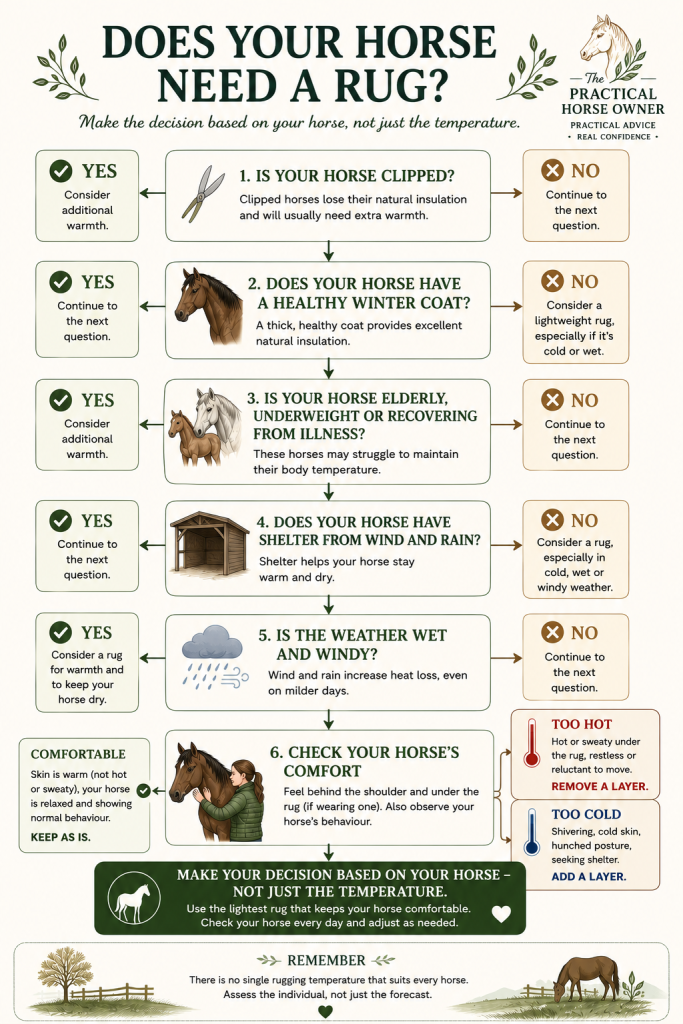
The decision to rug should always be based on the individual horse, rather than the temperature alone.
Horses That May Not Need a Rug
Many horses remain comfortable without a rug throughout much of the year, particularly if they:
- Have a full, healthy winter coat.
- Maintain a healthy body condition.
- Have access to adequate shelter from wind and rain.
- Are native or hardy breeds adapted to colder climates.
- Live out with companions, allowing them to move freely and generate body heat.
- Are not clipped and are in light or no work.
These horses are often well equipped to cope with normal winter weather, provided their basic needs are met.
Horses That May Benefit from Wearing a Rug
Some horses may require additional protection during colder or wetter weather, including:
- Horses that have been fully or partially clipped.
- Elderly horses.
- Young foals.
- Underweight horses or those struggling to maintain condition.
- Horses recovering from illness.
- Finer-coated breeds, such as Thoroughbreds.
- Horses living in exposed environments with little natural shelter.
- Horses in heavier work that are clipped to prevent excessive sweating.
For these horses, rugs can help reduce heat loss and improve comfort during challenging weather conditions.
Weather Is More Than Just Temperature
Air temperature is only one part of the picture.
A mild but wet and windy day may cause a horse to lose more body heat than a colder, dry and still day. Rain flattens the winter coat, reducing its insulating ability, while strong winds remove the warm layer of air trapped within the coat.
When deciding whether your horse needs a rug, always consider:
- Air temperature.
- Rain.
- Wind strength.
- Humidity.
- Access to shelter.
- Whether your horse is wet.
- Your horse’s individual needs.
Looking at the overall conditions rather than simply checking the thermometer will usually lead to better rugging decisions.
There Is No Perfect Temperature
It can be tempting to search for a chart that tells you exactly which rug to use at a certain temperature. While these charts can provide a general guide, they should never replace careful observation of your own horse.
A clipped Thoroughbred standing in an exposed field has very different needs from an unclipped native pony living out with a thick winter coat.
The best way to decide whether your horse needs a rug is to assess the horse, not simply the weather forecast.
💡 Practical Horse Owner Tip
Instead of asking, “What rug should I use today?”, ask yourself:
“Is my horse comfortable today?”
Taking a few moments to assess your horse’s body condition, coat, behaviour and the weather will almost always lead to a better decision than relying on a temperature chart alone.
Understanding Rug Weights
One of the biggest sources of confusion for horse owners is understanding what rug weights actually mean. It’s easy to assume that a heavier rug is always warmer or that a particular weight should be worn at a certain temperature. In reality, rug weight simply refers to the amount of insulation contained within the rug—it is only one factor to consider when choosing the most appropriate rug for your horse.
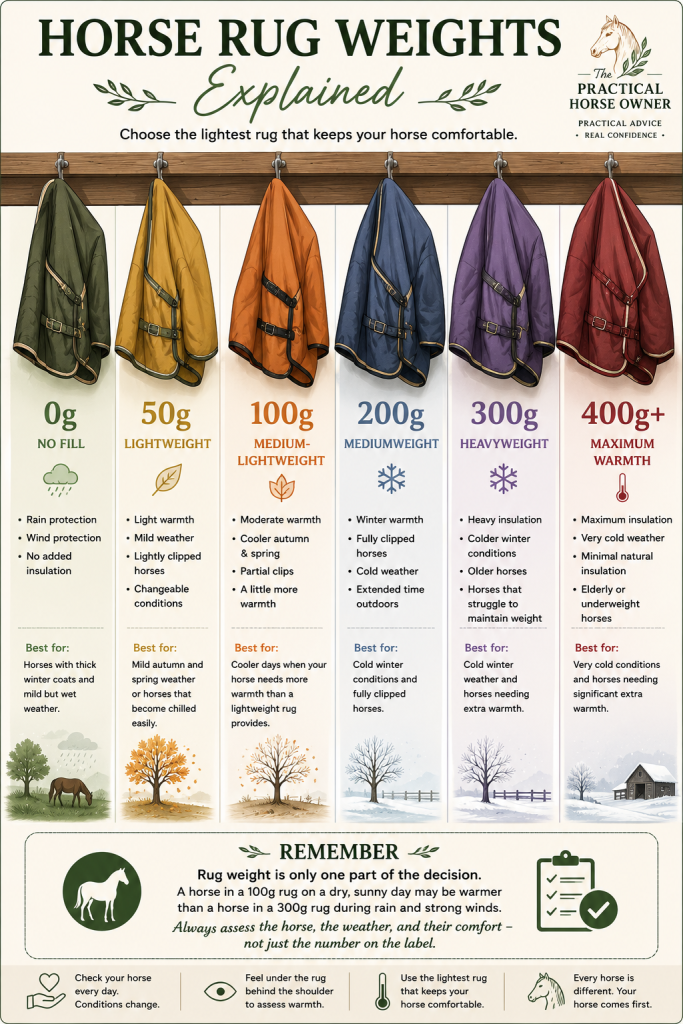
Rug weights are measured in grams (g), which refers to the weight of the filling or insulation inside the rug. The higher the number, the more insulation the rug provides. However, a horse’s comfort is influenced by many other factors, including whether they are clipped, their body condition, the weather, and whether they have access to shelter.
The following guide explains the most common rug weights and when they are typically used.
0g (No Fill)
A 0g rug contains no insulating filling and is designed primarily to keep the horse dry and protected from wind rather than to provide warmth.
A 0g turnout rug may be suitable for:
- Horses with thick winter coats.
- Mild but wet weather.
- Native and hardy breeds.
- Preventing the coat from becoming saturated during heavy rain.
50g Lightweight
A 50g rug provides a small amount of insulation while remaining lightweight.
It is commonly used for:
- Mild autumn and spring weather.
- Horses that become chilled easily.
- Clipped horses needing only a little extra warmth.
- Changeable weather conditions.
100g Medium-Lightweight
A 100g rug provides moderate insulation without being excessively warm.
It may be suitable for:
- Cooler autumn days.
- Mild winter conditions.
- Horses that are partially clipped.
- Horses that require a little more warmth than a lightweight rug provides.
200g Mediumweight
A 200g rug is one of the most commonly used winter rug weights.
It may be appropriate for:
- Colder winter weather.
- Fully clipped horses.
- Horses that naturally feel the cold.
- Horses spending extended periods outdoors during winter.
300g Heavyweight
A 300g rug provides substantial insulation for colder conditions.
It is often used for:
- Cold winter weather.
- Fully clipped competition horses.
- Older horses requiring additional warmth.
- Horses that struggle to maintain condition.
400g+ Heavyweight
Rugs with 400g or more filling provide significant insulation and are generally reserved for horses with higher warmth requirements.
These rugs may be appropriate for:
- Very cold weather.
- Horses with minimal natural insulation.
- Elderly or underweight horses where extra warmth is beneficial.
However, heavier rugs should always be used with care, as horses can overheat surprisingly easily.
Remember…
Rug weight is not the only factor that determines whether your horse will feel warm.
A horse wearing a 100g rug on a dry, sunny day may actually be warmer than a horse wearing a 300g rug during heavy rain and strong winds.
Likewise, two horses standing side by side may require completely different rugs despite experiencing the same weather conditions.
The goal is not to choose the heaviest rug available—it is to choose the lightest rug that keeps your individual horse comfortable.
💡 Practical Horse Owner Tip
Think of rug weights as tools, not rules.
A 200g rug is not automatically the correct choice because the temperature has dropped. Always consider your horse’s coat, condition, the weather, and how they feel underneath the rug before deciding whether to add or remove a layer.
Types of Horse Rugs Explained
Walk into any tack shop or browse an online retailer, and you’ll quickly discover a huge range of horse rugs. From turnout rugs and stable rugs to coolers, fleeces and fly rugs, choosing the right one can seem confusing at first.
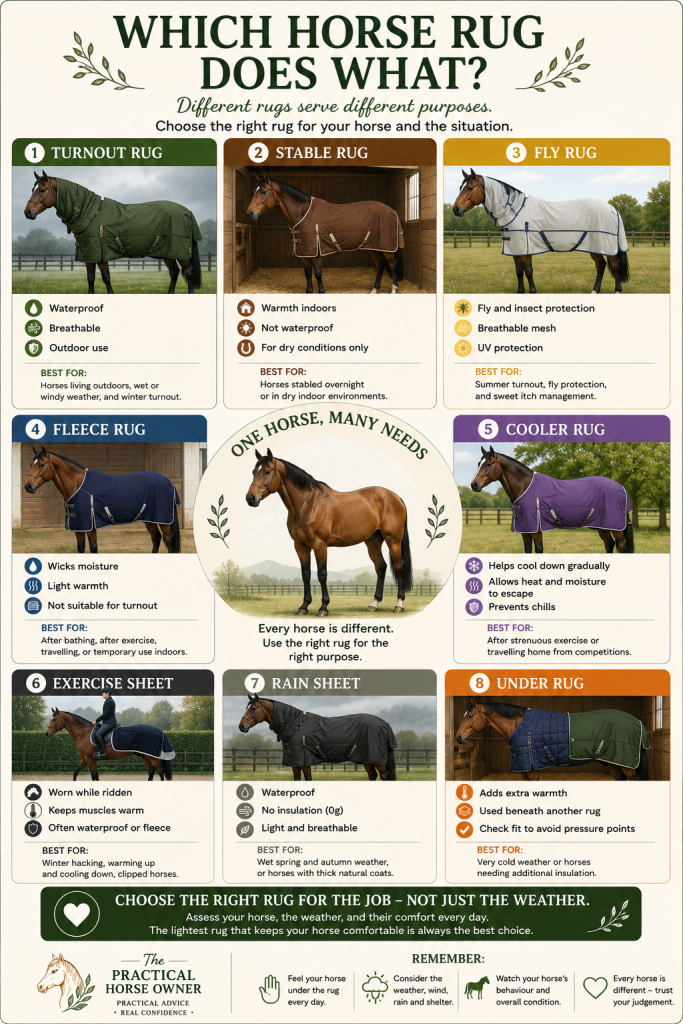
The good news is that each rug has a specific purpose. Once you understand what each type is designed to do, selecting the right rug becomes much easier.
Turnout Rug
A turnout rug is designed to be worn outdoors and is one of the most commonly used horse rugs.
Good-quality turnout rugs are waterproof, breathable and durable enough to withstand daily wear in the field. They protect your horse from rain, wind and mud while helping to maintain body temperature when appropriate.
Turnout rugs are available in a wide range of weights, from lightweight 0g rain sheets to heavyweight winter rugs with substantial insulation.
Best for:
- Horses living outdoors.
- Wet or windy weather.
- Winter turnout.
- Horses requiring protection from the elements.
Stable Rug
Unlike turnout rugs, stable rugs are designed for indoor use only.
They are not waterproof and should never be worn outside in wet weather. Stable rugs provide warmth while allowing the horse to remain comfortable in the stable.
Many owners use stable rugs overnight during colder months or after bringing horses in from the field.
Best for:
- Horses stabled overnight.
- Dry indoor environments.
- Providing warmth without waterproofing.
Fly Rug
Fly rugs are lightweight rugs designed to protect horses from flies, midges and other biting insects.
Most are made from breathable mesh fabric that allows airflow while providing a physical barrier against insects. Some also offer UV protection during sunny weather.
Fly rugs are particularly useful for horses that suffer from sweet itch or become irritated by flies during the summer months.
Best for:
- Summer turnout.
- Horses sensitive to flies.
- Sweet itch management.
- UV protection.
Fleece Rug
A fleece rug is designed to wick moisture away from the horse’s coat while providing light warmth.
They are commonly used after exercise, bathing or travelling to help dry the horse gradually while preventing them from becoming chilled.
Fleece rugs should not be used as turnout rugs, as they quickly become wet in rain.
Best for:
- Cooling down after exercise.
- Drying after bathing.
- Travelling.
- Temporary use indoors.
Cooler Rug
Although similar to a fleece, a cooler rug is specifically designed to help horses cool down gradually after exercise.
Cooler rugs allow heat and moisture to escape while preventing the horse from cooling too rapidly.
Many competition horses wear cooler rugs after work or following transport.
Best for:
- After strenuous exercise.
- Travelling home from competitions.
- Preventing chills during cooling down.
Exercise Sheet
An exercise sheet is worn while riding to help keep the horse’s hindquarters and back warm during cold weather.
They are particularly useful for clipped horses that continue to work throughout winter.
Many exercise sheets are waterproof, while others are made from fleece or wool depending on their intended use.
Best for:
- Winter hacking.
- Warming up and cooling down.
- Clipped horses in work.
Rain Sheet
A rain sheet is essentially a waterproof turnout rug with no filling (0g).
Its main purpose is to keep the horse dry without adding significant warmth, making it ideal during mild but wet weather.
Best for:
- Wet spring and autumn weather, or heavy rain days in summer.
- Horses with thick natural coats.
- Keeping the coat dry without overheating.
Under Rug
An under rug is designed to sit beneath another rug to provide additional insulation.
Rather than purchasing a heavier rug, some owners choose to add an under rug when temperatures drop, allowing greater flexibility throughout the winter.
Always ensure rugs fit correctly and do not create pressure points when layering.
Best for:
- Very cold weather.
- Horses needing extra warmth.
- Layering systems.
Neck Covers
Many turnout and stable rugs are available with detachable or fixed neck covers.
While they can provide additional protection during particularly cold, wet or windy weather, they are not always necessary. Some horses remain perfectly comfortable without one.
As with any rug, the decision should be based on the individual horse and the weather conditions rather than assuming a neck cover is always required.
💡 Practical Horse Owner Tip
Try to build your rug collection around different purposes, not simply different weights.
For example, many horse owners find it useful to have:
– A lightweight rain sheet (0g)
– A lightweight turnout rug
– A mediumweight turnout rug
– A heavyweight turnout rug
– A stable rug
– A fleece or cooler rug
– A fly rug for summer
This gives you flexibility throughout the year without needing a rug for every possible weather forecast.
How to Choose the Right Rug for Your Horse
Choosing the right rug is about much more than checking the outside temperature. Every horse is an individual, and what keeps one horse comfortable may cause another to become too hot or too cold.
Instead of relying on temperature charts alone, take a few moments to assess your horse and the conditions they are living in. A thoughtful assessment each day will help you make far better rugging decisions than following a fixed set of rules.
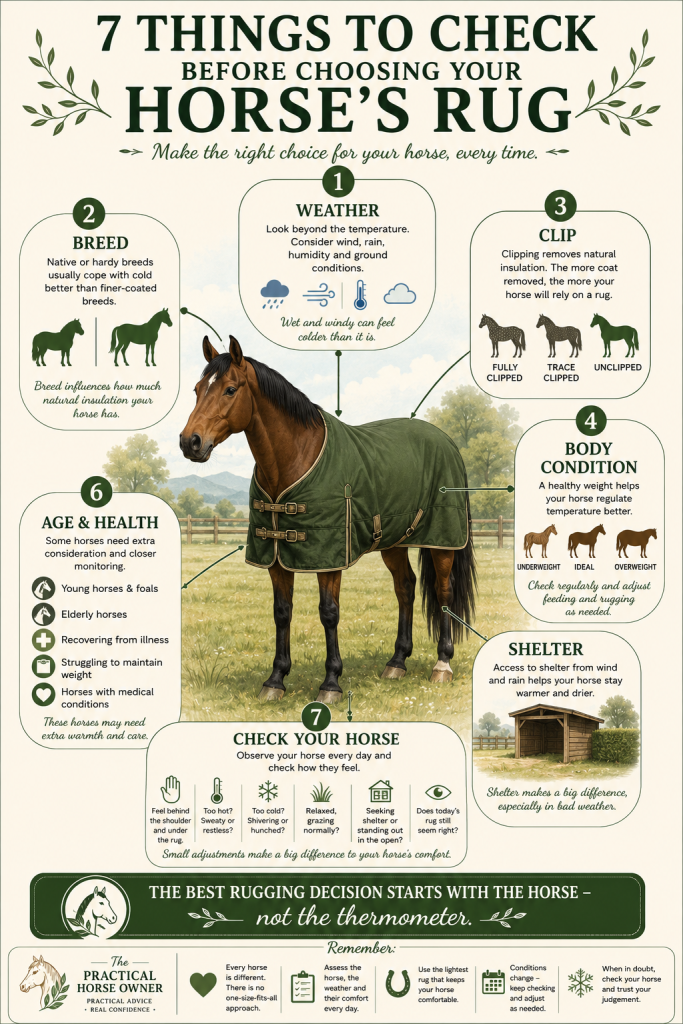
1. Think About the Weather—Not Just the Temperature
A dry, sunny day at 2°C can actually feel more comfortable than a wet, windy day at 8°C.
When assessing the weather, consider:
- Air temperature
- Wind strength
- Rain
- Snow
- Humidity
- Ground conditions
- Whether your horse has become wet
Wind and rain often have a much greater effect on heat loss than temperature alone.
2. Consider Your Horse’s Breed
Different breeds cope with cold weather very differently.
Hardy native breeds such as Shetlands, Exmoors, Highlands and Welsh ponies naturally develop thick winter coats and are often well equipped to cope with cold conditions.
Finer-coated breeds, such as Thoroughbreds and many warmbloods, generally have less natural insulation and may require additional protection during cold or wet weather.
Breed should never be the only deciding factor, but it is an important consideration.
3. Is Your Horse Clipped?
Clipping removes much of your horse’s natural insulation.
A fully clipped horse is far more likely to require rugging than an unclipped horse living under the same conditions.
The more coat removed, the greater the horse’s reliance on rugs to help maintain body temperature.
4. Body Condition Matters
Horses carrying a healthy amount of body fat often tolerate colder temperatures better than underweight horses.
Conversely, overweight horses may overheat more easily beneath heavy rugs.
Regularly assessing your horse’s body condition score can help you make more informed rugging decisions throughout the year.
5. Does Your Horse Have Shelter?
A horse with access to a well-designed field shelter or natural hedgerows can often regulate their own comfort much more effectively.
Shelter reduces exposure to wind and rain, allowing the horse’s winter coat to work as nature intended.
Horses kept in exposed fields without adequate shelter may require additional protection during poor weather.
6. Age and Health
Some horses need extra consideration.
These include:
- Elderly horses
- Young foals
- Horses recovering from illness
- Horses struggling to maintain weight
- Horses with certain medical conditions
These horses may find it more difficult to regulate their body temperature and should be monitored carefully.
7. Observe Your Horse Every Day
The best rugging decisions come from observing your horse rather than relying solely on weather forecasts.
Ask yourself:
- Do they feel comfortably warm behind the shoulder?
- Are they sweating beneath the rug?
- Are they shivering?
- Are they relaxed and grazing normally?
- Are they seeking shelter?
- Does today’s rug still seem appropriate?
Daily observation allows you to make small adjustments before your horse becomes uncomfortable.
There Is No “Perfect” Rugging Formula
It’s understandable to look for a simple chart that tells you exactly which rug to use.
However, experienced horse owners know that successful rugging comes from understanding the individual horse.
Two horses standing in neighbouring fields may require completely different rugs despite experiencing identical weather conditions.
Learning to assess your own horse will always produce better results than following a generic temperature guide.
💡 Practical Horse Owner Tip
If you’re unsure whether to increase your horse’s rug weight, start by checking the horse rather than reaching for a heavier rug.
Feeling behind the shoulder, under the neck and beneath the rug will usually tell you far more than looking at the thermometer.
Remember:
Dress the horse you have—not the weather forecast.
How to Tell if Your Horse Is Too Hot or Too Cold
Even after carefully choosing a rug, it’s important to remember that your horse’s comfort can change throughout the day. Weather conditions, activity levels and even sunshine can quickly alter how warm or cool your horse feels.
The only reliable way to know whether your horse is comfortable is to assess the horse regularly, rather than relying on the weather forecast or the rug label.
Checking your horse every day allows you to make small adjustments before they become uncomfortable.
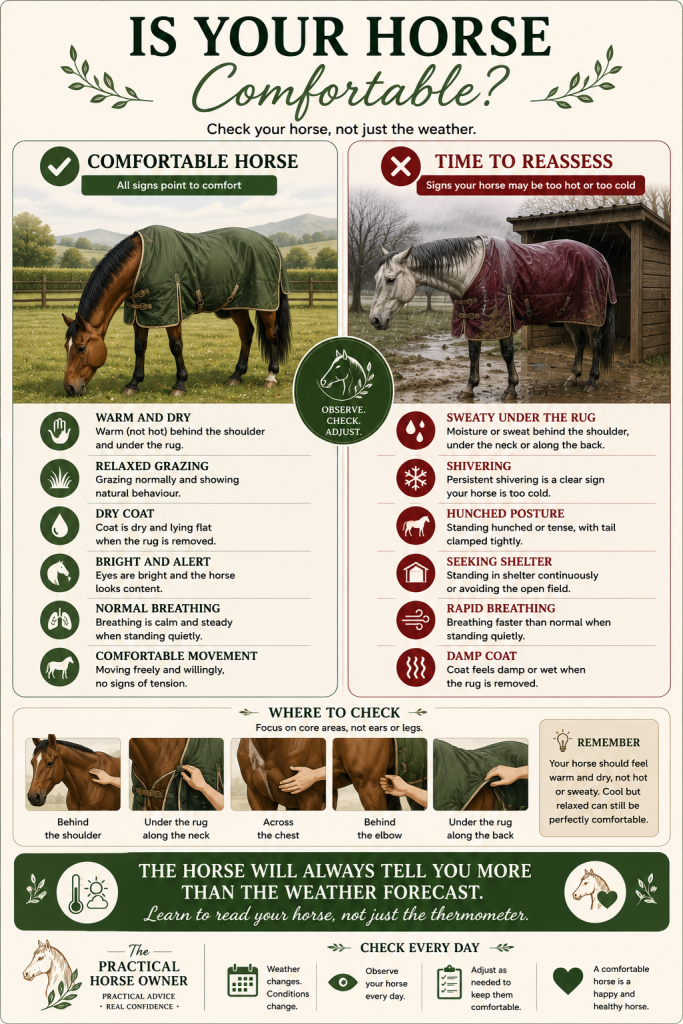
Signs Your Horse May Be Too Hot
Over-rugging is more common than many owners realise. Horses generate a significant amount of body heat, and wearing a rug that is too warm can quickly lead to overheating.
Signs your horse may be too hot include:
- Sweating beneath the rug.
- Feeling hot or damp behind the shoulders or under the neck.
- Rapid breathing when standing quietly.
- Restlessness or appearing uncomfortable.
- Reluctance to move.
- A damp or flattened coat when the rug is removed.
If your horse appears too warm, consider removing the rug or replacing it with a lighter option.
Signs Your Horse May Be Too Cold
Some horses cope remarkably well with cold weather, while others require additional protection.
Signs your horse may be too cold include:
- Persistent shivering.
- Holding the tail tightly against the body.
- Tense muscles.
- Weight loss over time.
- Seeking shelter continuously.
- Feeling cold beneath the rug in combination with other signs.
Remember that cold ears or a cool nose alone do not necessarily mean your horse is cold. These areas naturally feel cooler and are not reliable indicators of body temperature.
Where Should You Check?
Rather than feeling your horse’s ears or legs, check areas that better reflect their core body temperature.
Good places to assess include:
- Behind the shoulder.
- Under the rug along the neck.
- Across the chest.
- Behind the elbow.
- Under the rug along the back.
Your horse should feel comfortably warm and dry.
If they are sweaty or very hot, they are likely wearing too much insulation.
If they feel cool but are relaxed, dry and behaving normally, they may still be perfectly comfortable.
Behaviour Can Tell You a Lot
Your horse’s behaviour is often just as informative as how they feel beneath the rug.
A comfortable horse is likely to:
- Graze normally.
- Move freely around the field.
- Rest comfortably.
- Interact with companions.
A horse that is uncomfortable may:
- Stand hunched for long periods.
- Continuously seek shelter.
- Become restless.
- Sweat unnecessarily.
- Show signs of irritation beneath the rug.
Always consider behaviour alongside your physical checks.
Check Every Day
Rugging isn’t a decision you make once and forget.
Temperatures can rise unexpectedly, rain may stop, the wind may pick up or your horse’s condition may change throughout the season.
A quick daily check only takes a few minutes and can help prevent both overheating and excessive heat loss.
💡 Practical Horse Owner Tip
Try to make checking your horse part of your normal routine.
Each time you visit your horse, ask yourself:
– Are they warm and dry?
– Are they behaving normally?
– Has the weather changed?
– Is today’s rug still the best choice?
Small adjustments made early often prevent bigger problems later
Rugging Through the Seasons
As the seasons change, so do your horse’s rugging requirements. A rug that was ideal a few weeks ago may no longer be suitable as temperatures rise or fall, daylight hours change, or your horse’s winter coat develops.
Rather than following the calendar alone, regularly assess your horse and adjust their rugs according to both the weather conditions and their individual needs.
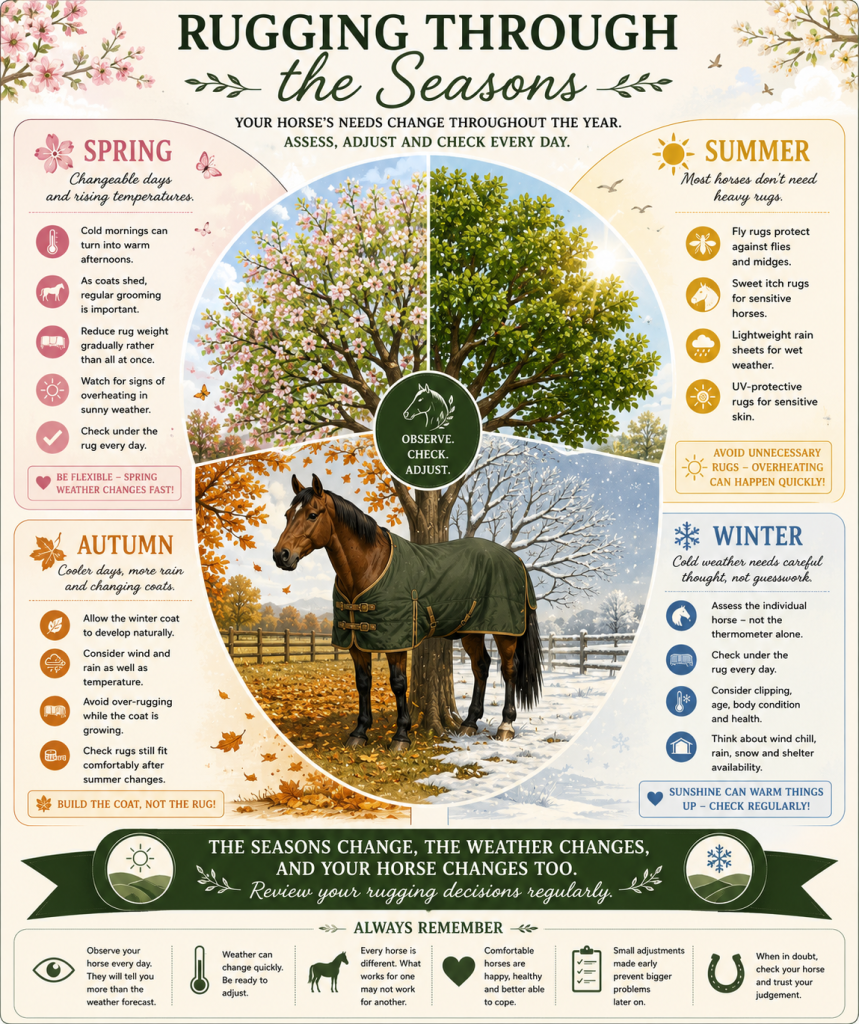
🌸 Spring
Spring often brings some of the most changeable weather of the year. Cold mornings can quickly turn into warm afternoons, making it easy for horses to become over-rugged.
As your horse begins to lose their winter coat, regular grooming becomes increasingly important to remove loose hair and help regulate body temperature.
During spring:
- Monitor daily temperature changes.
- Reduce rug weight gradually rather than all at once.
- Watch for signs of overheating during sunny afternoons.
- Continue checking beneath the rug every day.
☀️ Summer
Many horses do not require rugs during summer.
However, some horses still benefit from certain types of rugs.
These may include:
- Fly rugs to protect against flies and midges.
- Sweet itch rugs for horses affected by insect allergies.
- Lightweight rain sheets during prolonged wet weather.
- UV-protective rugs for horses with sensitive skin.
Avoid using unnecessary heavy rugs during warm weather, as overheating can occur surprisingly quickly.
🍂 Autumn
Autumn is another season of change.
Temperatures begin to fall, rainfall often increases and horses start growing their winter coats.
Resist the temptation to reach for heavier rugs too early.
Allowing your horse to develop a natural winter coat provides excellent insulation for the months ahead.
During autumn:
- Monitor overnight temperatures.
- Consider wind and rain as well as air temperature.
- Avoid over-rugging while the winter coat is developing.
- Check rugs still fit comfortably after summer weight changes.
❄️ Winter
Winter generally requires the most careful monitoring.
Cold weather alone doesn’t automatically mean a horse needs a heavier rug.
Instead, consider:
- Whether your horse is clipped.
- Their age and body condition.
- Wind chill.
- Rain or snow.
- Shelter availability.
- Whether they are maintaining weight.
Remember that bright winter sunshine can significantly increase temperatures beneath a rug, particularly on still days.
Continue checking your horse every day and adjust rugs whenever necessary.
Seasonal Coat Changes
One of the most important things to remember is that your horse’s coat changes naturally throughout the year.
Allowing healthy horses to grow an appropriate winter coat gives them one of the best forms of insulation available.
Over-rugging too early in autumn may reduce the development of this natural protection, while removing rugs too late in spring can make horses unnecessarily warm as temperatures rise.
Working with your horse’s natural coat, rather than against it, will often lead to more comfortable and effective rugging decisions.
💡 Practical Horse Owner Tip
The seasons provide a useful guide—but your horse should always have the final say.
A chilly spring morning may require a rug for one horse but not another. Likewise, a bright winter afternoon may mean it’s time to remove a heavier rug, even in the middle of January.
The weather changes every day, and your rugging decisions should be flexible enough to change with it
Common Rugging Mistakes
Even experienced horse owners occasionally make mistakes when it comes to rugging. Weather conditions change quickly, horses change throughout the seasons, and every individual has different needs.
Fortunately, many common rugging mistakes are easy to avoid once you know what to look for.
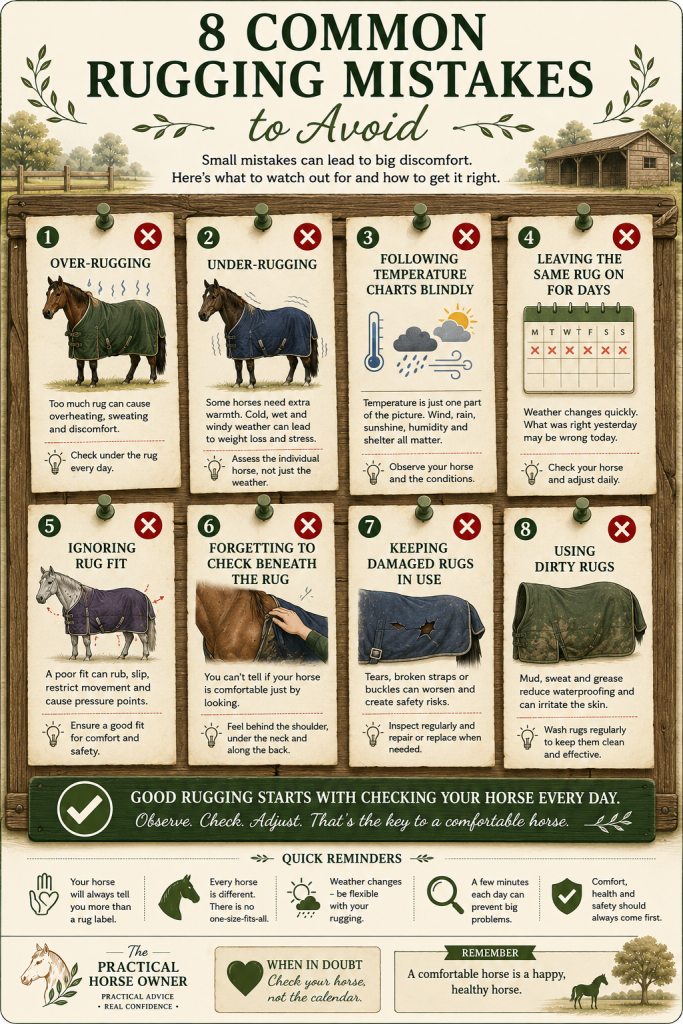
❌Over-Rugging
One of the most common mistakes is assuming that colder weather always means a heavier rug.
In reality, horses are extremely good at regulating their body temperature. Wearing a rug that is too warm can cause overheating, excessive sweating and discomfort.
Regularly checking beneath your horse’s rug is the best way to identify whether they are becoming too warm.
❌Under-Rugging
While many horses cope well without heavy rugs, some horses genuinely need extra protection.
Clipped horses, elderly horses, underweight horses and those recovering from illness may struggle to stay warm during prolonged periods of cold, wet or windy weather.
Always assess the individual horse rather than assuming every horse can cope with the same conditions.
❌Choosing a Rug Based Only on Temperature
Temperature charts can provide a useful starting point, but they should never replace observation.
Wind, rain, sunshine, humidity, shelter and your horse’s individual characteristics all play an important role.
Remember:
A wet, windy day at 8°C may feel much colder than a dry, still day at 2°C.
❌Leaving the Same Rug On for Too Long
Many owners put a rug on at the beginning of the week without considering how much the weather may change over the following days.
Forecasts can change rapidly.
Checking your horse every day allows you to adjust their rug before they become uncomfortable.
❌Ignoring Rug Fit
Even the correct rug weight won’t help if the rug doesn’t fit properly.
A poorly fitting rug may:
- Rub the shoulders.
- Restrict movement.
- Slip backwards.
- Cause pressure points.
- Allow rain to enter.
- Create safety hazards.
A well-fitting rug should allow your horse to move comfortably while remaining secure.
❌Forgetting to Check Beneath the Rug
Many owners judge their horse’s comfort simply by looking at them.
However, you cannot tell whether a horse is comfortable without checking underneath the rug.
Lift the rug every day and feel:
- Behind the shoulder.
- Under the neck.
- Along the back.
Your horse should feel warm and dry—not hot, sweaty or damp.
❌Keeping Damaged Rugs in Use
Small tears can quickly become much larger.
Broken straps, damaged buckles or ripped fabric may also present safety risks if a horse catches a leg or becomes tangled.
Inspect rugs regularly and repair or replace them when necessary.
❌Using Dirty Rugs
Mud, sweat and grease gradually reduce a rug’s breathability and waterproof performance.
Cleaning rugs according to the manufacturer’s recommendations helps them continue performing as intended while also reducing the risk of skin irritation.
💡 Practical Horse Owner Tip
If you’re ever unsure whether you’ve chosen the right rug, remember one simple rule:
Check your horse—not your calendar.
Your horse’s comfort today is far more important than what the weather was yesterday or what a rugging chart suggests
Myths VS Facts
Horse rugging is one of the most debated topics in the equestrian world, and with that comes plenty of myths. While some advice has been passed down for generations, not all of it is supported by current understanding of equine care.
| Myth | Fact |
|---|---|
| Horses always need a rug in winter. | Many healthy horses with a full winter coat can regulate their body temperature extremely well. Whether a horse needs a rug depends on factors such as breed, age, body condition, clipping, weather conditions and access to shelter—not simply the season |
| A heavier rug is always better. | Over-rugging can be just as harmful as under-rugging. Horses that become too warm may sweat beneath their rugs, increasing the risk of discomfort and skin problems. The goal is to use the lightest rug that keeps your individual horse comfortable. |
| You can tell if your horse is cold by touching their ears. | A horse’s ears, nose and legs naturally feel cooler than their core body. These areas are not reliable indicators of whether a horse needs another rug. Instead, check behind the shoulder, under the neck and beneath the rug. |
| If one horse is wearing a rug, mine should be too. | Every horse is different. Two horses standing side by side may have completely different rugging requirements depending on their breed, coat, age, workload and body condition. |
| Rugging charts are always correct. | Temperature charts can provide a useful starting point, but they should never replace daily assessment of your horse. Wind, rain, sunshine, shelter and the individual horse all play a major role in deciding whether a rug is needed. |
| Once you’ve chosen a rug, you can leave it on until the weather changes. | Your horse should be checked every day. Conditions can change rapidly, and your horse’s comfort should always be reassessed. |
💡 Practical Horse Owner Tip
Whenever you hear rugging advice, ask yourself one simple question:
“Does this apply to my horse?”
No article, chart or experienced owner knows your horse better than you do. Learning to assess your own horse will always be the best guide.
Frequently Asked Questions
Should my horse wear a rug every day?
Not necessarily. Many horses cope perfectly well without rugs for much of the year. Rugging should be based on your horse’s individual needs and the current weather conditions.
Can a horse get too hot in a rug?
Yes. Overheating is a common problem, particularly during mild weather or when horses are wearing rugs that provide more insulation than they need. Checking beneath the rug daily is the best way to monitor your horse’s comfort.
Is it better to under-rug or over-rug?
Neither is ideal. The aim is to provide just enough protection to keep your horse comfortable. Regular observation allows you to adjust rugs before your horse becomes too hot or too cold.
Should I rug my horse if it’s raining?
Not always. An unclipped horse with a healthy winter coat and access to shelter may cope very well in wet weather. However, clipped horses or those with additional needs may benefit from a waterproof turnout rug.
How often should I check my horse under their rug?
Ideally every day. Lift the rug and feel behind the shoulder, along the neck and across the back to ensure your horse is warm and dry rather than hot or sweaty.
Does clipping always mean my horse needs a rug?
Not necessarily, but clipping removes some of the horse’s natural insulation. The more extensive the clip, the more likely the horse is to require rugging in colder or wetter weather.
Can horses wear rugs all year round?
Some horses wear fly rugs or sweet itch rugs during summer, while others may wear lightweight rain sheets during prolonged wet weather. However, heavy insulated rugs are generally unnecessary during warm conditions.
How many rugs does the average horse need?
There is no set number. Many owners manage perfectly well with a small collection that covers different purposes, such as a rain sheet, a lightweight turnout, a medium or heavyweight turnout, a stable rug, a fleece or cooler, and a fly rug.
Key Takeaways
- Rug the horse, not the thermometer.
- There is no perfect rugging temperature.
- Every horse is different.
- Wind and rain often matter more than temperature alone.
- Check beneath your horse’s rug every day.
- Use the lightest rug that keeps your horse comfortable.
- Review your rugging decisions as the seasons change.
- Your horse’s behaviour and comfort should always guide your decisions.
Final Thoughts
Horse rugging is rarely about finding a single “correct” answer. Instead, it is about learning to understand your individual horse and making informed decisions based on their needs, the weather and their environment.
While rugging charts and general advice can provide a useful starting point, no guide can replace careful daily observation. By checking your horse regularly and remaining flexible as conditions change, you will be able to make confident decisions that keep them comfortable throughout the year.
With time and experience, you’ll begin to recognise what works best for your own horse. Trust your observations, continue learning, and remember that successful rugging isn’t about following strict rules—it’s about providing thoughtful, individual care.
Glossary
Breathable – Fabric that allows moisture vapour to escape while helping keep rain out.
Clipped Horse – A horse that has had some or all of its winter coat removed.
Cooler Rug – A rug designed to help horses cool down gradually after exercise.
Denier (D) – A measure of the strength of the outer fabric. Higher denier fabrics are generally more resistant to tears and wear.
Fill (g) – The weight of insulation inside a rug, measured in grams.
Fly Rug – A lightweight rug designed to protect against flies and biting insects.
Neck Cover – An extension attached to some rugs that covers part or all of the horse’s neck.
Rain Sheet – A waterproof rug with no insulating fill.
Stable Rug – A non-waterproof rug designed for indoor use.
Sweet Itch Rug – A specialised rug designed to protect horses suffering from sweet itch by covering much of the body from biting insects.
Turnout Rug – A waterproof, breathable rug designed for outdoor use.
Under Rug – An additional insulating layer worn beneath another rug to provide extra warmth.
References
- British Horse Society (BHS)
- World Horse Welfare
- Redwings Horse Sanctuary
- Blue Cross – Horse Care
- Horse & Hound
- Horse & People
Disclaimer:
The information provided in this article is intended for educational purposes only and should not be considered a substitute for professional veterinary advice, diagnosis or treatment.
Every horse is an individual, and management decisions should always consider your horse’s age, health, workload and individual needs. If your horse is unwell, or you have any concerns about their health or welfare, contact your veterinary surgeon without delay.
While every effort has been made to ensure the information in this guide is accurate and up to date at the time of publication, recommendations and best practice may change as new research becomes available.