In This Guide
- At a Glance
- Introduction
- What is Equine First Aid?
- Being Safe While Helping Your Horse
- Assessing Your Horse
- Know Your Horses Normal Vital Signs
- Building an Equine First Aid Kit
- How To Treat Minor Cuts and Grazes
- How To Treat Insect Bites and Stings
- What To Do If Your Horse Loses a Shoe
- How To Treat Sunburn and Minor Burns
- Common First Aid Mistakes to Avoid
- What To Do in an Equine Emergency
- When Should I Call The Vet?
- To Summarise
- Frequently Asked Questions
- Glossary
- References
At a Glance
✔ Stay calm and keep yourself safe before helping your horse.
✔ Assess the situation by checking for obvious injuries, bleeding, swelling or signs of distress.
✔ Know your horse’s normal vital signs so you can recognise when something is wrong.
✔ Control severe bleeding by applying direct pressure with a clean dressing.
✔ Clean minor wounds carefully using clean water or sterile saline where appropriate.
✔ Never remove objects that are embedded in a wound—leave them in place until your veterinarian advises otherwise.
✔ Contact your veterinarian immediately if your horse has severe bleeding, a deep wound, suspected fracture, difficulty breathing, severe lameness, colic signs, or any injury involving the eye.
✔ Keep a well-stocked equine first aid kit somewhere easily accessible and check it regularly to replace used or expired items.
✔ Monitor your horse closely after any injury and seek veterinary advice if you’re unsure or if their condition changes.
✔ Remember that first aid is not a substitute for veterinary treatment—its purpose is to provide immediate care while protecting your horse until professional help is available.
Introduction
Every horse owner will experience an injury or medical emergency at some point. It might be a small cut discovered after turnout, a loose shoe, a swollen leg or something more serious that requires immediate veterinary attention.
Knowing how to respond in those first few minutes can make a significant difference. Staying calm, assessing the situation carefully and providing appropriate first aid can help keep your horse comfortable while ensuring they receive the care they need.
Equine first aid is not about replacing your veterinarian. Instead, it is about recognising problems early, providing safe and appropriate immediate care, and understanding when professional veterinary treatment is essential.
In this guide, we’ll explain how to assess an injured horse safely, what every equine first aid kit should contain, how to monitor your horse’s vital signs, when to contact your vet, and the basic first aid steps every horse owner should know.
Whether you own your first pony or have cared for horses for many years, having a good understanding of equine first aid is an essential part of responsible horse ownership.
What Is Equine First Aid?
Equine first aid is the immediate care given to a horse that has been injured or has suddenly become unwell. Its purpose is to help protect your horse, prevent the condition from worsening, and provide appropriate care until veterinary advice or treatment is available.
First aid can be as simple as cleaning a minor graze or applying pressure to control bleeding, but it also includes recognising when an injury or illness requires urgent veterinary attention. Knowing what to do—and just as importantly, what not to do—can make a significant difference during an emergency.
It is important to remember that first aid is not a substitute for veterinary treatment. While many minor injuries can be managed safely at home, more serious conditions such as deep wounds, suspected fractures, severe lameness, eye injuries or signs of colic should always be assessed by a veterinarian as soon as possible.
Every horse owner should have a basic understanding of first aid principles, even if they hope never to need them. Accidents can happen at any time, whether your horse is in the stable, the field, travelling or competing. Being prepared can help you respond calmly and confidently, giving your horse the best possible care while waiting for professional assistance.
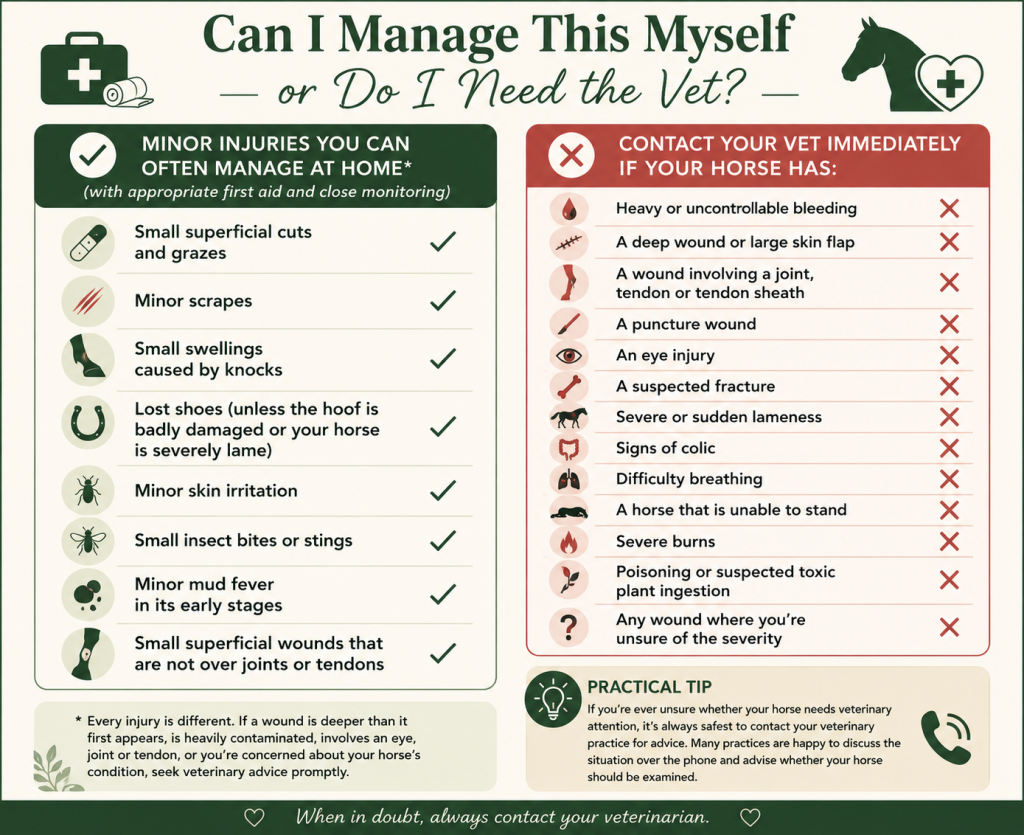
It is very importat to understand the difference between minor ailments that can be treated safely at home, and more serious ailments that may need a vet.
Being Safe While Helping Your Horse
When a horse is injured or frightened, even the calmest horse can react unpredictably. Pain, fear and stress may cause them to kick, strike, bite or pull away without warning. Before providing any first aid, always take a moment to assess the situation and make sure it is safe for both you and your horse.
Remember, an injured owner cannot help an injured horse. Your safety should always come first.
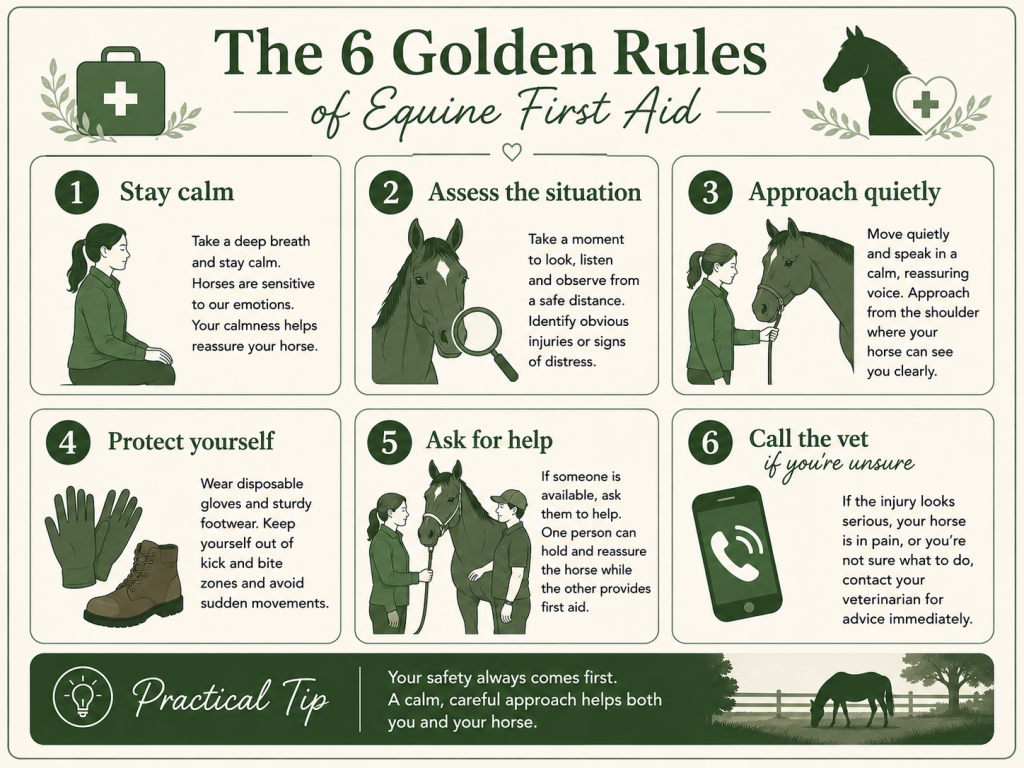
Stay calm
Take a deep breath and avoid rushing. Horses are highly sensitive to our body language and emotions, so remaining calm can help reassure your horse and prevent the situation from escalating.
Approach carefully
Approach your horse quietly and speak in a calm, reassuring voice. Avoid sudden movements or loud noises that could startle them. If possible, approach from the shoulder where your horse is most likely to see you clearly.
Be aware of pain reactions
Even the gentlest horse may react defensively when in pain. Never assume your horse won’t kick or bite simply because they are usually well behaved. Stay alert and avoid putting yourself in a vulnerable position.
Use appropriate restraint
If it is safe to do so, fit a headcollar and lead rope to help keep your horse under control. Ask someone experienced to hold your horse while you assess the injury. Avoid tying your horse up if they are distressed or likely to panic.
Protect yourself
Wear disposable gloves whenever possible, particularly when dealing with wounds or bodily fluids. Sturdy footwear and suitable clothing will also help protect you while handling an injured horse.
Don’t be afraid to ask for help
If another person is available, ask them to assist you. One person can safely hold and reassure the horse while the other carries out the assessment or provides first aid. Working together is often safer and less stressful for everyone involved.
💡Practical Horse Owner Tip
If your horse is extremely distressed, dangerous to approach or in a location where your safety is at risk, keep a safe distance and contact your veterinarian immediately. Do not put yourself in danger trying to provide first aid.
Assessing Your Horse
Once you’ve made sure the situation is safe, take a few moments to assess your horse before beginning any treatment. Looking carefully at the whole picture can help you identify serious problems quickly and provide useful information to your veterinarian if you need to call.
Try to avoid rushing straight to the injury. Instead, take a step back and observe your horse from a safe distance first.
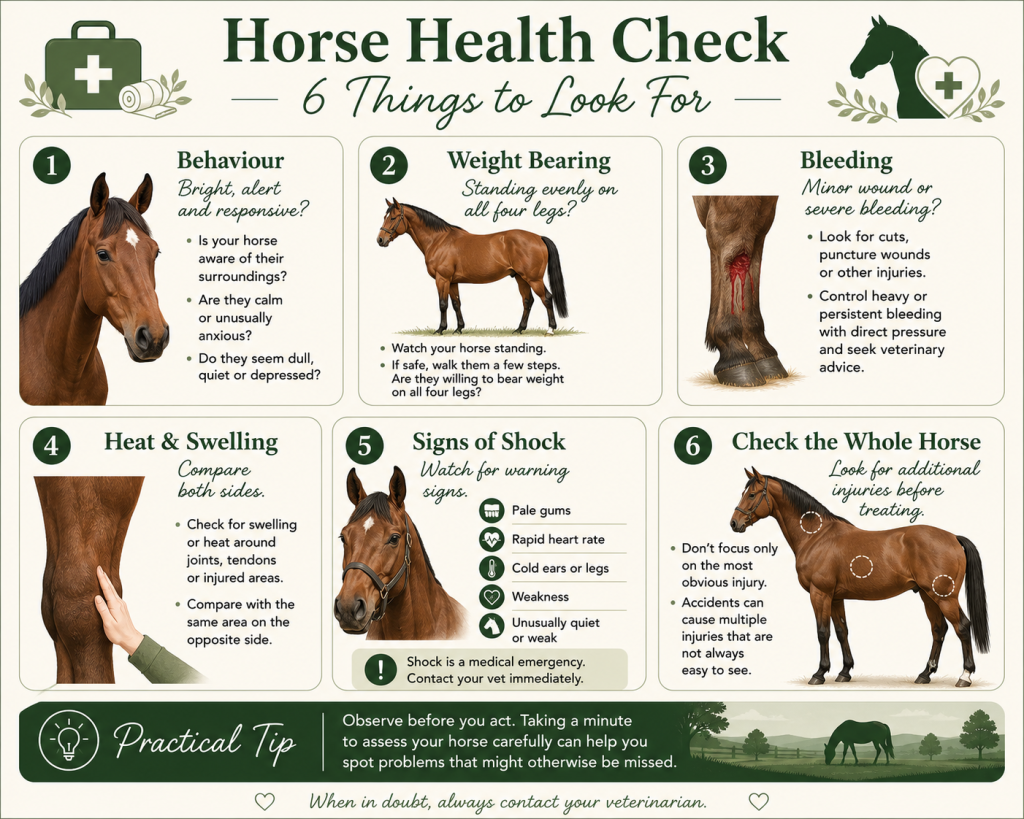
Is your horse bright and alert?
Look at your horse’s overall behaviour. Are they standing quietly and aware of their surroundings, or do they seem dull, depressed or unusually anxious? Changes in behaviour are often one of the first signs that something isn’t right.
Can your horse bear weight?
Watch your horse standing and, if it is safe to do so, take a few steps forward. Are they placing weight evenly on all four legs, or are they reluctant to bear weight on one limb? Severe or sudden lameness should always be taken seriously.
Is there any bleeding?
Check for obvious wounds or areas of bleeding. Small cuts may only require basic first aid, but heavy or persistent bleeding should be controlled immediately using direct pressure while veterinary advice is sought.
Look for swelling or heat
Run your hands gently over the affected area if your horse allows. Swelling, heat or pain when touched can indicate inflammation or injury. Compare both sides of the body where possible, as differences are often easier to identify.
Are there any signs of shock?
A horse experiencing shock may appear weak, have pale gums, cold ears or legs, a rapid heart rate or become unusually quiet. Shock is a medical emergency and requires immediate veterinary attention.
Check for other injuries
Don’t focus solely on the most obvious wound. Horses involved in accidents may have multiple injuries that are not immediately apparent. Take a few moments to examine the rest of your horse carefully before deciding on the next steps.
💡 Practical Horse Owner Tip
Take photographs of any wounds or swelling before you begin treatment, if it is safe to do so. Photos can help your veterinarian assess the injury, monitor healing and compare changes over time
Know Your Horse’s Normal Vital Signs
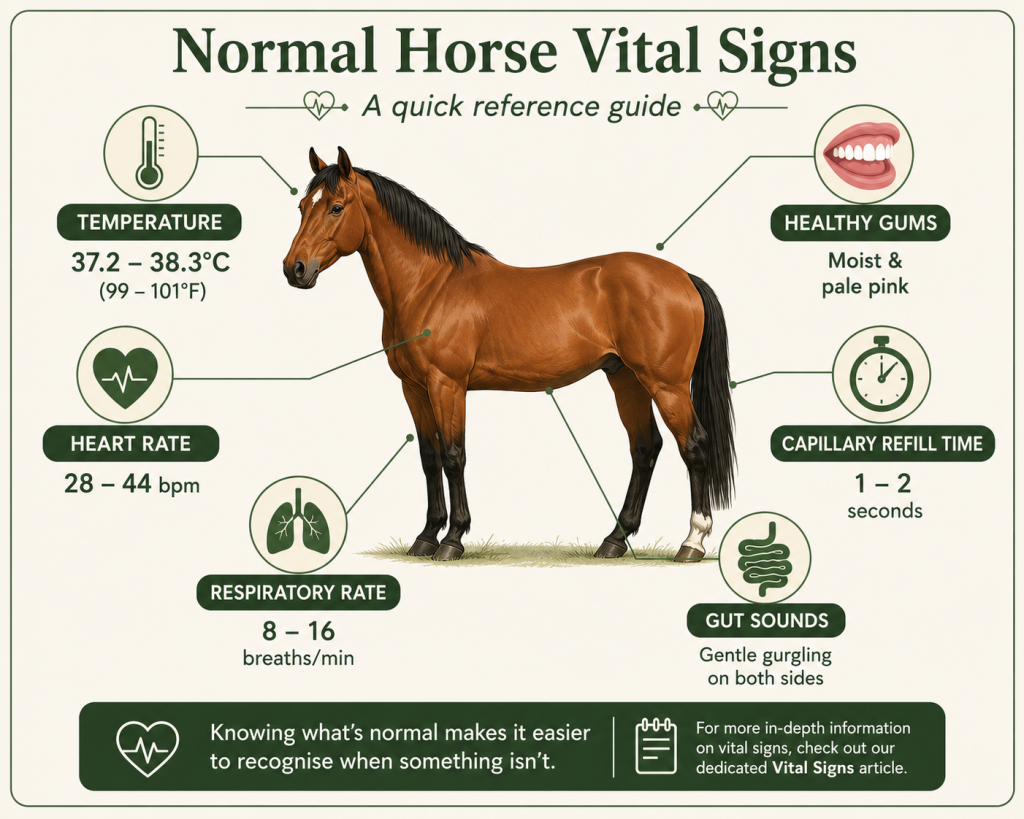
One of the most valuable things you can do as a horse owner is become familiar with your horse’s normal vital signs. Changes in temperature, heart rate or breathing can often be one of the earliest indicators that something is wrong.
Whenever possible, check your horse’s vital signs before administering treatment, especially if your veterinarian has asked for this information. Recording your findings can also help monitor any changes while you wait for professional advice or assistance.
Temperature
A horse’s normal body temperature is typically between 37.2°C and 38.3°C (99°F–101°F).
A raised temperature may indicate infection, inflammation or illness, while a temperature below the normal range can sometimes be associated with shock or severe illness.
A digital rectal thermometer is the most accurate way to measure your horse’s temperature. Always stand to one side of your horse and use a piece of string attached to the thermometer to prevent it being lost.
Heart Rate (Pulse)
A healthy adult horse usually has a resting heart rate of 28–44 beats per minute (bpm).
Pain, excitement, stress and exercise can all increase the heart rate, but a persistently elevated pulse in a resting horse may indicate pain, shock or another medical problem.
The pulse is commonly felt beneath the jaw (facial artery) or using a stethoscope behind the left elbow.
Respiratory Rate
A normal resting respiratory rate is 8–16 breaths per minute.
Watch your horse’s chest or nostrils and count each breath over 30 seconds before doubling the number. Increased breathing can occur after exercise, but rapid or laboured breathing in a resting horse should always be investigated.
Mucous Membranes
Lift your horse’s upper lip and examine the gums.
Healthy gums should be moist and pale pink.
Very pale, dark red, blue or purple gums can indicate serious illness or poor circulation and require immediate veterinary attention.
Capillary Refill Time (CRT)
Press your finger gently onto the gums for two seconds before releasing.
The area should return to its normal pink colour within 1–2 seconds.
A delayed refill time may indicate dehydration, shock or poor circulation and should be discussed with your veterinarian.
Gut Sounds
Your horse’s digestive system should produce gentle gurgling sounds that can be heard on both sides of the abdomen.
Reduced or absent gut sounds, particularly if accompanied by signs of discomfort, may indicate a digestive problem such as colic and should be assessed by your veterinarian.
If you would like to go into more detail on the horses vital signs, we have done an article dedicated to the subject. You can click the link below to go straight to that guide and learn more about a horses vital signs:
Go to the Guide —>
💡 Practical Horse Owner Tip
Take a few minutes to practise checking your horse’s vital signs while they are healthy and relaxed. This helps you become confident with the process and gives you a better understanding of what is normal for your horse
Building an Equine First Aid Kit
Having a well-stocked first aid kit means you’ll have the essential supplies ready if your horse becomes injured or unwell. While a first aid kit won’t replace veterinary treatment, it allows you to provide immediate care and can make those first few minutes much less stressful.
Keep your first aid kit somewhere clean, dry and easy to access, and make sure everyone who cares for your horse knows where it is kept. It’s also a good idea to carry a smaller version when travelling to competitions or hacking away from home.
Check your kit regularly and replace any items that have been used or have passed their expiry date.
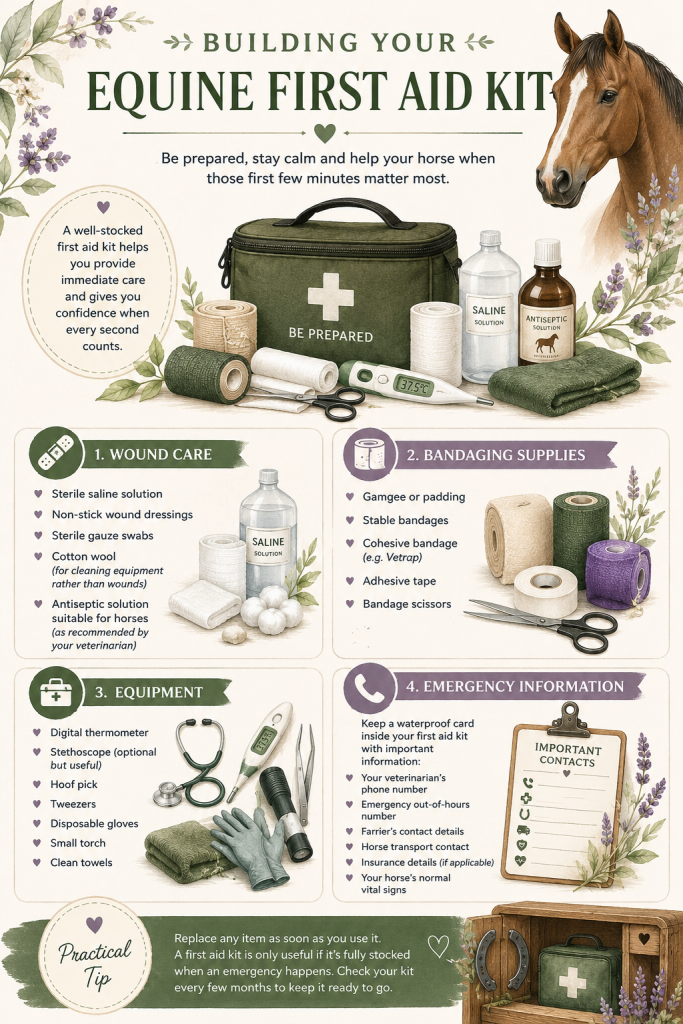
Essential Items for Every Equine First Aid Kit
Wound Care
- Sterile saline solution
- Non-stick wound dressings
- Sterile gauze swabs
- Cotton wool (for cleaning equipment rather than wounds)
- Antiseptic solution suitable for horses (as recommended by your veterinarian)
Bandaging Supplies
- Gamgee or padding
- Stable bandages
- Cohesive bandage (e.g. Vetrap)
- Adhesive tape
- Bandage scissors
Equipment
- Digital thermometer
- Stethoscope (optional but useful)
- Hoof pick
- Tweezers
- Disposable gloves
- Small torch
- Clean towels
Emergency Information
Keep a waterproof card inside your first aid kit containing:
- Your veterinarian’s phone number
- Emergency out-of-hours number
- Farrier’s contact details
- Horse transport contact
- Insurance details (if applicable)
- Your horse’s normal vital signs
💡Practical Horse Owner Tip
Replace any item as soon as you use it. A first aid kit is only useful if it’s fully stocked when an emergency happens. Setting a reminder to check your kit every few months is a simple way to make sure everything stays ready to use.
How to Treat Minor Cuts and Grazes
Minor cuts and grazes are a common part of horse ownership. Horses are naturally curious animals and can easily pick up small scrapes from fencing, hedges, stable doors or playful interactions with other horses.
Most superficial wounds can be managed safely at home with basic first aid, provided they are small, clean and your horse remains bright, comfortable and sound. However, any wound that is deep, heavily contaminated, continues to bleed heavily or is located near a joint, tendon, tendon sheath or the eye should always be assessed by your veterinarian.
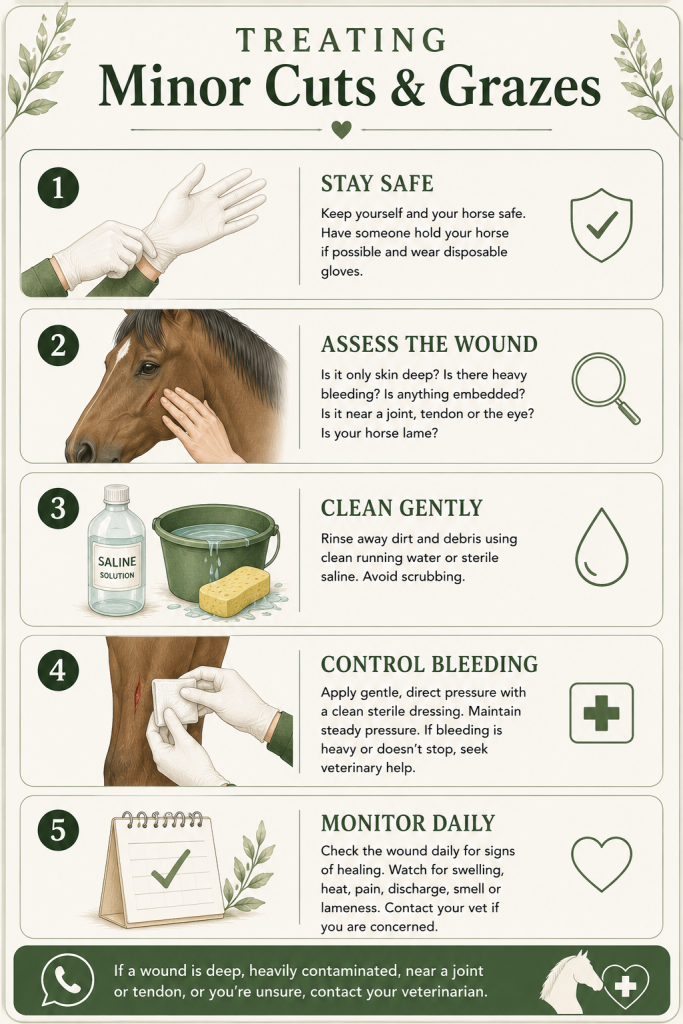
Step 1: Stay Safe
Before examining the wound, make sure your horse is calm and safely restrained if appropriate. If possible, ask someone to hold your horse while you assess the injury. Wear disposable gloves whenever available to help keep the wound clean and reduce the risk of infection.
Step 2: Assess the Wound
Take a moment to look carefully at the injury before doing anything else.
Ask yourself:
- Is it only skin deep?
- Is there heavy bleeding?
- Is anything embedded in the wound?
- Is the wound close to a joint, tendon or the eye?
- Is your horse lame?
If you’re unsure about the severity of the wound, contact your veterinarian before beginning treatment.
Step 3: Clean the Wound
If the wound is minor, gently rinse away dirt and debris using clean running water or sterile saline solution.
Avoid scrubbing the wound, as this can damage healthy tissue and delay healing. The aim is simply to remove contamination while causing as little disturbance as possible.
Step 4: Control Bleeding
Small wounds often stop bleeding on their own after a few minutes.
If the wound continues to bleed, apply gentle, direct pressure using a clean sterile dressing or gauze pad. Maintain steady pressure for several minutes without repeatedly lifting the dressing to check the wound.
If bleeding is heavy or does not stop, seek veterinary attention immediately.
Step 5: Monitor Healing
Check the wound daily for signs of healing.
Watch for:
- Increased swelling
- Heat
- Pain
- Discharge or pus
- An unpleasant smell
- Your horse becoming lame
Any of these changes may indicate infection or another complication and should be discussed with your veterinarian.
💡Practical Horse Owner Tip
Resist the temptation to apply lots of creams or powders straight away. If your veterinarian may need to examine the wound, it’s often best to leave it clean and uncovered (or simply protected with a clean dressing if appropriate) until they’ve assessed it, as some products can make examination or treatment more difficult.
How to Treat Insect Bites and Stings
Insect bites and stings are a common problem for horses, particularly during the warmer months. While most cause only mild irritation, some horses can develop more severe reactions that require veterinary attention.
Common culprits include horseflies, midges, bees and wasps. Bites may result in small swellings, itching or local discomfort, while stings can occasionally trigger a more serious allergic reaction.
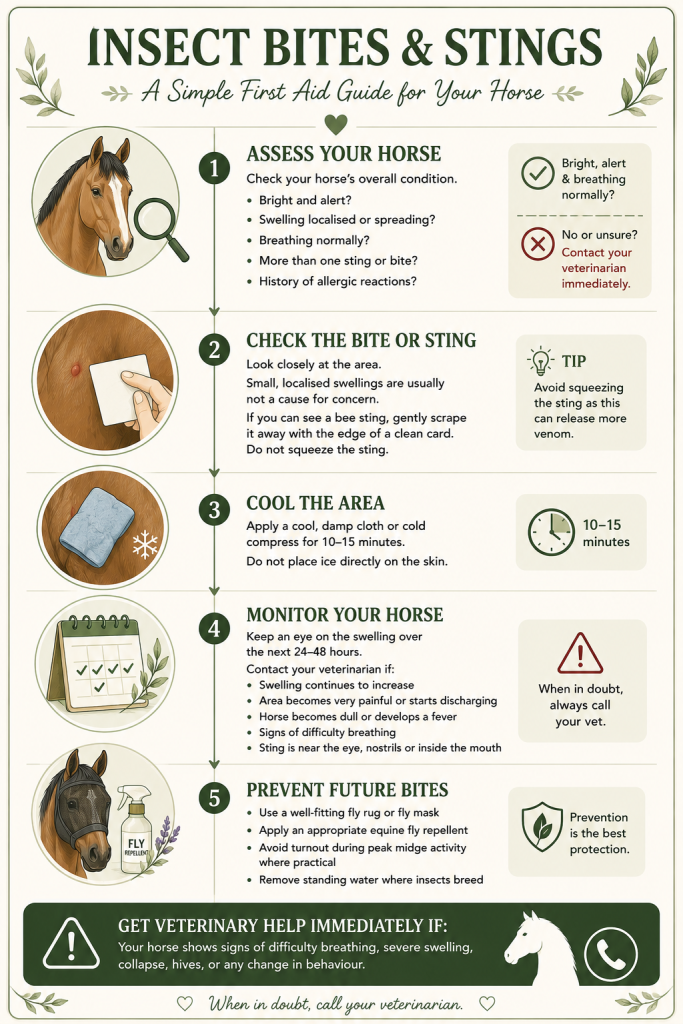
Step 1: Assess Your Horse
Before treating the bite, take a moment to assess your horse’s overall condition.
Ask yourself:
- Is your horse bright and alert?
- Is the swelling localised or spreading?
- Is your horse breathing normally?
- Is there more than one sting or bite?
- Has your horse had allergic reactions in the past?
If your horse appears distressed or unwell, contact your veterinarian immediately.
Step 2: Check the Bite or Sting
Look closely at the affected area.
Small, localised swellings are usually not a cause for concern and often settle within a day or two. If you can safely see a bee sting, you may be able to gently scrape it away using the edge of a clean card or your fingernail. Avoid squeezing the sting, as this can release more venom.
Step 3: Cool the Area
Applying a cool, damp cloth or a cold compress for 10–15 minutes may help reduce swelling and provide comfort.
Avoid placing ice directly onto the skin.
Step 4: Monitor Your Horse
Keep an eye on the swelling over the next 24–48 hours.
Contact your veterinarian if:
- The swelling continues to increase.
- The area becomes very painful or starts discharging.
- Your horse becomes dull or develops a fever.
- Your horse shows signs of difficulty breathing.
- The sting is close to the eye, nostrils or inside the mouth.
Step 5: Prevent Future Bites
Reducing insect exposure can help prevent further problems.
Simple measures include:
- Using a well-fitting fly rug or fly mask.
- Applying an appropriate equine fly repellent.
- Avoiding turnout during peak midge activity where practical.
- Removing standing water where insects breed.
💡Practical Horse Owner Tip
Large local swellings can look alarming but are often much less serious than they appear. It’s your horse’s overall condition that matters most. If they’re bright, comfortable and breathing normally, careful monitoring is usually appropriate. However, always contact your veterinarian if you’re unsure or if the swelling continues to worsen.
What to Do If Your Horse Loses a Shoe
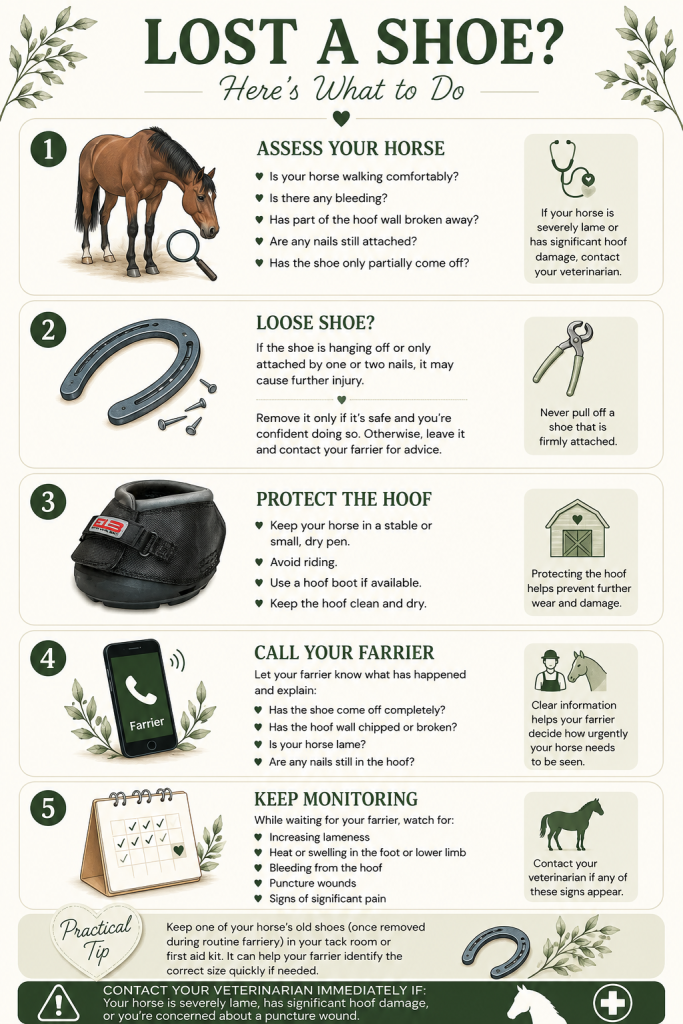
Finding that your horse has lost a shoe can be frustrating, but in most cases it isn’t an emergency. The most important thing is to protect the hoof from further damage and arrange for your farrier to replace the shoe as soon as practical.
Step 1: Stay Calm and Assess Your Horse
Begin by checking your horse’s overall condition.
Ask yourself:
- Is your horse walking comfortably?
- Is there any bleeding?
- Has part of the hoof wall broken away?
- Are any nails still attached?
- Has the shoe only partially come off?
If your horse is severely lame, unwilling to bear weight or has significant hoof damage, contact your veterinarian for advice.
Step 2: Remove a Loose Shoe (If Safe)
If the shoe is hanging off or only attached by one or two nails, it may catch on fencing, rugs or the opposite leg, causing further injury.
If you are experienced and it is safe to do so, carefully remove the loose shoe. If you are unsure, keep your horse confined in a safe area and contact your farrier for advice.
Never attempt to pull off a shoe if it is firmly attached.
Step 3: Protect the Hoof
Until your farrier can attend, try to minimise further wear and damage to the hoof.
Depending on the situation, you may choose to:
- Keep your horse in a stable or a small, dry pen.
- Avoid riding.
- Use a hoof boot if your horse is comfortable wearing one.
- Keep the hoof as clean and dry as possible.
Step 4: Contact Your Farrier
Let your farrier know that your horse has lost a shoe and explain whether:
- The shoe has come off completely.
- The hoof wall has chipped or broken.
- Your horse is lame.
- Any nails remain in the hoof.
Providing clear information may help your farrier decide how urgently your horse needs to be seen.
Step 5: Monitor Your Horse
While waiting for your farrier, continue to monitor your horse.
Contact your veterinarian if your horse develops:
- Severe lameness.
- Bleeding from the hoof.
- A puncture wound.
- Heat or swelling in the foot or lower limb.
- Signs of significant pain.
💡Practical Horse Owner Tip
Keep one of your horse’s old shoes (once it has been removed during routine farriery) in your first aid kit or tack room. It can help your farrier identify the correct size if a replacement is needed quickly, particularly if they haven’t shod your horse before.
How to Treat Sunburn and Minor Burns
Horses can develop minor burns for a variety of reasons, but the most common is sunburn. Horses with pink skin, particularly around the nose, eyelids and other lightly pigmented areas, are especially susceptible during sunny weather.
Most mild sunburn can be managed at home with simple first aid, but more severe burns or burns covering a large area should always be assessed by your veterinarian.
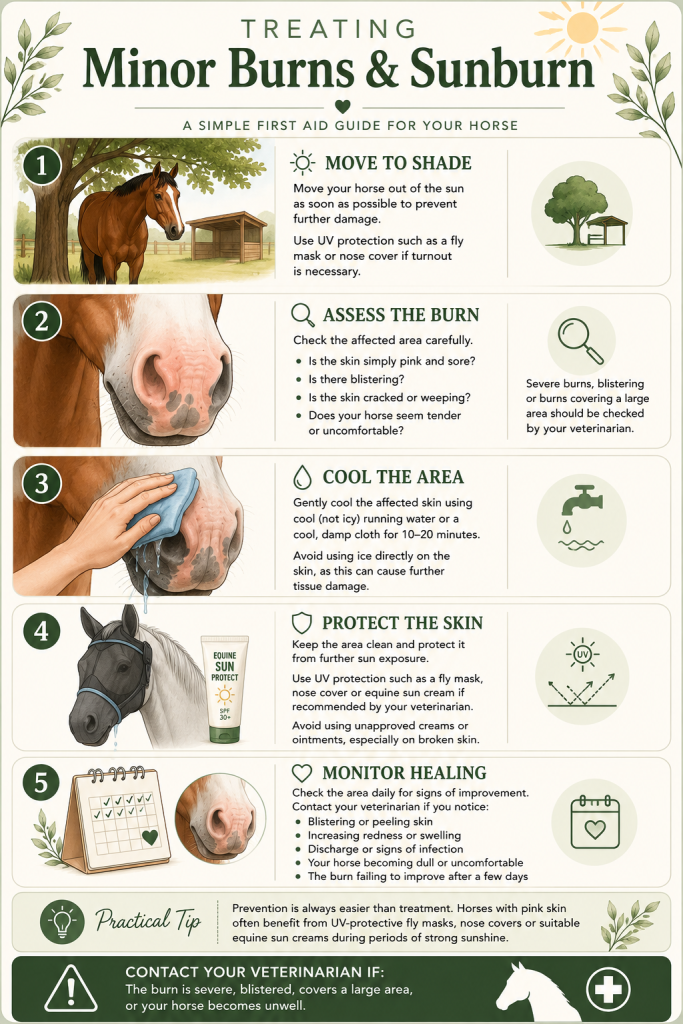
Step 1: Move Your Horse Out of the Sun
If you suspect sunburn, move your horse into the shade or a well-ventilated stable as soon as possible to prevent further damage.
If turnout is necessary, consider using a fly mask with UV protection or a nose cover to help protect sensitive areas.
Step 2: Assess the Burn
Look closely at the affected area.
Ask yourself:
- Is the skin simply pink and sore?
- Is there blistering?
- Is the skin cracked, scabby or weeping?
- Does your horse appear uncomfortable when the area is touched?
Severe blistering, extensive skin damage or burns affecting a large area should be examined by your veterinarian.
Step 3: Cool the Area
For minor burns, gently cool the affected skin using cool (not icy) running water or a cool, damp cloth for around 10–20 minutes.
Avoid using ice directly on the skin, as this can cause further tissue damage.
Step 4: Protect the Skin
Keep the affected area clean and avoid further exposure to direct sunlight while the skin heals. Keep in shaded areas or use UV rugs and masks.
You can apply an appropriate equine sun protection or soothing creams.
Avoid using creams or ointments that have not been recommended for horses, particularly if the skin is blistered or broken.
Step 5: Monitor Healing
Check the area daily for signs of improvement.
Contact your veterinarian if you notice:
- Blistering or peeling skin.
- Increasing redness or swelling.
- Discharge or signs of infection.
- Your horse becoming dull or uncomfortable.
- The burn failing to improve after a few days.
💡Practical Horse Owner Tip
Prevention is always easier than treatment. Horses with pink skin often benefit from UV-protective fly masks, nose covers or suitable equine sun creams during periods of strong sunshine.
Common First Aid Mistakes to Avoid
When a horse is injured, it’s natural to want to help as quickly as possible. However, acting in haste can sometimes make the situation worse. Knowing what not to do is just as important as knowing what you should do.
Here are some of the most common first aid mistakes horse owners make.
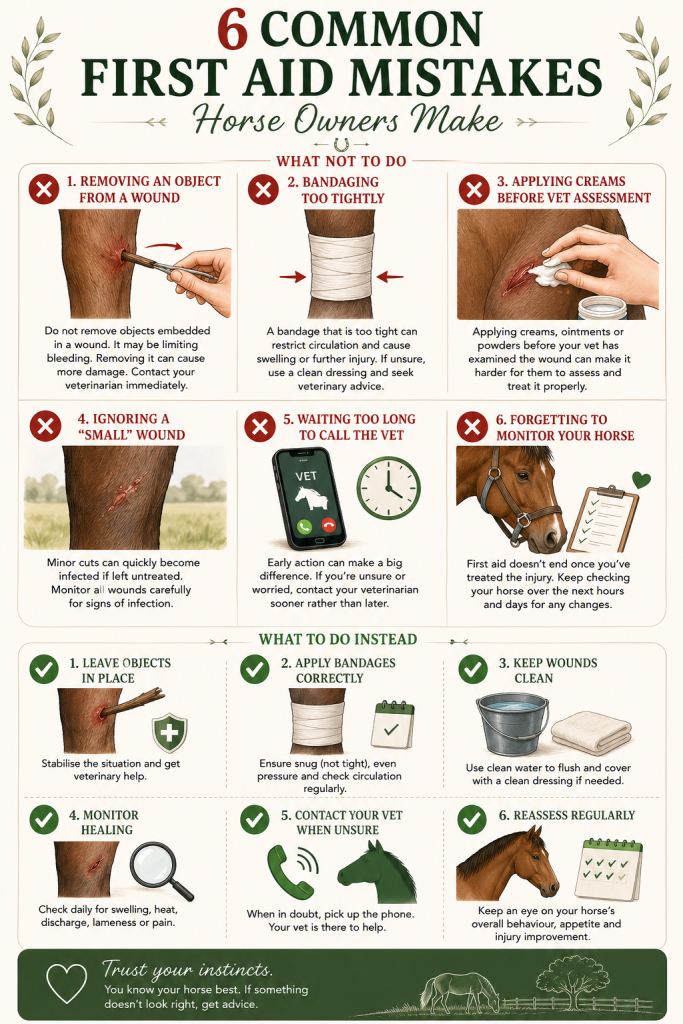
❌Applying creams before the vet has examined the wound
Although it may seem helpful to apply antiseptic creams or wound powders immediately, doing so can sometimes make it more difficult for your veterinarian to properly assess or treat the injury.
If the wound is serious enough to require veterinary attention, it is often best to simply keep it clean and protect it with a clean dressing if advised.
❌Removing objects embedded in a wound
If a foreign object is lodged in your horse’s wound, do not remove it.
The object may be helping to limit bleeding, and removing it could cause further tissue damage. Keep your horse as still as possible and contact your veterinarian immediately.
❌Bandaging too tightly
A bandage that is too tight can restrict circulation and cause more harm than good.
If you’re unsure how to apply a supportive bandage correctly, it’s safer to use a clean dressing and seek veterinary advice.
❌Ignoring small wounds
Minor cuts can quickly become infected if left untreated.
Even if a wound appears small, monitor it carefully over the following days and watch for swelling, heat, discharge or lameness.
❌Waiting too long to call the vet
Many owners worry about bothering their veterinarian.
In reality, your vet would much rather be contacted early than after a condition has become significantly worse. If you’re unsure whether your horse needs veterinary attention, don’t hesitate to ask for advice.
❌Forgetting to monitor your horse
First aid doesn’t end once you’ve cleaned a wound or applied a bandage.
Continue checking your horse regularly over the following hours and days. Changes in behaviour, appetite, temperature or the appearance of an injury can all indicate that further treatment is needed.
💡Practical Horse Owner Tip
If something doesn’t look right, trust your instincts. You know your horse better than anyone else. If you’re concerned, it’s always worth discussing the situation with your veterinarian.
What to Do in an Equine Emergency
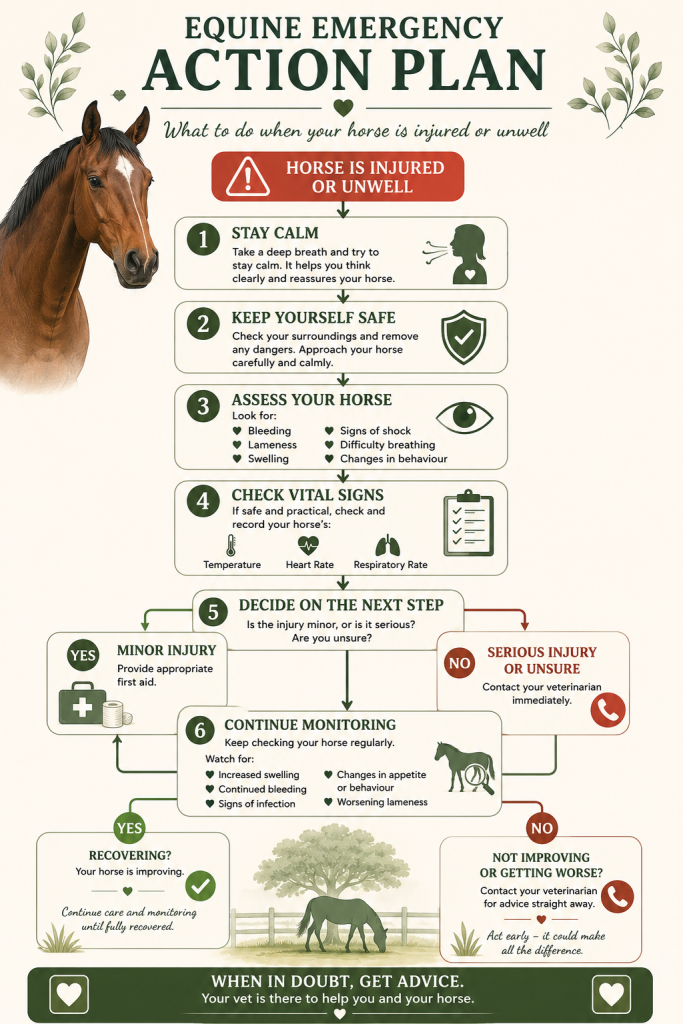
Discovering that your horse is injured or suddenly unwell can be frightening, but having a simple plan to follow can help you stay calm and make good decisions.
Remember that first aid is about protecting your horse, preventing the situation from getting worse and providing appropriate care until veterinary help is available if it’s needed. If at any point you are unsure about the severity of your horse’s condition, contact your veterinarian for advice.
The following action plan provides a simple step-by-step approach to managing most equine first aid situations.
When should I call the vet?
Always contact your veterinarian if your horse has:
- Heavy or uncontrollable bleeding
- A deep or contaminated wound
- A suspected fracture
- An eye injury
- Difficulty breathing
- Severe or sudden lameness
- Signs of shock
- Severe burns
- Signs of colic
- Or if you’re ever unsure about the severity of the situation.
To Summarise
Equine first aid is about being prepared, staying calm and knowing when to seek professional help. By keeping a well-stocked first aid kit, learning your horse’s normal vital signs and understanding how to respond to common injuries, you’ll be in a much stronger position to protect your horse if an emergency arises. Remember, when in doubt, always contact your veterinarian. Acting early can make all the difference to your horse’s health and recovery.
Frequently Asked Questions
Should I always call the vet if my horse has a cut?
Not necessarily. Small, superficial cuts and grazes can often be managed at home with basic first aid and careful monitoring. However, wounds that are deep, heavily contaminated, continue to bleed, involve a joint, tendon, tendon sheath or the eye, or cause significant lameness should always be assessed by a veterinarian.
What should I do first if my horse is injured?
Stay calm and make sure the situation is safe before approaching your horse. Assess your horse from a distance, check for serious injuries and decide whether immediate veterinary attention is needed. If the injury appears minor, provide appropriate first aid while continuing to monitor your horse closely.
What should every equine first aid kit contain?
Every horse owner should keep a well-stocked first aid kit containing items such as sterile saline, non-stick dressings, gauze swabs, bandages, cohesive bandage, padding, scissors, disposable gloves, a digital thermometer and emergency contact details. Regularly check your kit to replace used or expired items.
Can I use human antiseptic creams on my horse?
Only use products that are recommended by your veterinarian or specifically intended for use on horses. Some human products may not be suitable for equine skin or open wounds. If your veterinarian needs to examine the injury, it’s often best to avoid applying creams until they’ve assessed it.
Should I remove an object that’s stuck in a wound?
No. Never remove an object embedded in a wound unless specifically instructed by your veterinarian. The object may be limiting bleeding, and removing it could cause further damage.
How often should I check an injured horse?
Monitor your horse regularly after any injury. Check the wound for signs of swelling, heat, discharge, increased pain or an unpleasant smell, and watch your horse’s appetite, behaviour and comfort levels. If anything changes or worsens, seek veterinary advice.
Can I ride my horse after a minor injury?
It depends on the nature and severity of the injury. Even small wounds or bruises may worsen with exercise. If your horse is lame, uncomfortable or you’re unsure whether it’s safe to ride, avoid exercise until you’ve spoken to your veterinarian or farrier, where appropriate.
When is a burn or sunburn considered an emergency?
Mild sunburn can often be managed at home by moving your horse out of the sun, cooling the area and protecting the skin while it heals. However, severe burns, blistering, burns covering a large area or burns causing significant pain should always be assessed by a veterinarian.
My horse has lost a shoe. Is it an emergency?
Not usually. Most lost shoes can be managed by protecting the hoof and arranging for your farrier to replace the shoe. However, if your horse is severely lame, the hoof is badly damaged or you suspect a puncture wound, contact your veterinarian promptly.
Glossary
Bandage Padding – A soft layer placed beneath a bandage to provide cushioning and help distribute pressure evenly.
Capillary Refill Time (CRT) – A simple test used to assess circulation by pressing on the gums and timing how long it takes for the pink colour to return.
Cohesive Bandage – A self-adhesive bandage that sticks to itself but not to your horse’s hair or skin. Commonly used to secure dressings.
Digital Thermometer – A thermometer used to accurately measure your horse’s body temperature.
First Aid – The immediate care given to a horse following an injury or sudden illness before veterinary treatment is available.
Heart Rate – The number of times your horse’s heart beats each minute, usually measured in beats per minute (bpm).
Lameness – An abnormality in your horse’s movement caused by pain or injury affecting a limb or hoof.
Mucous Membranes – The moist tissues inside your horse’s mouth. Their colour can provide useful information about circulation and overall health.
Respiratory Rate – The number of breaths your horse takes each minute while at rest.
Saline Solution – A sterile salt-water solution used to gently flush dirt and debris from wounds.
Shock – A serious medical condition where the body’s tissues do not receive enough oxygen-rich blood. Shock requires immediate veterinary attention.
Superficial Wound – A wound affecting only the outer layers of the skin and not extending into deeper tissues.
Vital Signs – Measurements such as temperature, heart rate and respiratory rate that help assess your horse’s overall health.
Wound Dressing – A sterile pad or dressing placed over a wound to help protect it while it heals.
References
- PetPlan Equine. Equine Insurers offering horse advise.
- British Horse Society (BHS). Horse Care and Welfare Resources.
- MSD Veterinary Manual. Equine Disorders and First Aid Guidance.
- World Horse Welfare. Horse Health and Welfare Advice.
- Blue Cross. Horse Health and Welfare Resources.
Disclaimer:
The information provided in this article is intended for educational purposes only and should not be considered a substitute for professional veterinary advice, diagnosis or treatment.
Every horse is an individual, and management decisions should always consider your horse’s age, health, workload and individual needs. If your horse is unwell, or you have any concerns about their health or welfare, contact your veterinary surgeon without delay.
While every effort has been made to ensure the information in this guide is accurate and up to date at the time of publication, recommendations and best practice may change as new research becomes available.