Published: 8th July 2026
Last Edited: 10th July 2026
In this Guide
- At a Glance
- Introduction
- Why Knowing Your Horses Vital Signs Matter
- Understanding Normal Vital Signs
- How to Take Your Horses Temperature
- How To Take Your Horses Pulse (Heart Rate)
- How To Measure Your Horses Respiration Rate
- Checking Your Horse’s Mucous Membranes & Capillary Refill Time (CRT)
- Assessing Your Horses Hydration
- Listening To Your Horses Gut Sounds
- Recording Your Horses Normal Vital Signs
- Myths VS Facts
- Frequently Asked Questions (FAQ’s)
- Glossary
- References
- Disclaimer
At a Glance
✔ Learn the normal temperature, pulse and respiration ranges for a healthy adult horse.
✔ Discover how to safely check your horse’s vital signs at home.
✔ Understand what your horse’s gums, hydration and gut sounds can tell you about their health.
✔ Learn why knowing your horse’s normal readings can help you recognise illness sooner.
✔ Understand when changes in vital signs may indicate an emergency requiring veterinary attention.
✔ Find practical tips to help you monitor your horse’s health with confidence.
Introduction
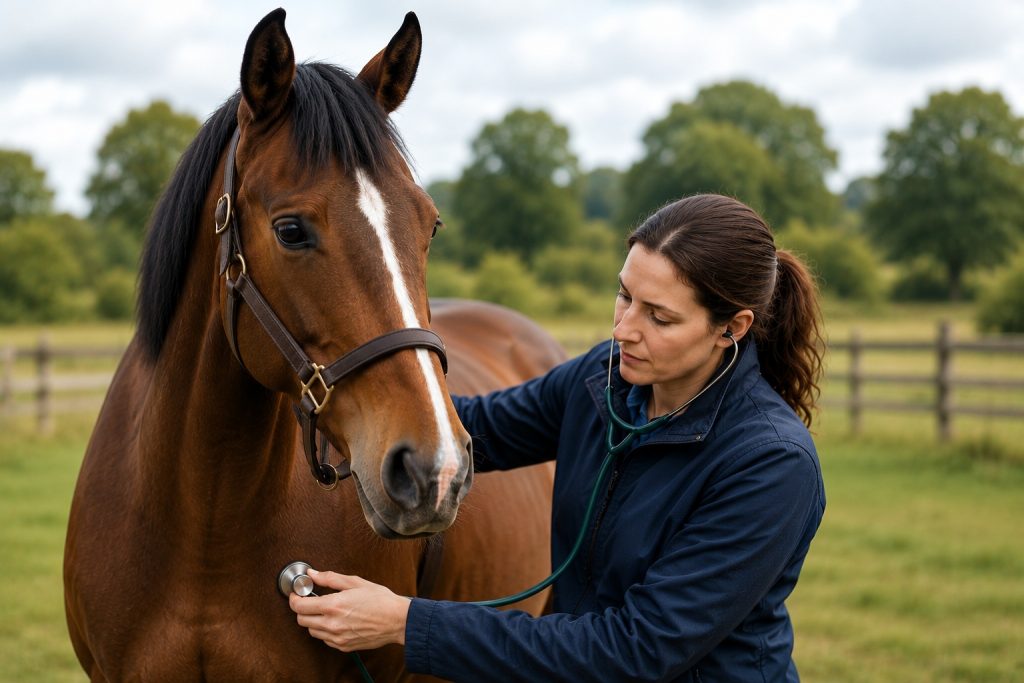
Every horse owner hopes they’ll never have to deal with an emergency, but recognising that something isn’t quite right often begins with noticing small changes before obvious signs of illness appear.
Learning how to check your horse’s vital signs is one of the most useful skills you can develop. Temperature, pulse and respiration provide valuable information about your horse’s overall health and can help you identify when veterinary advice may be needed. Regularly checking these measurements when your horse is healthy also helps you understand what is normal for your individual horse, making it easier to spot changes in the future.
While vital signs should never replace a veterinary examination, they provide important information that can support your vet if your horse becomes unwell. Keeping a record of your horse’s normal values can also be helpful during routine health checks or emergencies.
Why Knowing Your Horse’s Vital Signs Matters
Checking your horse’s vital signs is one of the simplest and most valuable health checks you can perform. A horse’s temperature, pulse and respiration provide important information about how their body is functioning and can often give the earliest indication that something is wrong.
Many illnesses, including infections, colic, respiratory disease and heat stress, can cause changes in one or more vital signs before other symptoms become obvious. Learning what is normal for your horse allows you to recognise unusual changes quickly and provide useful information to your veterinary surgeon if concerns arise.
It’s important to remember that every horse is an individual. Factors such as age, breed, fitness level, excitement and environmental conditions can all influence vital signs to some extent. For this reason, it’s good practice to become familiar with your horse’s normal readings while they are healthy and relaxed.
Taking a few minutes to check your horse’s vital signs regularly can help you build confidence, improve your understanding of your horse’s health and support early recognition of potential problems.
💡 Practical Horse Owner Tip
Don’t wait until your horse is unwell to learn how to take their vital signs. Practise when your horse is healthy and relaxed so that both you and your horse become comfortable with the process.
Understanding Normal Vital Signs
A horse’s vital signs provide valuable information about their overall health and wellbeing. While there is a recognised normal range for each measurement, it’s important to remember that every horse is an individual. Age, breed, fitness level, excitement, stress and environmental conditions can all influence vital signs to some degree.
For this reason, it’s useful to become familiar with your horse’s normal readings while they are healthy, calm and relaxed. Having a baseline makes it much easier to recognise when something has changed and to provide accurate information to your veterinary surgeon if concerns arise.
The table below shows the typical resting vital signs for a healthy adult horse.
| Vital Sign | Normal Range (Healthy Adult Horse) |
|---|---|
| 🌡 Temperature | 37.2–38.3°C |
| ❤️ Heart Rate (Pulse) | 28–44 beats per minute |
| 🌬 Respiration Rate | 8–16 breaths per minute |
| ⏱ Capillary Refill Time (CRT) | Less than 2 seconds |
| 🩷 Mucous Membranes | Moist and healthy pink |
Please note: Foals naturally have higher heart and respiration rates than adult horses. This guide focuses on healthy adult horses.
💡 Practical Horse Owner Tip
Don’t rely on memory alone. Keeping a record of your horse’s normal vital signs can make it much easier to recognise changes and provide useful information to your vet if your horse becomes unwell.
🌡 How to Take Your Horse’s Temperature
A horse’s body temperature is one of the most useful indicators of their overall health. A raised temperature (fever) is often one of the earliest signs that your horse may be fighting an infection or illness, while a lower than normal temperature can occasionally occur in cases of shock or severe illness.
Taking your horse’s temperature is a straightforward procedure and is an important skill for every horse owner to learn.
What You’ll Need
- A digital rectal thermometer
- A small amount of lubricant (such as petroleum jelly or a water-based lubricant)
- Disposable gloves (optional)
- A notebook or your phone to record the reading
Many horse owners also attach a piece of string and a clip to the end of the thermometer to reduce the risk of accidentally dropping it.
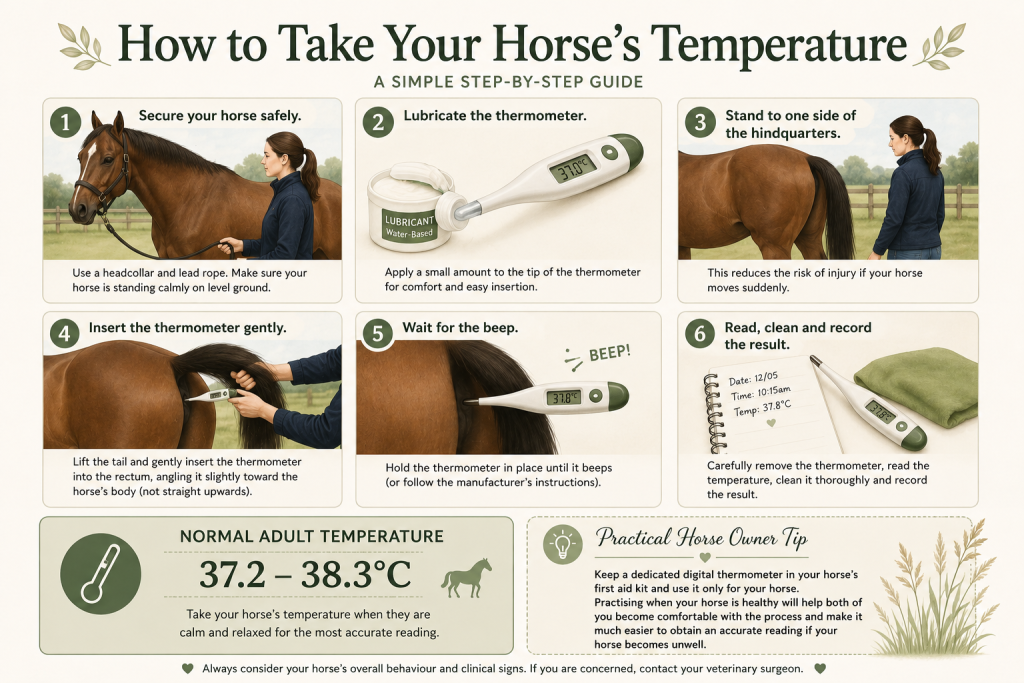
How to Take Your Horse’s Temperature
- Ensure your horse is standing calmly on a level surface and is safely restrained using a headcollar and lead rope.
- Stand to one side of your horse’s hindquarters, rather than directly behind them, to reduce the risk of injury if they move suddenly.
- Apply a small amount of lubricant to the tip of the thermometer.
- Gently lift the horse’s tail and carefully insert the thermometer into the rectum, directing it slightly towards the horse’s body rather than straight upwards.
- Hold the thermometer in place until it beeps (or according to the manufacturer’s instructions).
- Carefully remove the thermometer and read the temperature.
- Clean the thermometer thoroughly before storing it.
What’s Normal?
A healthy adult horse typically has a resting body temperature of:
🌡 37.2–38.3°C
It’s best to take your horse’s temperature when they are calm and relaxed, as stress, excitement or exercise can cause a temporary increase.
When Should You Be Concerned?
Contact your veterinary surgeon if:
- Your horse has a temperature above 38.5°C, particularly if they appear unwell.
- Your horse has a persistently raised temperature.
- Your horse has a low body temperature and is showing signs of illness or shock.
- A change in temperature is accompanied by other symptoms such as lethargy, loss of appetite, nasal discharge, coughing or signs of colic.
A single temperature reading should always be considered alongside your horse’s overall behaviour and clinical signs.
❤️ How to Check Your Horse’s Pulse (Heart Rate)
A horse’s pulse, also known as their heart rate, measures how many times the heart beats in one minute. Monitoring your horse’s pulse can provide valuable information about their overall health and may help identify pain, illness, stress or other underlying problems.
A horse’s heart rate can naturally increase after exercise, during hot weather or if they are excited or anxious. For the most accurate reading, check your horse’s pulse when they are calm and relaxed.
What You’ll Need
- A watch or timer with a second hand (or a stopwatch on your phone)
- A quiet environment where your horse is standing calmly
You do not need a stethoscope, although one can be useful if you’re confident using it.
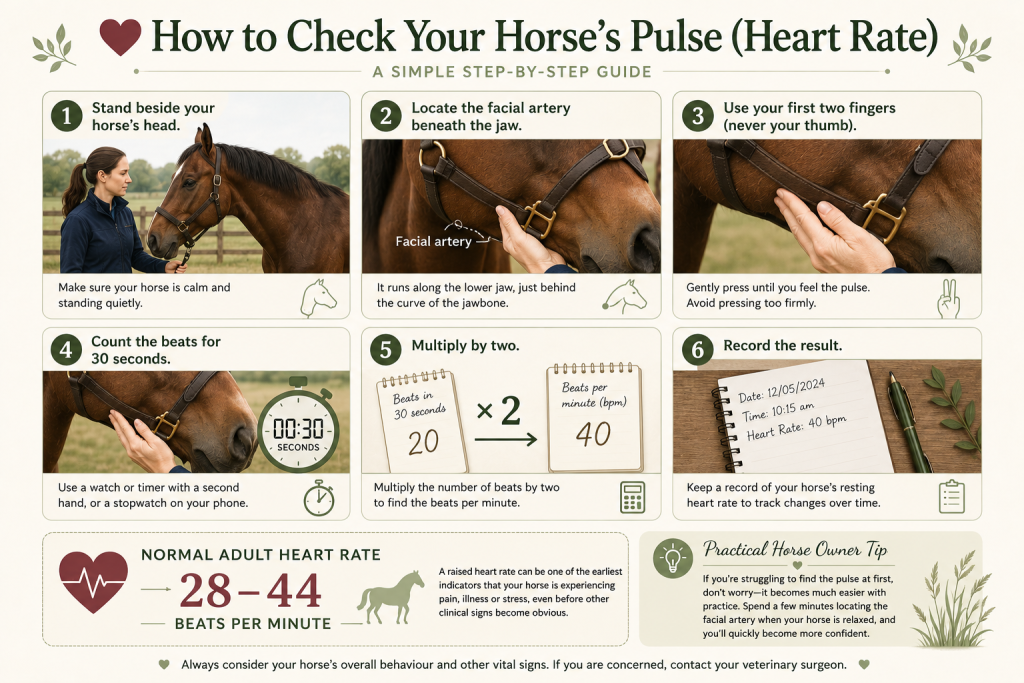
How to Check Your Horse’s Pulse
The easiest place to feel your horse’s pulse is the facial artery, which runs beneath the lower jaw.
- Stand calmly beside your horse’s head.
- Place your first two fingers (not your thumb) underneath the lower jaw, just behind the curve of the jawbone.
- Gently move your fingers until you feel the pulse.
- Count the number of beats for 30 seconds, then multiply by two to calculate the beats per minute.
- Alternatively, count for a full minute for the most accurate reading.
Avoid pressing too firmly, as this can make the pulse more difficult to feel.
What’s Normal?
A healthy adult horse typically has a resting heart rate of:
❤️ 28–44 beats per minute
Individual horses may naturally sit towards the lower or higher end of this range, so it’s helpful to know what is normal for your own horse.
When Should You Be Concerned?
Contact your veterinary surgeon if:
- Your horse has a persistently elevated resting heart rate.
- The pulse remains high even after your horse has been resting.
- Your horse has an unusually weak, irregular or difficult-to-find pulse.
- An increased heart rate is accompanied by signs of pain, colic, fever, injury or respiratory distress.
Remember that excitement, stress and recent exercise can temporarily increase your horse’s heart rate, so always interpret the reading alongside your horse’s behaviour and other vital signs.
💡 Practical Horse Owner Tip:
If you’re struggling to find the pulse at first, don’t worry—it becomes much easier with practice. Spend a few minutes locating the facial artery when your horse is relaxed, and you’ll quickly become more confident.
🌬 How to Measure Your Horse’s Respiration Rate
Your horse’s respiration rate is the number of breaths they take each minute. Monitoring your horse’s breathing can provide valuable information about their health and may help identify pain, respiratory disease, stress or other underlying conditions.
Like heart rate, respiration naturally increases during exercise, excitement and hot weather. For the most accurate reading, measure your horse’s breathing when they are calm, relaxed and standing quietly.
What You’ll Need
- A watch or timer with a second hand (or a stopwatch on your phone)
- A quiet environment where your horse is standing calmly
Unlike temperature or pulse, you won’t need any equipment to measure your horse’s breathing.
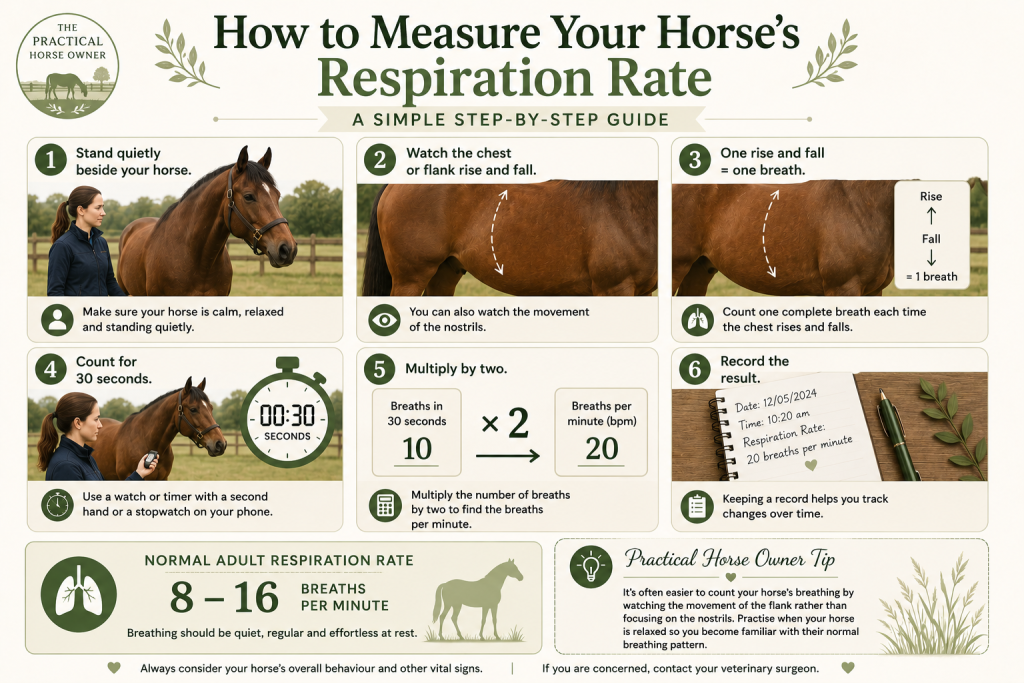
How to Measure Your Horse’s Respiration
- Stand quietly to one side of your horse where you can clearly see their chest or flank.
- Watch the rise and fall of the chest or movement of the nostrils.
- Count one complete breath each time the chest rises and falls.
- Count the number of breaths for 30 seconds, then multiply by two to calculate the breaths per minute.
- Alternatively, count for a full minute for the most accurate reading.
Try not to distract or excite your horse while counting, as this can alter the result.
What’s Normal?
A healthy adult horse typically has a resting respiration rate of:
🌬 8–16 breaths per minute
Your horse’s breathing should be quiet, regular and effortless. You should not see exaggerated chest movements or hear unusual breathing noises when they are at rest.
When Should You Be Concerned?
Contact your veterinary surgeon if your horse:
- Has a resting respiration rate above the normal range.
- Appears to be working hard to breathe.
- Has flared nostrils while at rest.
- Is making unusual breathing noises such as wheezing or rasping.
- Has a persistent cough or nasal discharge.
- Shows increased breathing alongside fever, lethargy or signs of pain.
Rapid breathing doesn’t always mean there is a problem, particularly after exercise or during hot weather. However, breathing should gradually return to normal once your horse has cooled down and is resting comfortably.
💡 Practical Horse Owner Tip:
It’s often easier to count your horse’s breathing by watching the movement of the flank rather than focusing on the nostrils. Practise when your horse is relaxed so you become familiar with their normal breathing pattern.
🩷 Checking Your Horse’s Mucous Membranes & Capillary Refill Time (CRT)
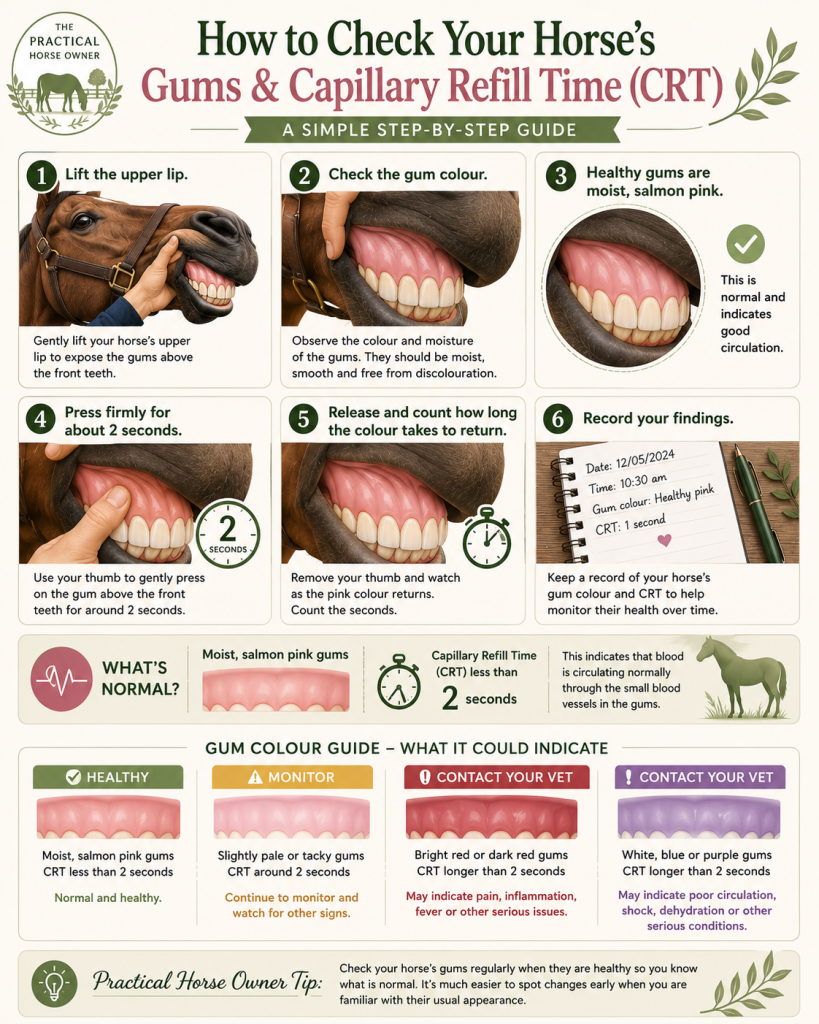
Your horse’s mucous membranes (gums) and capillary refill time (CRT) can provide valuable information about their circulation, hydration and overall health. These checks are quick, require no equipment and are commonly performed by veterinary surgeons as part of a routine examination.
Like the other vital signs, it’s helpful to become familiar with what is normal for your horse while they are healthy and relaxed.
What You’ll Need
No equipment is required.
Simply ensure your horse is calm and standing quietly in a safe environment.
How to Check Your Horse’s Gums
- Gently lift your horse’s upper lip.
- Observe the colour and moisture of the gums.
- Healthy gums should be light to salmon pink, moist and smooth.
Pale, very dark red, blue or purple gums, or gums that appear dry or tacky, can indicate an underlying health problem and should not be ignored.
How to Check Capillary Refill Time (CRT)
- Using your thumb, gently press on the gum above the front teeth for around 2 seconds.
- Remove your thumb and watch as the colour returns.
- Count how long it takes for the pink colour to return.
What’s Normal?
A healthy adult horse should have:
🩷 Moist, salmon pink gums
⏱ Capillary refill time of less than 2 seconds
This indicates that blood is circulating normally through the small blood vessels in the gums.
When Should You Be Concerned?
Contact your veterinary surgeon if your horse has:
- Pale, white or grey gums.
- Bright red, dark red, blue or purple gums.
- Dry or sticky gums.
- A capillary refill time longer than 2 seconds.
- Abnormal gum colour or CRT alongside signs of illness, colic, dehydration or injury.
These changes may indicate problems with circulation, dehydration, shock or other serious conditions requiring prompt veterinary assessment.
💡 Practical Horse Owner Tip:
Check your horse’s gums regularly when they are healthy so you know what is normal. It’s much easier to recognise an abnormal colour or delayed capillary refill time when you’re already familiar with your horse’s usual appearance.
💧 Assessing Your Horse’s Hydration
Adequate hydration is essential for every aspect of your horse’s health. Water supports circulation, digestion, temperature regulation and normal body function. Even mild dehydration can affect your horse’s performance and wellbeing, while more severe dehydration can become a veterinary emergency.
Although ensuring your horse has access to clean, fresh water is the best way to maintain hydration, there are a few simple checks you can carry out if you are concerned your horse may be dehydrated.
What You’ll Need
No equipment is required.
These simple checks can be performed while your horse is calm and standing quietly.
How to Check Hydration
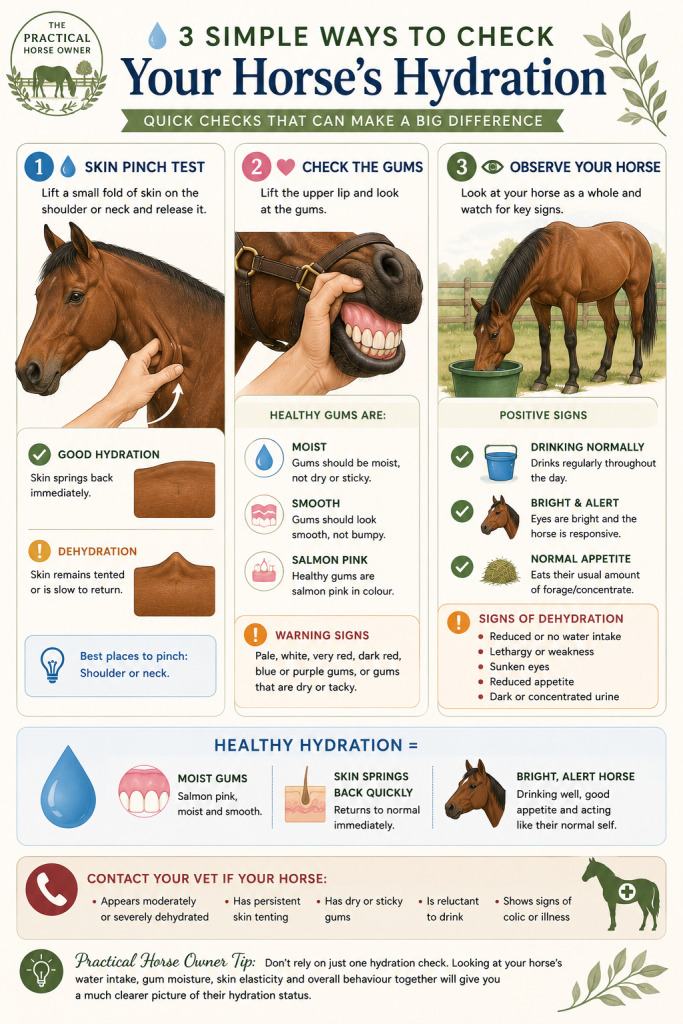
1. Perform a Skin Pinch Test
Gently lift a small fold of skin on your horse’s shoulder or neck and then release it.
In a well-hydrated horse, the skin should return to its normal position almost immediately.
If the skin remains tented or is slow to return, this may indicate dehydration.
2. Check the Gums
Healthy gums should be:
- Moist
- Smooth
- Salmon pink
Dry or tacky gums may suggest your horse is becoming dehydrated.
3. Observe Your Horse
Also look for signs such as:
- Reduced water intake
- Lethargy
- Sunken eyes
- Reduced appetite
- Dark or concentrated urine
Hydration should always be assessed alongside your horse’s other vital signs and overall behaviour.
What’s Normal?
A healthy horse should:
💧 Drink regularly throughout the day.
💧 Have moist, pink gums.
💧 Have skin that quickly returns to its normal position after the skin pinch test.
When Should You Be Concerned?
Contact your veterinary surgeon if your horse:
- Appears moderately or severely dehydrated.
- Has persistent skin tenting.
- Has dry or sticky gums.
- Is reluctant to drink.
- Shows signs of colic alongside dehydration.
- Has a fever or appears generally unwell.
Young, elderly and sick horses are particularly vulnerable to dehydration and should be monitored closely.
💡 Practical Horse Owner Tip:
Don’t rely on just one hydration check. Looking at your horse’s water intake, gum moisture, skin elasticity and overall behaviour together will give you a much clearer picture of their hydration status.
🔊 Listening to Your Horse’s Gut Sounds
Your horse’s digestive system is constantly working, moving food through the intestines using rhythmic muscular contractions known as gut motility. These movements produce the familiar gurgling and rumbling noises that can often be heard when listening to your horse’s abdomen.
Changes in gut sounds can sometimes indicate that the digestive system isn’t functioning normally. While listening to gut sounds should never replace a veterinary examination, it can provide another useful piece of information when assessing your horse’s health.
What You’ll Need
- A quiet environment
- A watch or timer (optional)
A stethoscope can make gut sounds easier to hear, but it isn’t essential. In many horses, the sounds can be heard by placing your ear gently against the horse’s side.
How to Listen to Gut Sounds
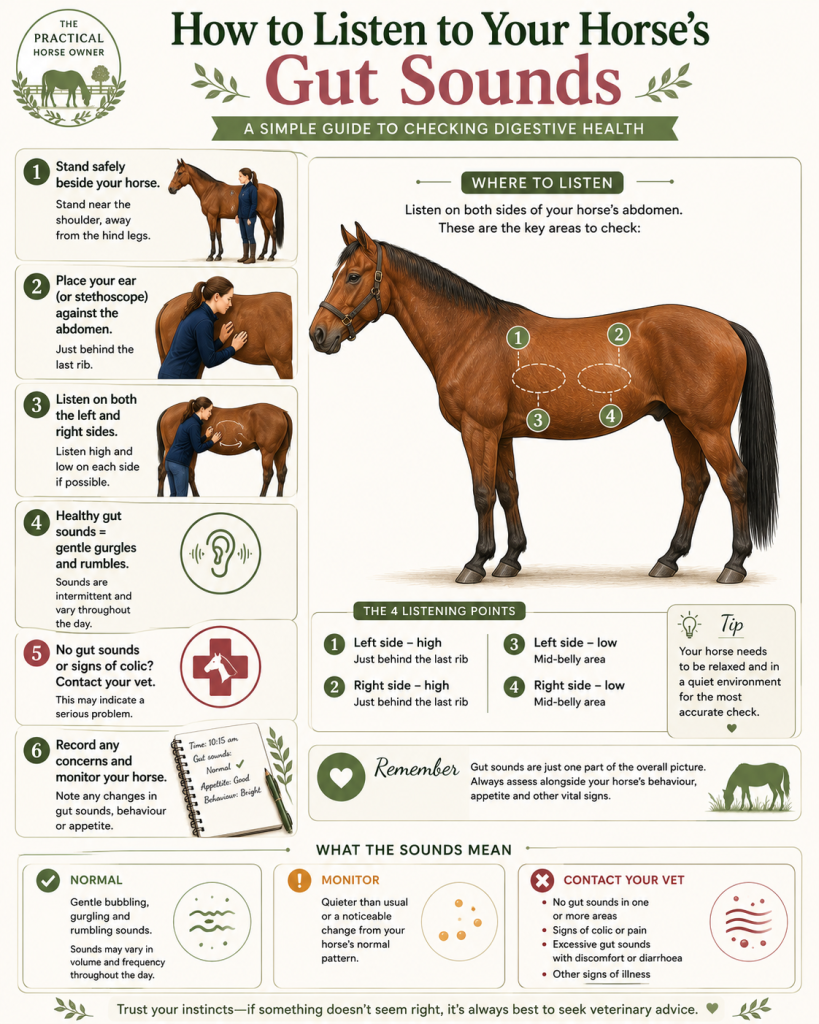
- Ensure your horse is standing calmly in a quiet environment.
- Stand safely beside your horse, avoiding the hind legs.
- Place your ear (or a stethoscope) gently against your horse’s abdomen.
- Listen to both the left and right sides, high and low if possible.
- You should hear intermittent gurgling, bubbling or rumbling sounds.
Remember that gut sounds naturally vary throughout the day, particularly after eating.
What’s Normal?
A healthy horse should have:
🔊 Regular gurgling or rumbling sounds on both sides of the abdomen.
The sounds may vary in volume and frequency, but complete silence is not considered normal.
When Should You Be Concerned?
Contact your veterinary surgeon immediately if your horse:
- Has no gut sounds in one or more areas.
- Shows signs of colic alongside reduced gut sounds.
- Has excessive gut sounds accompanied by discomfort or diarrhoea.
- Appears dull, in pain or unwilling to eat.
Gut sounds are just one part of the overall picture and should always be assessed alongside your horse’s behaviour and other vital signs.
💡 Practical Horse Owner Tip:
Don’t worry if you’re unsure what normal gut sounds should sound like at first. Listen to your horse regularly when they are healthy and relaxed—you’ll soon become familiar with what is normal for them.
📝 Recording Your Horse’s Normal Vital Signs
You don’t need to check your horse’s vital signs every day, but becoming familiar with what is normal for your individual horse can be incredibly valuable.
Every horse is slightly different, and keeping a simple record of their normal temperature, pulse, respiration and other health observations provides a useful baseline for comparison if they ever become unwell.
Try checking and recording your horse’s vital signs when they are:
- Calm and relaxed.
- Healthy and free from illness.
- Standing quietly in a familiar environment.
If your horse later becomes unwell, you’ll have a much better understanding of what is normal for them and will be able to provide more accurate information to your veterinary surgeon.
Ensure you record your results so that you can always refer back to them, and produce them for the vet if needed. It also helps you see the trend of what’s normal for your horse and makes it very easy to spot any abnormalities.
Remember that vital signs are only one part of assessing your horse’s health. Always consider them alongside your horse’s behaviour, appetite, water intake and any other signs of illness.
Myths VS Facts
| Myth | Fact |
|---|---|
| It’s only worth learning how to take vital signs if my horse becomes ill | The best time to practise taking your horse’s vital signs is when they are healthy and relaxed. This helps both you and your horse become comfortable with the process and gives you a reliable baseline for future comparison. |
| If my horse looks happy and is eating normally, their vital signs must be normal. | Knowing your horse’s normal resting temperature makes it much easier to recognise when something has changed. Regularly checking vital signs when your horse is healthy helps establish a useful baseline. |
| I need a stethoscope to check my horse’s pulse. | The facial artery beneath the jaw can usually be felt using your first two fingers. A stethoscope can be helpful but isn’t essential for checking your horse’s heart rate. |
| A horse’s breathing should always be slow and quiet. | A horse’s respiration rate naturally increases after exercise, during hot weather or when they are excited. However, it should return to normal once they have recovered and are resting comfortably. |
| Dry gums always mean my horse is dehydrated. | Dry or tacky gums can be a sign of dehydration, but they should always be assessed alongside your horse’s other vital signs, behaviour and overall condition. Looking at the whole picture provides a much more accurate assessment. |
| If I can’t hear any gut sounds, it doesn’t necessarily mean anything is wrong. | Reduced or absent gut sounds, particularly if your horse is showing signs of discomfort or colic, should always be taken seriously and assessed by a veterinary surgeon. |
| Taking my horse’s vital signs will tell me exactly what’s wrong. | Vital signs are an important monitoring tool, but they don’t provide a diagnosis. They help identify when something may be wrong and provide valuable information to your veterinary surgeon, who can determine the underlying cause. |
| Every healthy horse has exactly the same normal vital signs. | While there are recognised normal ranges for adult horses, every horse is an individual. Age, breed, fitness, temperament and environmental conditions can all influence vital signs. That’s why it’s so important to become familiar with what is normal for your own horse. |
Frequently Asked Questions (FAQ’s)
How often should I check my horse’s vital signs?
It’s a good idea to become familiar with your horse’s normal vital signs by checking them regularly when they are healthy and relaxed. You don’t need to record them every day, but taking occasional readings provides a useful baseline for comparison if your horse becomes unwell.
What are the normal vital signs for an adult horse?
A healthy adult horse typically has:
- 🌡 Temperature: 37.2–38.3°C
- ❤️ Heart Rate: 28–44 beats per minute
- 🌬 Respiration Rate: 8–16 breaths per minute
- 🩷 Capillary Refill Time: Less than 2 seconds
- 🩷 Gums: Moist and salmon pink
Remember that every horse is an individual, so it’s important to know what is normal for your own horse.
Should I check my horse’s vital signs after exercise?
Vital signs naturally increase during and immediately after exercise. If you want to establish your horse’s normal resting values, wait until they have fully recovered, are calm and standing quietly before taking any measurements.
Can hot weather affect my horse’s vital signs?
Yes. Hot weather can increase your horse’s heart rate, respiration rate and body temperature, particularly after exercise. Always allow your horse time to cool down before assessing their resting vital signs, and monitor them closely during periods of extreme heat.
Why is my horse’s heart rate higher than normal?
An increased heart rate can occur after exercise, excitement or stress. However, it may also indicate pain, illness, dehydration or other underlying health problems. If your horse’s heart rate remains elevated while resting or is accompanied by other concerning signs, contact your veterinary surgeon.
Do I need a stethoscope to check my horse’s vital signs?
No. Most horse owners can accurately check their horse’s temperature, pulse, respiration, gum colour and capillary refill time without specialised equipment. A stethoscope can be useful for listening to heart or gut sounds, but it isn’t essential for routine monitoring.
What should healthy horse gums look like?
Healthy gums should be moist, smooth and a light salmon pink colour. Pale, bright red, dark red, blue, purple or dry gums can indicate an underlying health problem and should be assessed alongside your horse’s other vital signs.
Why is it important to know my horse’s normal vital signs?
Knowing your horse’s normal readings makes it much easier to recognise changes that may indicate illness or injury. It also allows you to provide accurate information to your veterinary surgeon, helping them assess your horse more effectively.
Can I diagnose my horse’s illness using vital signs?
No. Vital signs are an important monitoring tool, but they cannot diagnose a specific condition. They help identify when something may be wrong and should always be considered alongside your horse’s behaviour, clinical signs and veterinary advice.
When should I contact my vet?
If your horse has abnormal vital signs alongside symptoms such as lethargy, loss of appetite, signs of colic, difficulty breathing, persistent fever or any sudden change in behaviour, contact your veterinary surgeon promptly. If you’re ever unsure, it’s always safest to seek professional advice.
Should I keep a thermometer in my horse’s first aid kit?
Yes. A digital rectal thermometer is one of the most useful and inexpensive items you can keep in your horse’s first aid kit. Having one readily available means you can quickly check your horse’s temperature if you have any concerns about their health.
Glossary
Capillary Refill Time (CRT)
The time it takes for colour to return to the gums after gentle pressure is applied. In a healthy adult horse, this should usually be less than 2 seconds.
Dehydration
A condition where the horse does not have enough fluid in the body for normal function. Signs may include dry gums, sunken eyes, reduced drinking and skin that is slow to return after a skin pinch test.
Facial Artery
A blood vessel that runs beneath the lower jaw. It is one of the easiest places to feel a horse’s pulse.
Gut Motility
The natural movement of the digestive system that helps move food through the intestines. Gut motility produces the gurgling and rumbling sounds heard in the abdomen.
Gut Sounds
The bubbling, gurgling or rumbling noises produced by movement within the digestive tract. Reduced, absent or abnormal gut sounds can be a concern, especially alongside signs of colic.
Heart Rate
The number of times the heart beats in one minute. In adult horses, this is commonly measured as beats per minute.
Mucous Membranes
The moist tissues lining areas such as the gums. In horses, gum colour and moisture can provide useful information about circulation and hydration.
Pulse
The rhythmic beat felt in an artery as blood is pumped around the body. Pulse is commonly checked at the facial artery beneath the lower jaw.
Respiration Rate
The number of breaths a horse takes in one minute. This is usually measured by watching the chest or flank rise and fall.
Skin Pinch Test
A simple hydration check where a small fold of skin is gently lifted and released. In a well-hydrated horse, the skin should return to normal quickly.
Vital Signs
Basic health measurements that help assess how the body is functioning. In horses, these commonly include temperature, pulse, respiration, gum colour, capillary refill time, hydration and gut sounds.
Free Printable?
Did you find this article useful? We believe that the skills we have discussed in this guide are very important for every horse owner to have, so we have decided to provide all 6 of our diagrams (as seen in this article) for you print and hang in your feed room, tack room or yard office, so its always to hand when you need it.
Just enter your email below, and we will send them straight to your inbox!

Looking for somewhere to record your horses vital signs?
Check out our Horse Health Tracker, the perfect place to keep all of your horses important health information in one place!
References
- B&W Equine Vets – Veterinary group dedicated to excellent equine healthcare
- The Horse – A guide to equine health care
- Pony Club Blog – Organisation dedicated to educating the next generation of equestrians
- The Complete Horse Care Manual – Comprehensive guide to horse health, management and first aid.
- Manual of Equine Practice – Veterinary reference covering clinical examination and normal parameters.
Information reviewed: This guide has been written using current equine veterinary guidance and horse care resources available at the time of publication. Recommendations may change as new research becomes available, so always follow the advice of your own veterinary surgeon regarding your horse’s individual healthcare needs.
Disclaimer:
The information provided in this article is intended for educational purposes only and should not be considered a substitute for professional veterinary advice, diagnosis or treatment.
Every horse is an individual, and management decisions should always take into account your horse’s age, health, workload and individual needs. If your horse is unwell, or you have any concerns about their health or welfare, contact your veterinary surgeon without delay.
While every effort has been made to ensure the information in this guide is accurate and up to date at the time of publication, recommendations and best practice may change as new research becomes available.