
In This Guide:
- At a Glance
- Introduction
- Before You Load
– Is Your Horse Fit to Travel?
– When Should You Postpone a Non-urgent Journey?
– Emergency Transport
– Check Your Vehicle and Equipment
– Pack Everything You’ll Need
– Plan Your Journey - Choosing Suitable Travel Protection
- Preparing Your Horse Mentally
- Loading Your Horse Safely
- During The Journey
- Arriving Safely
- Long-Distance Travel
- Common Traveling Problems
- Emergency Situations
- Myths VS Facts
- Frequently Asked Questions
- Glossary
- References
At a Glance
✔ Ensure your horse is fit and healthy enough to travel. If horse unwell, only travel under veterinary advise.
✔ Check that your trailer or horsebox is roadworthy before every journey.
✔ Carry your horse’s passport and any other required documents.
✔ Pack essential equipment, including water, haynet and a well-stocked equine first aid kit.
✔ Load your horse calmly and never rush the process.
✔ Use suitable travel equipment that your horse is comfortable wearing.
✔ Drive smoothly, allowing plenty of time for braking and cornering.
✔ Ensure good ventilation throughout the journey.
✔ Take breaks and offer water on longer journeys.
✔ Check your horse carefully after travelling for signs of injury, dehydration or stress.
✔ Always have a plan for breakdowns or emergencies before setting off.
Introduction
For many horse owners, travelling is a routine part of horse ownership. Whether you’re heading to a competition, attending a riding lesson, moving yards, visiting the vet or simply going out for a fun ride, travelling safely is an important skill for both horse and handler.
While many horses travel happily, transport can be a stressful experience if they are unprepared or if important safety checks are overlooked. Good planning before you leave home can make a significant difference to your horse’s comfort, wellbeing and safety throughout the journey.
This guide will take you through everything you need to know before, during and after travelling your horse. We’ll cover how to prepare your horse and vehicle, what to pack, loading safely, travelling with confidence, recognising potential problems and knowing what to do if something doesn’t go to plan.
By understanding the principles of safe horse transport and taking a calm, methodical approach, you can help make every journey as smooth and stress-free as possible—for both you and your horse.
Before You Load
There are vital things to check before you even think about loading your horse. This section explains all the things you should look over and prepare before traveling your horse:
Is Your Horse Fit to Travel?
Before every journey, take a few moments to assess whether your horse is well enough to travel. Even a short trip can be physically demanding, and transporting a horse that is unwell, injured or stressed may worsen their condition.
However, there are situations where travelling is necessary because your horse requires urgent veterinary treatment. If your veterinarian advises that your horse should be transported to a veterinary hospital or referral centre, their advice should always take priority.
The guidance in this section is intended to help you decide whether it is appropriate to continue with routine or non-urgent journeys, such as competitions, lessons or fun rides.
Before a day out, Ask Yourself These Questions:
Is your horse bright and alert?
Your horse should appear interested in their surroundings, responsive and behaving normally. A horse that seems dull, depressed or unusually quiet may not be fit to travel.
Is your horse eating and drinking normally?
A sudden loss of appetite or reluctance to drink may indicate an underlying health problem that should be investigated before travelling.
Is your horse sound?
Observe your horse walking on a firm, level surface.
If your horse is lame or appears uncomfortable, consider whether travelling is appropriate. Unless you’re travelling to a veterinary practice for treatment, it is usually best to postpone the journey until the cause has been identified.
Does your horse have any signs of illness?
Look for symptoms such as:
- Nasal discharge.
- Coughing.
- Fever.
- Swollen lymph nodes.
- Diarrhoea.
- Unusual lethargy.
Travelling a horse showing signs of illness may not only affect their recovery but could also increase the risk of spreading infectious disease if other horses are present. Postpone travel and contact your vet to arrange a check up.
Has your horse recently been sedated?
Sedated horses should not usually be transported unless specifically advised by your veterinarian.
Sedation can affect balance and coordination, making it more difficult for horses to stabilise themselves during the journey.
If your horse has been sedated at either your own yard or at the veterinary clinic, you must wait until they have fully come round from the sedation before traveling.
Is your mare heavily pregnant?
Pregnant mares may require special consideration when travelling.
If you have any concerns about whether it is safe to transport your mare, seek advice from your veterinarian before making the journey.
When Should You Postpone a Non-Urgent Journey?
It is generally best to delay travel if your horse:
- Has a fever.
- Is showing signs of an infectious disease.
- Is lame or has a significant injury.
- Has been sedated (unless advised otherwise by your veterinarian).
- Appears unwell or is behaving unusually.
If your horse is showing any of these signs, you should not travel them to your day out, and contact your vet to have them checked.
If travelling to a veterinary hospital is necessary because of an emergency, always follow the advice given by your veterinarian. In these situations, the benefits of travelling may outweigh the risks, and prompt transport could be essential for your horse’s treatment or survival.
🚨 Emergency Transport
If your veterinarian advises that your horse should be transported urgently to a veterinary hospital or referral centre, try to remain calm and follow their instructions carefully.
If possible:
- Let the hospital know you’re on your way.
- Drive smoothly and avoid sudden braking or cornering.
- Take your horse’s passport if time allows.
- Travel with another person if possible.
- Follow any specific advice given by your veterinarian.
Remember that in an emergency, getting your horse to the right treatment quickly is often more important than following every routine travel preparation.
Check Your Vehicle and Equipment
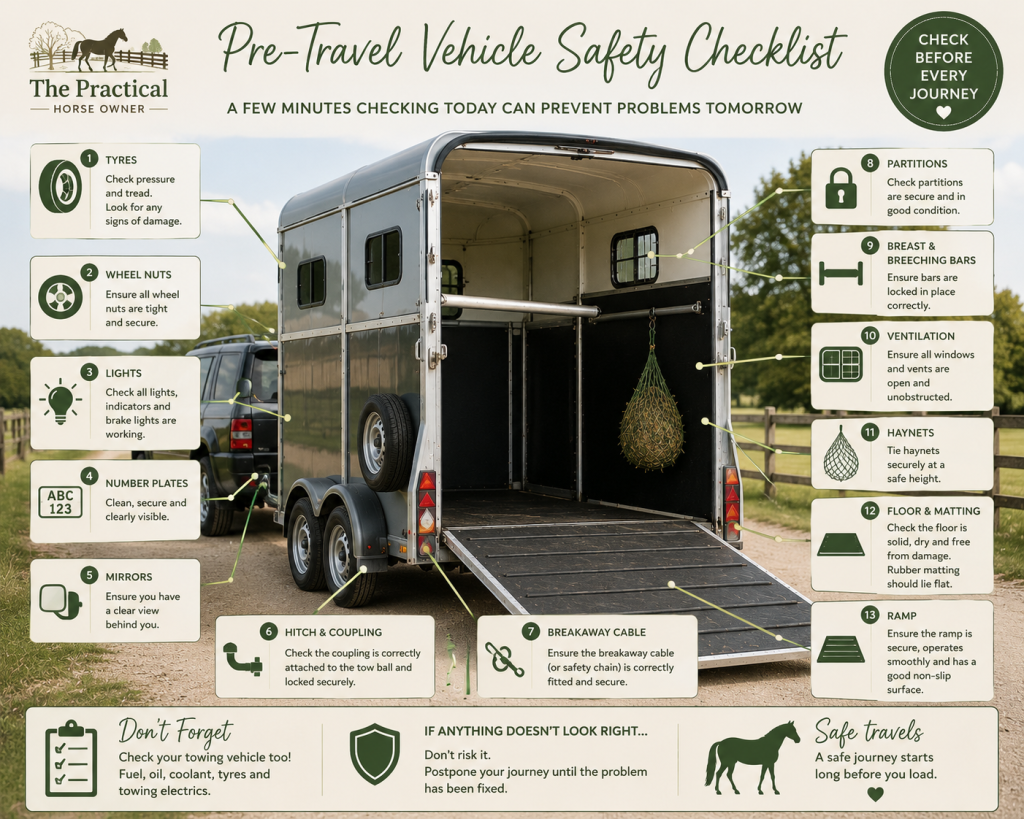
Before every journey, take a few minutes to inspect your trailer or horsebox. Regular checks help identify potential problems before they become serious and can improve the safety of both your horse and other road users.
Even if your vehicle is serviced regularly, it’s good practice to carry out a quick inspection before every trip—especially if it hasn’t been used for a while.
Exterior Checks
Walk around your trailer or horsebox before loading your horse and look for anything that appears damaged, loose or out of place.
Check:
- Tyres are correctly inflated and have sufficient tread.
- Wheel nuts are secure.
- Lights, indicators and brake lights are working properly.
- Number plates are clean, secure and clearly visible.
- Mirrors provide a clear view behind your vehicle.
- The trailer coupling is correctly attached to the tow ball.
- The breakaway cable (or safety chain where appropriate) is correctly fitted.
- All doors, ramps and access hatches close and lock securely.
If anything looks damaged or doesn’t seem right, postpone the journey until the problem has been repaired.
Inside the Trailer or Horsebox
Once inside, make sure the travelling area is clean, secure and free from hazards.
Check that:
- The floor is solid, dry and free from signs of rot or corrosion.
- Rubber matting lies flat without curled edges or tears.
- Partitions are secure and correctly positioned.
- Breast bars and breeching bars are properly locked into place.
- Ramps have a non-slip surface and operate smoothly.
- Ventilation openings are unobstructed.
- Haynets are tied securely at a safe height.
- There are no sharp edges, loose fittings or protruding screws that could injure your horse.
Check Your Towing Vehicle
If you’re towing a trailer, don’t forget to inspect your towing vehicle as well.
Make sure:
- Fuel levels are sufficient for the journey.
- Oil and coolant levels are adequate.
- Tyres are in good condition.
- The vehicle is suitable for towing the weight of your trailer and horse.
- The towing electrics are connected and functioning correctly.
Inspect Your Horse’s Equipment
Before loading, check all of your horse’s travel equipment.
Look for signs of wear or damage, including:
- Headcollar.
- Lead rope.
- Travel boots or bandages.
- Tail guard (if used).
- Poll guard (if used).
- Rug or cooler (if appropriate for the weather).
Replace worn or damaged equipment before travelling, as broken straps or poorly fitting equipment can create unnecessary risks.
💡Practical Horse Owner Tip
A five-minute safety check before every journey can prevent hours of delays—and, more importantly, help keep both you and your horse safe. Making these checks part of your routine means you’re more likely to spot small problems before they become serious.
Pack Everything You’ll Need
Being well prepared can make your journey safer, more comfortable and far less stressful if unexpected situations arise.
While the equipment you need may vary depending on your destination and the length of your journey, there are some essentials that every horse owner should consider taking whenever they travel.
It’s also worth keeping many of these items permanently stored in your trailer or horsebox, so you’re always prepared for last-minute trips or emergencies.
Essential Documents
Before leaving, make sure you have any paperwork you may need.
This may include:
- Horse passport (a legal requirement in the UK when transporting your horse).
- Competition or event information.
- Veterinary referral documents (if applicable).
- Insurance details.
- Emergency contact numbers.
Horse Equipment
Pack everything your horse will need throughout the journey.
Consider taking:
- Headcollar and lead rope.
- Spare headcollar and lead rope.
- Travel boots or bandages (if your horse travels in them).
- Tail guard (if used).
- Rug or cooler if appropriate for the weather.
- Haynet and suitable forage.
- Water and a clean bucket.
- Feed if you’ll be away for an extended period.
- Grooming kit.
- Droppings fork and broom for cleaning up after your horse.
- Tack if needed at your destination.
- Your riding equipment if needed at your destination.
Emergency Equipment
It’s always better to have emergency supplies and not need them than to need them and not have them.
Consider carrying:
- A well-stocked equine first aid kit.
- Human first aid kit.
- High-visibility clothing.
- Torch with spare batteries.
- Mobile phone and portable charger.
- Spare trailer light bulbs (if applicable).
- Basic toolkit.
- Spare wheel and jack (where appropriate).
- Warning triangle (where legally permitted and safe to use).
- Fire extinguisher.
For Longer Journeys
If you’re travelling for several hours or staying away overnight, you may also need:
- Extra hay and feed.
- Additional water.
- Stable equipment.
- Bedding (if staying overnight).
- Buckets for feed and water.
- Mucking out equipment.
- Rugs suitable for changing weather conditions.
- Electrolytes if recommended by your veterinarian.
💡Practical Horse Owner Tip
Keep a travel checklist inside your trailer or horsebox. After each trip, replace anything you’ve used so you’re always ready for the next journey. A few minutes of preparation at home can save a lot of stress later.
Plan Your Journey
Taking a few minutes to plan your journey before setting off can help reduce stress, avoid unnecessary delays and make travelling a safer experience for both you and your horse.
Rushing to leave or dealing with unexpected problems on the road can increase stress levels for both horse and handler. A little preparation beforehand can make all the difference.
Plan Your Route
Before you leave, decide on the safest and most suitable route to your destination.
Consider:
- Checking for roadworks, road closures or major traffic delays.
- Avoiding particularly narrow lanes or low bridges where possible.
- Choosing routes with good road surfaces and fewer sharp bends.
- Saving your destination in your sat nav or mobile phone before you leave.
- Having the destination’s contact number readily available in case you’re delayed.
If you’re travelling somewhere unfamiliar, it can also be helpful to look at the route in advance using satellite or street view to identify any potential access issues.
Allow Plenty of Time
Always allow extra time for your journey.
Leaving early means you can:
- Drive at a steady pace without feeling rushed.
- Cope with unexpected traffic or diversions.
- Take breaks if needed on longer journeys.
- Arrive with enough time to unload your horse calmly.
A relaxed driver often results in a more relaxed horse.
Think About the Weather
Weather conditions can have a significant impact on travelling.
Before setting off, check the forecast and consider whether conditions are suitable.
Take extra care during:
- Heavy rain.
- Strong winds.
- Snow and ice.
- Extremely hot weather.
If severe weather is expected, it may be safer to postpone non-essential travel.
Plan for Longer Journeys
If you’ll be travelling for several hours, think ahead about where you may need to stop.
Consider:
- Safe places to pull over if necessary.
- Fuel stations along your route.
- Where your horse can be offered water during longer journeys.
- The location of veterinary practices or equine hospitals if you’re travelling a considerable distance.
Having a plan before you leave can help you stay calm if something unexpected happens.
Tell Someone Where You’re Going
If you’re travelling alone, it’s good practice to let a friend or family member know:
- Where you’re going.
- Your planned route.
- Your expected arrival time.
If you’re delayed or experience difficulties, someone will know where you should be.
Don’t rely solely on your sat nav—always sense-check the route before you leave
💡Practical Horse Owner Tip
Before you pull away, take one final walk around your vehicle. Check that ramps and doors are securely closed, the hitch is locked, lights are working and your horse is settled before beginning your journey. One last look only takes a few seconds and can help prevent avoidable mistakes.
Choosing Suitable Travel Protection
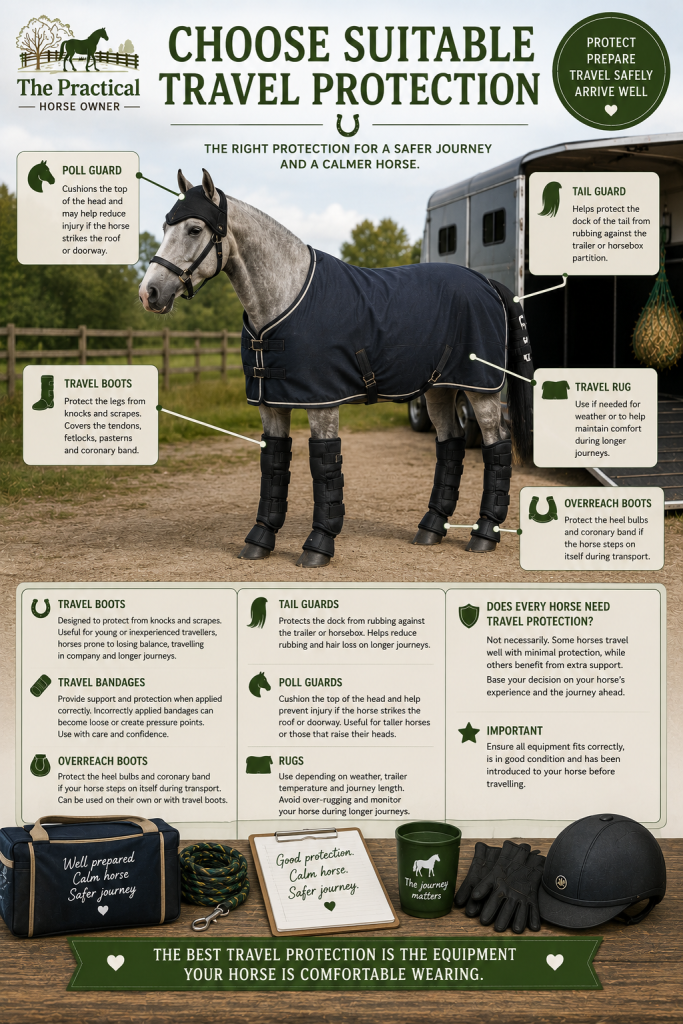
Many horse owners choose to use protective equipment when travelling to help reduce the risk of injury. However, not every horse requires the same level of protection, and what works well for one horse may not be suitable for another.
The most important consideration is that any equipment fits correctly and that your horse is familiar and comfortable wearing it before travelling.
Introducing new travel equipment immediately before a journey can cause unnecessary stress and may affect your horse’s balance or confidence. Always try equipment at home first to allow your horse to get used to them before you travel them.
Travel Boots
Travel boots are designed to protect a horse’s legs from knocks and scrapes while travelling.
Most travel boots extend from below the knee or hock down to the hoof, offering protection to the tendons, fetlocks, pasterns and coronary band.
Travel boots may be particularly useful for:
- Young or inexperienced travellers.
- Horses that are prone to scrambling or losing their balance.
- Horses travelling in company.
- Longer journeys.
Some horses, however, find bulky travel boots restrictive and may initially walk awkwardly while wearing them. Allow your horse plenty of time to become accustomed to them before travelling.
Travel Bandages
Some owners prefer to use travel bandages instead of travel boots.
When applied correctly, travel bandages can provide support and protection to the lower limbs.
However, incorrectly applied bandages may become loose, create pressure points or even increase the risk of injury. If you are not confident applying travel bandages, travel boots are often the simpler and safer option.
Overreach Boots
Overreach boots help protect the heel bulbs and coronary band from injury if a horse accidentally stands on its own feet during transport.
Some owners choose to use overreach boots alone, while others use them alongside travel boots for additional protection.
Tail Guards
A tail guard helps protect the dock of the tail from rubbing against the trailer or horsebox partition during transport.
For horses with long or full tails, a tail guard may also help reduce rubbing and hair loss on longer journeys.
Poll Guards
Some horses naturally raise or throw their heads while loading or travelling.
A poll guard provides cushioning over the top of the head and may help reduce injury if the horse strikes the roof or doorway.
Poll guards are particularly useful for taller horses or those that have previously bumped their heads during transport.
Rugs
Whether your horse needs a rug depends on several factors, including:
- The weather.
- The temperature inside the trailer or horsebox.
- The length of the journey.
- Your horse’s individual needs.
Horseboxes and trailers can become surprisingly warm, even on cooler days. Avoid over-rugging, and regularly monitor your horse during longer journeys if it is safe to do so.
Does Every Horse Need Travel Protection?
Not necessarily.
Some experienced travellers remain calm and balanced throughout a journey and may travel comfortably with minimal protection. Others benefit from additional protective equipment.
The decision should be based on your individual horse, their previous travelling experience and the type of journey you’re undertaking.
Whatever equipment you choose, ensure it fits correctly, is in good condition and has been introduced to your horse before travelling.
💡Practical Horse Owner Tip
Never put travel boots, bandages or other protective equipment on your horse for the first time immediately before a journey. Let your horse wear them at home first so they can become familiar with how they feel.
Preparing Your Horse Mentally
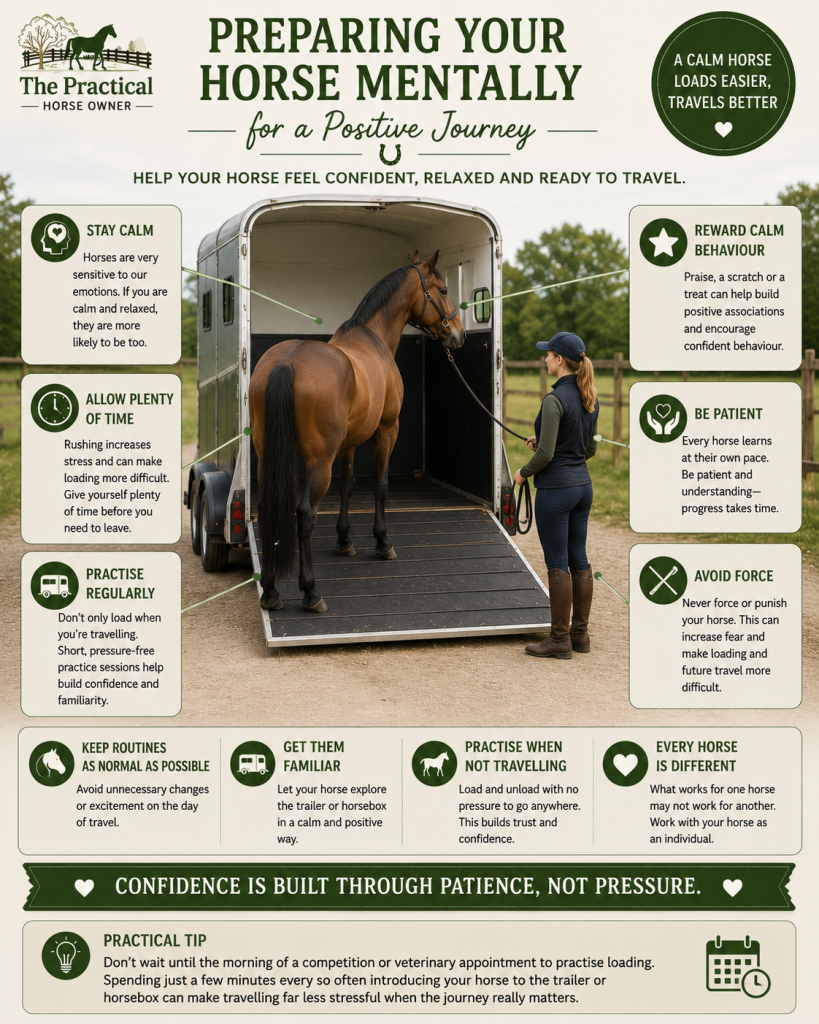
Preparing your horse mentally is just as important as preparing your vehicle or packing your equipment. Horses are naturally cautious animals, and unfamiliar situations or rushed handling can quickly lead to anxiety.
By keeping your horse relaxed and allowing plenty of time, you can help create a more positive travelling experience for both of you.
Keep Your Routine Calm
Horses often take confidence from familiar routines.
On the day of travel, try to keep your horse’s routine as normal as possible. Avoid rushing, making sudden changes or creating unnecessary excitement around the yard.
If you remain calm and organised, your horse is more likely to stay relaxed too.
Allow Plenty of Time
One of the most common mistakes owners make is leaving loading until the last minute.
Allow yourself plenty of time before you need to leave. If your horse is hesitant to load, feeling rushed can increase frustration and make the experience more stressful for everyone involved.
Planning ahead means you can work patiently and avoid putting unnecessary pressure on your horse.
Help Your Horse Become Familiar with the Trailer or Horsebox
If your horse is inexperienced or lacks confidence, spend time allowing them to investigate the trailer or horsebox without the expectation of travelling.
Simple sessions can include:
- Walking calmly around the vehicle.
- Standing quietly near the ramp.
- Walking onto and off the ramp.
- Exploring the inside without closing partitions or travelling.
These short, positive experiences can help build confidence over time.
Practise Loading When You’re Not Going Anywhere
Loading practice shouldn’t only happen when you need to travel.
Regular short sessions with no pressure to leave can help your horse view the trailer or horsebox as a normal part of everyday life rather than something to fear.
Many experienced owners find that occasional practice sessions make future journeys much easier.
Reward Calm Behaviour
Whenever your horse remains calm or makes progress, reward them with praise, a scratch in their favourite spot or another form of positive reinforcement that they enjoy.
Building positive associations can help increase your horse’s confidence over time.
Avoid Punishment
If your horse becomes worried or refuses to load, avoid shouting, hitting or forcing them forwards.
Punishment can increase fear and make future loading more difficult.
Instead, remain patient, work at your horse’s pace and consider seeking guidance from a qualified trainer or behaviourist if loading problems persist.
Every Horse Learns Differently
Some horses will walk onto a trailer or horsebox with very little encouragement, while others may need more time to develop confidence.
Be patient and work with your horse as an individual. Progress may take time, but building confidence gradually is far more effective than rushing the process.
💡Practical Horse Owner Tip
Don’t wait until the morning of a competition or veterinary appointment to practise loading. Spending just a few minutes every so often introducing your horse to the trailer or horsebox can make travelling far less stressful when the journey really matters.
Loading Your Horse Safely
Loading your horse should never feel like a race against the clock. By staying calm, allowing plenty of time and putting safety first, you can help make loading a positive experience for both you and your horse.
Every horse is different. Some will walk straight on, while others may need more reassurance. Patience and consistency are usually far more effective than rushing or using force.
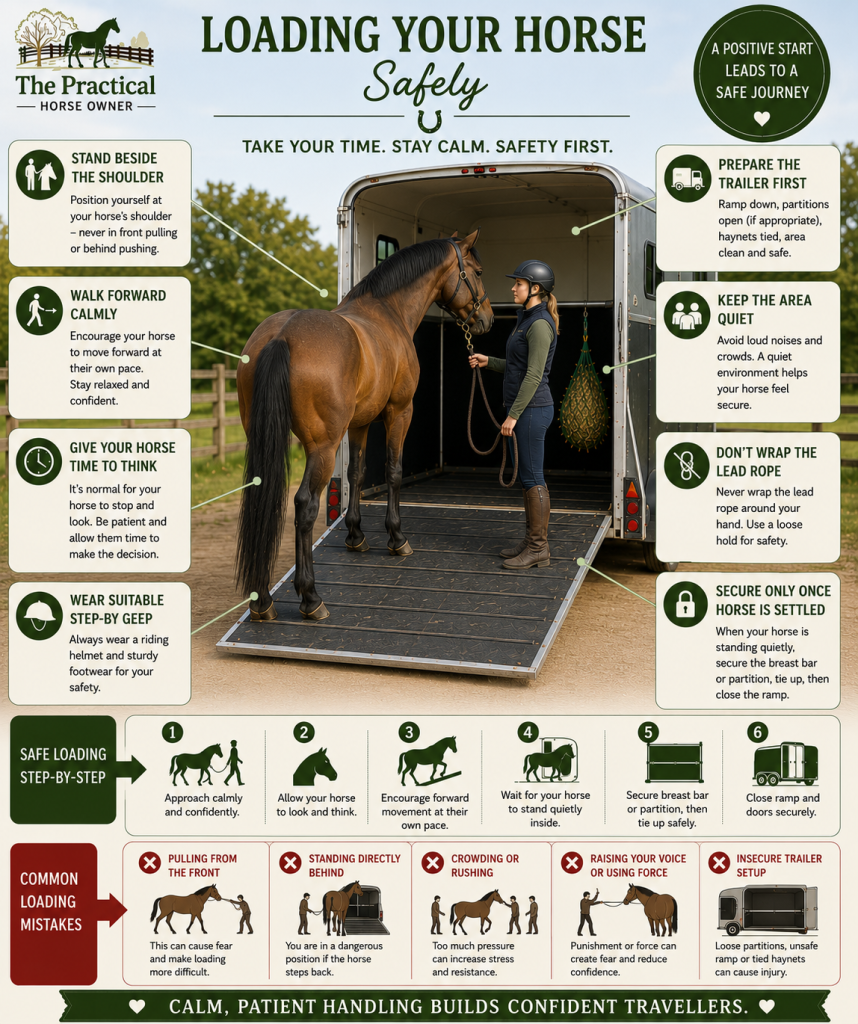
Prepare the Trailer or Horsebox
Before asking your horse to load, make sure everything is ready.
Check that:
- The ramp is fully lowered and secure.
- Doors are safely positioned and won’t move unexpectedly.
- Partitions are open (if appropriate) to allow sufficient space.
- Haynets are securely tied before loading.
- The interior is well ventilated.
- There are no hazards inside the travelling area.
Having everything prepared means you can focus entirely on your horse.
Stay Calm and Confident
Horses are highly observant and often respond to our body language.
Walk confidently, breathe normally and avoid showing frustration if your horse hesitates.
A calm handler helps create a calm horse.
Lead Your Horse Forward
Walk positively towards the ramp, encouraging your horse to move forwards at their own pace.
Avoid:
- Pulling continuously on the lead rope.
- Standing directly behind your horse.
- Shouting or waving equipment.
- Allowing several people to crowd around the horse.
Give your horse time to think and investigate if they hesitate.
Let Your Horse Think
It’s perfectly normal for a horse to stop and look at the trailer.
Allow them a moment to process what they’re seeing before asking them to move forwards again.
Many horses load more confidently when they don’t feel pressured.
Once Your Horse Is Loaded
When your horse is standing quietly inside:
- Ask them to stand calmly before rushing to fasten anything.
- Secure the breast bar or partition first (following your trailer or horsebox manufacturer’s instructions).
- Then attach the lead rope using a suitable quick-release knot or safety tie.
- Finally, close the ramp and any remaining doors securely.
Following the same routine every time helps create consistency.
Never Put Yourself at Risk
Your safety is just as important as your horse’s.
Avoid:
- Standing underneath your horse’s neck while loading.
- Wrapping the lead rope around your hand.
- Standing directly behind the horse.
- Climbing into confined spaces if your horse is becoming distressed.
If you ever feel unsafe, stop and reassess the situation.
If Your Horse Refuses to Load
If your horse becomes anxious or refuses to load:
- Stay calm.
- Give them time to relax.
- Return to a previous step if necessary.
- Avoid punishment or force.
If loading difficulties continue despite patient training, seek advice from a qualified trainer or behaviourist experienced in positive loading techniques.
💡Practical Horse Owner Tip
Consistency builds confidence. Following the same calm loading routine every time helps your horse understand what to expect, making future journeys easier for both of you.
During the Journey
Once your horse is safely loaded and you’re ready to set off, your driving style plays an important role in their comfort and safety.
Unlike people, horses constantly adjust their balance while travelling. Every acceleration, corner and stop requires them to shift their weight to stay upright. Smooth, considerate driving helps reduce unnecessary movement and makes the journey more comfortable.
Drive Smoothly
Aim to drive as smoothly as possible throughout the journey.
This means:
- Accelerating gradually.
- Braking gently.
- Taking corners slowly.
- Avoiding sudden lane changes where possible.
- Leaving plenty of space between you and the vehicle in front.
Imagine your horse is trying to balance on four feet without being able to hold onto anything—that’s exactly what they’re doing.
Take Corners Carefully
Sharp bends and roundabouts can be particularly challenging for horses.
Reduce your speed well before entering a corner and steer smoothly through it.
This gives your horse time to adjust their balance and reduces the risk of scrambling.
Brake Early
Sudden braking can cause your horse to lose balance and stumble forwards.
Whenever possible:
- Look well ahead.
- Anticipate traffic.
- Slow down gradually.
Defensive driving benefits both you and your horse.
Leave Extra Space
Travelling with a horse requires more stopping distance than driving a car alone.
Leaving a larger gap between you and the vehicle ahead gives you more time to react and reduces the need for harsh braking.
Monitor Your Horse on Longer Journeys
If you’re travelling for several hours, stop periodically in a safe location to check your horse.
When it is safe to do so:
- Check your horse appears calm.
- Offer water if appropriate.
- Ensure haynets remain secure.
- Check travel equipment hasn’t shifted.
- Look for signs of excessive sweating or distress.
Avoid opening ramps or unloading your horse at the roadside unless absolutely necessary and it is safe to do so.
In the UK, the law states that a horse can travel for a maximum of 24 hours, and must be given a rest stop with water offered and feed (if needed) at least every 8 hours. If fed, you should wait 30-60 mins before resuming travel.
Avoid Unnecessary Stops
Frequent stopping and starting can make balancing more difficult for your horse.
Where possible, maintain a steady speed and avoid unnecessary interruptions to the journey.
Be Prepared for the Unexpected
Even well-planned journeys can encounter delays due to traffic, roadworks or accidents.
Remain patient and avoid rushing to make up lost time.
Your horse will benefit far more from calm, consistent driving than arriving a few minutes earlier.
💡Practical Horse Owner Tip
Drive as though you’re carrying a full glass of water on your dashboard. Smooth acceleration, gentle braking and steady cornering are usually far more comfortable for your horse than quick movements or sudden changes in speed.
Arriving Safely
Once you’ve reached your destination, it’s tempting to unload your horse straight away and get on with the day. However, taking a few moments to prepare before opening the trailer or horsebox can help ensure unloading is calm, safe and stress-free.
Just like loading, unloading should never be rushed.
Park in a Safe Location
Before unloading your horse, choose a suitable place to park.
Ideally, the area should be:
- Level and stable underfoot.
- Free from moving traffic.
- Quiet and free from unnecessary distractions.
- Large enough for your horse to walk safely away from the trailer or horsebox.
If you’re attending a competition or event, follow any designated unloading areas provided by the organisers.
Prepare Before Opening the Ramp
Before lowering the ramp, take a moment to make sure everything is ready.
Check that:
- There is enough space behind the trailer or horsebox.
- Other horses or people won’t be walking behind the ramp.
- Your horse appears calm before unloading.
- You have your lead rope ready.
Being organised helps avoid unnecessary rushing once the ramp is open.
Unload Calmly
When it’s time to unload, follow the unloading procedure recommended by your trailer or horsebox manufacturer.
In general:
- Open the rear ramp, exit ramp or doors safely.
- Release the breast bar or partition as appropriate before asking your horse to step backwards or forwards. (Always follow the manufacturer’s instructions for your vehicle.)
- Lead your horse calmly and allow them to step down at their own pace.
- Stand beside your horse’s shoulder rather than directly behind them.
Avoid pulling your horse or rushing them off the ramp.
Check Your Horse
Once your horse is safely unloaded, carry out a quick health check.
Look for:
- Cuts or scrapes.
- Swelling.
- Rubs caused by travel equipment.
- Lost shoes.
- Excessive sweating.
- Signs of stiffness or discomfort.
Spotting small problems early can prevent them becoming more serious.
Offer Water
Many horses will appreciate the opportunity to drink after travelling, particularly following longer journeys or in warm weather.
Offer clean, fresh water as soon as it is practical to do so.
Some horses are reluctant to drink away from home, so bringing water from home or gradually introducing different water sources can sometimes help.
Give Your Horse Time to Relax
Allow your horse a few minutes to settle before expecting them to work or continue with the day’s activities.
Walking quietly in hand can help them relax after the journey and gives you another opportunity to observe how they’re moving.
Check Your Equipment
Before leaving the trailer or horsebox unattended, take a quick look inside.
Check that:
- Haynets haven’t become tangled.
- Equipment hasn’t shifted during transport.
- Partitions and fittings remain secure.
- The trailer or horsebox hasn’t suffered any damage during the journey.
Regular inspections help keep your vehicle safe for future trips.
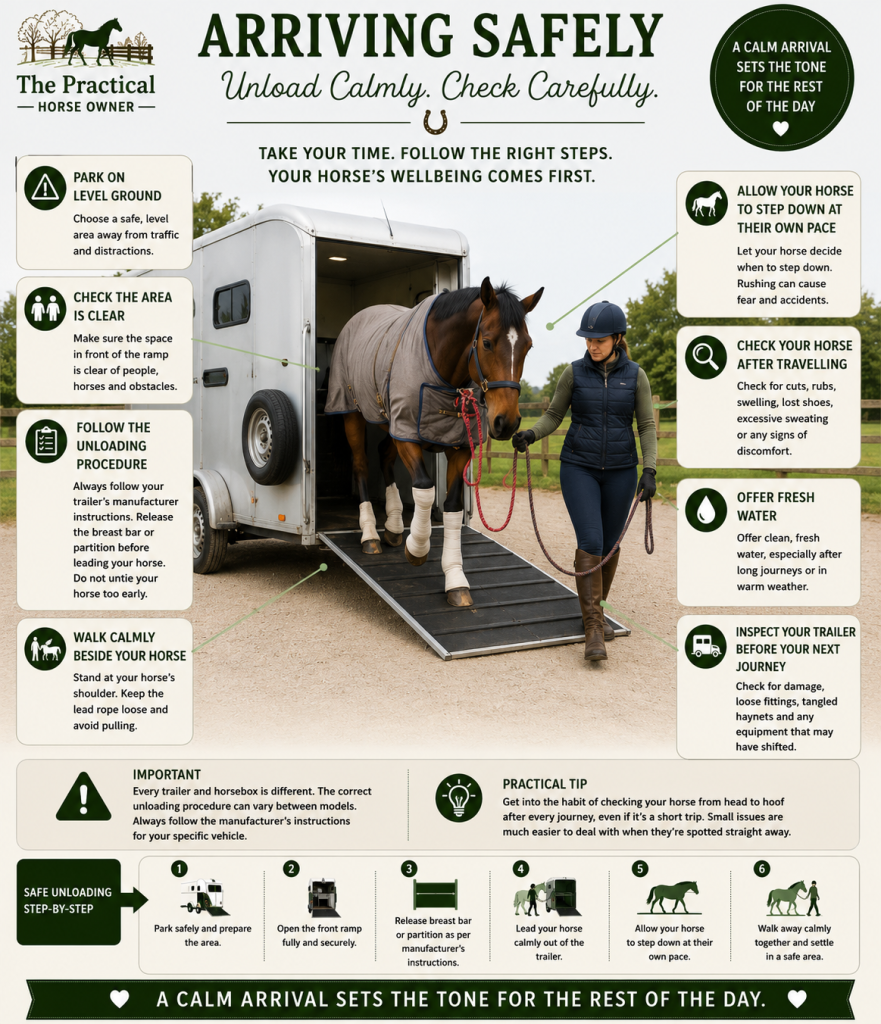
💡Practical Horse Owner Tip
Get into the habit of checking your horse from head to hoof after every journey, even if they’ve only travelled a short distance. Small cuts, loose travel boots or a missing shoe are much easier to deal with when they’re spotted straight away.
Long-Distance Travel
While many journeys only last a short time, there may be occasions when you need to travel several hours to reach a competition, training event, breeding facility or veterinary hospital. Longer journeys require additional planning to help keep your horse comfortable, hydrated and healthy throughout the trip.
By preparing in advance and monitoring your horse regularly, you can help reduce fatigue and minimise the risks associated with prolonged transport.
Plan Regular Stops
For longer journeys, plan your route so you know where you can stop safely if needed.
When choosing stopping locations, look for places that:
- Are away from busy traffic.
- Have enough space to park safely.
- Allow you to check your horse without causing an obstruction.
- Are suitable for larger towing vehicles or horseboxes.
Avoid stopping unnecessarily, but don’t hesitate to pull over safely if you have concerns about your horse or vehicle.
Offer Water Regularly
Travelling can increase the risk of dehydration, particularly during warm weather or on longer journeys.
Offer your horse clean, fresh water during planned stops where appropriate.
Some horses are reluctant to drink away from home. Bringing water from home or flavouring water consistently before travel can sometimes encourage reluctant drinkers.
Watch for signs of dehydration, including:
- Dry or tacky gums.
- Reduced skin elasticity.
- Dull appearance.
- Reduced interest in drinking.
Monitor Ventilation
Good airflow is essential throughout the journey.
Keep ventilation openings clear while avoiding excessive draughts directly onto your horse.
Poor ventilation can increase the risk of overheating and may contribute to respiratory problems, particularly during longer journeys.
Travel in Suitable Weather
Hot weather presents additional challenges for horses during transport.
If possible:
- Travel during the cooler parts of the day.
- Avoid unnecessary delays in stationary traffic.
- Check your horse more frequently.
- Ensure adequate ventilation throughout the journey.
In cold weather, avoid over-rugging. Horses often generate heat while travelling, and trailers and horseboxes can become warmer than expected.
Watch for Signs of Fatigue or Stress
During longer journeys, keep an eye out for signs that your horse may be becoming tired or uncomfortable.
These may include:
- Excessive sweating.
- Heavy breathing.
- Restlessness or scrambling.
- Reluctance to eat or drink.
- Signs of dehydration.
If you’re concerned about your horse’s condition, seek veterinary advice before continuing your journey.
Biosecurity Matters
If you’re travelling to competitions, clinics or equestrian centres, remember that your horse may come into contact with many others.
Simple biosecurity measures can help reduce the risk of spreading infectious diseases.
These include:
- Avoiding sharing water buckets or equipment.
- Using your own grooming kit.
- Cleaning and disinfecting your trailer or horsebox regularly.
- Monitoring your horse for signs of illness after returning home.
Travel Recovery
Once you’ve reached your destination, allow your horse time to recover before expecting them to perform.
Depending on the length of the journey, this may include:
- Offering water.
- Allowing access to forage.
- Walking quietly in hand.
- Giving your horse time to relax before exercise.
- Checking for any signs of injury, stiffness or dehydration.
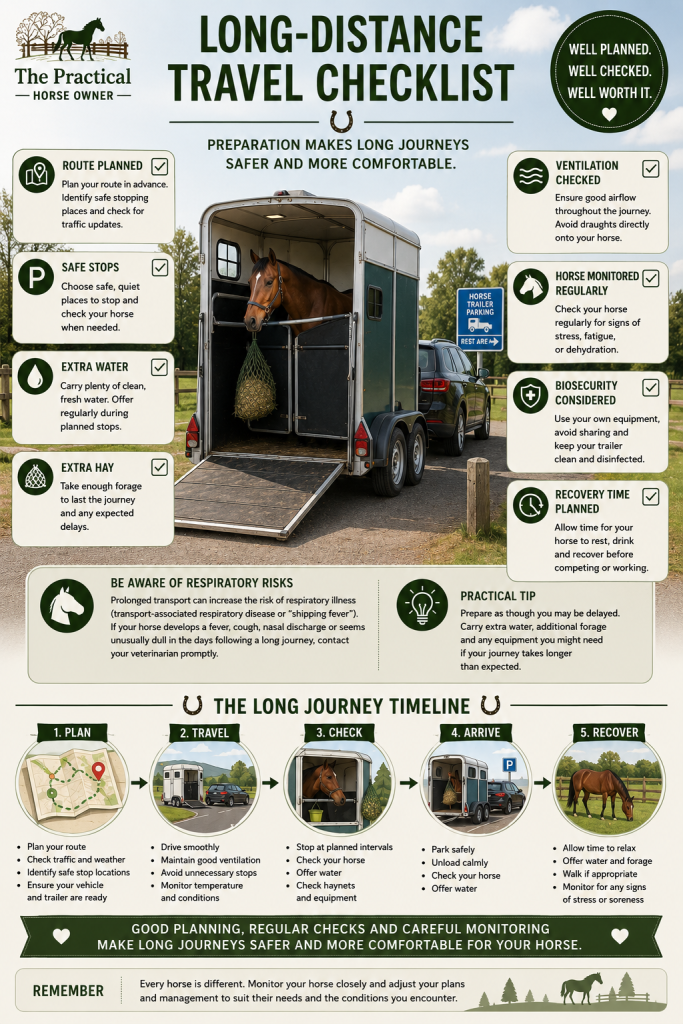
💡Practical Horse Owner Tip
For journeys lasting several hours, prepare as though you may be delayed. Carry extra water, additional forage and any equipment you might need if your journey takes longer than expected.
Common Travelling Problems
Not every horse will travel confidently from the outset. Some may become anxious when loading, while others may scramble, sweat or refuse to eat and drink during a journey.
Understanding why these behaviours occur is the first step towards helping your horse travel more comfortably and safely.
Horse Won’t Load
Reluctance to load is one of the most common travelling problems.
Possible reasons include:
- Previous negative experiences.
- Fear of confined spaces.
- Lack of confidence.
- Feeling rushed.
- Pain or discomfort.
- Inexperience.
What You Can Do
- Allow plenty of time.
- Stay calm and patient.
- Break loading into small, achievable steps.
- Reward calm behaviour.
- Practise loading regularly without travelling.
- Seek help from a qualified trainer or behaviourist if problems persist.
Avoid forcing your horse onto the trailer or horsebox, as this can increase fear and make future loading more difficult.
Scrambling During Travel
Some horses lose their balance during transport, particularly when accelerating, braking or cornering.
Possible reasons include:
- Sudden or harsh driving.
- Poor balance.
- Inexperience.
- Ill-fitting partitions.
- Travelling alongside an incompatible horse.
What You Can Do
- Drive as smoothly as possible.
- Ensure partitions are correctly adjusted.
- Allow your horse enough space to balance.
- Review your travel protection.
- If the problem continues, discuss it with your veterinarian to rule out pain or underlying health issues.
Excessive Sweating
Sweating during travel can occur for several reasons.
Possible causes include:
- Warm weather.
- Stress or anxiety.
- Poor ventilation.
- Over-rugging.
- Long journeys.
What You Can Do
- Improve ventilation.
- Avoid over-rugging.
- Travel during cooler parts of the day when possible.
- Monitor your horse closely.
- Contact your veterinarian if sweating is excessive or accompanied by signs of illness.
Refusing to Eat or Drink
Some horses are reluctant to eat or drink while travelling or after arriving at a new destination.
What You Can Do
- Offer familiar forage.
- Bring water from home if possible.
- Allow your horse time to settle.
- Monitor for signs of dehydration during longer journeys.
Calling or Becoming Anxious
Some horses become unsettled when travelling away from companions.
Possible reasons include:
- Separation anxiety.
- Unfamiliar surroundings.
- Lack of travelling experience.
What You Can Do
- Build confidence through regular practice.
- Keep your routine calm and consistent.
- Consider travelling with a suitable companion if appropriate and safe.
Pawing or Kicking
Occasional movement is normal as horses adjust their balance, but repeated kicking or pawing may indicate discomfort or stress.
Possible causes include:
- Anxiety.
- Boredom.
- Poor balance.
- Inadequate ventilation.
- Underlying pain.
What You Can Do
- Review your driving style.
- Check the trailer setup.
- Ensure good ventilation.
- If the behaviour develops suddenly or worsens, seek veterinary advice.
Travel Sickness or Illness
Although uncommon, some horses may become unwell after travelling, particularly following long journeys.
Watch for:
- Fever.
- Nasal discharge.
- Coughing.
- Loss of appetite.
- Lethargy.
If your horse develops these signs after travelling, contact your veterinarian promptly.
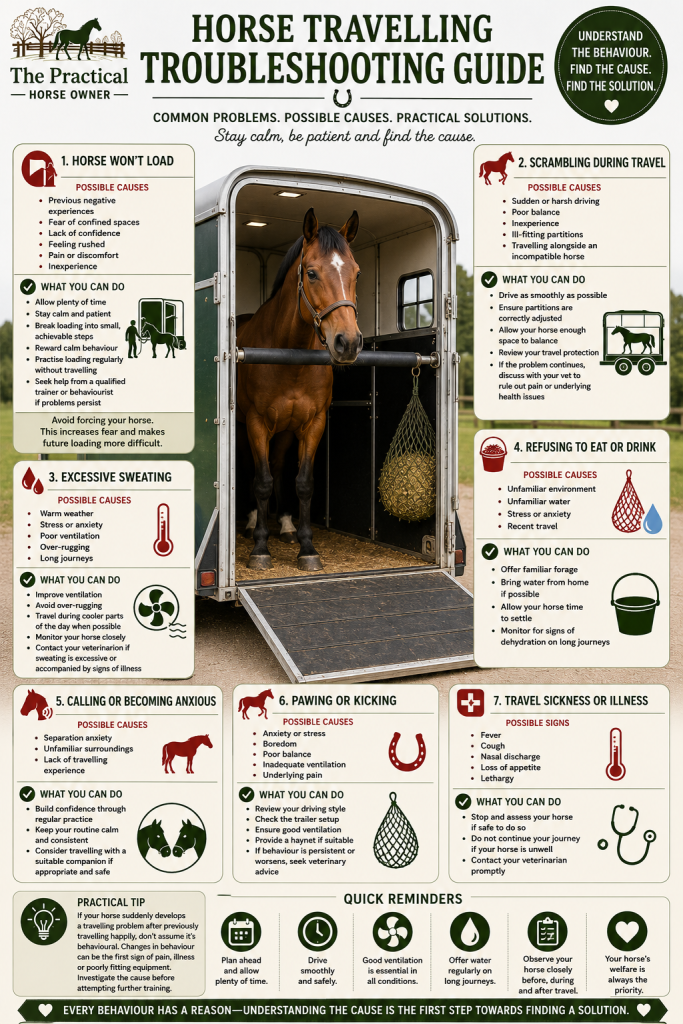
💡Practical Horse Owner Tip
If your horse suddenly develops a travelling problem after previously travelling happily, don’t assume it’s a behavioural issue. Changes in behaviour can sometimes be the first sign of pain, illness or poorly fitting equipment, so it’s worth investigating the cause before attempting further training.
Emergency Situations
Even with careful planning and preparation, emergencies can sometimes happen while travelling. Knowing how to respond calmly and safely can help protect both you and your horse.
Your first priority should always be the safety of yourself, your passengers and other road users. Once everyone is safe, you can then assess your horse and the situation.
If Your Vehicle Breaks Down
Breaking down can be stressful, particularly when travelling with a horse. If your vehicle develops a fault:
- Pull over in a safe location if possible.
- Turn on your hazard warning lights.
- Contact your breakdown provider.
- Explain that you are travelling with a horse so they understand the urgency and can send appropriate assistance.
- Stay calm and keep your horse inside the trailer or horsebox unless there is an immediate danger.
In most situations, horses are safer remaining inside the trailer or horsebox than being unloaded beside a busy road.
If You Have a Tyre Puncture or Blowout
A puncture or tyre blowout can affect the stability of your vehicle and trailer.
If this happens:
- Hold the steering wheel firmly.
- Slow down gradually.
- Avoid harsh braking or sudden steering.
- Pull over safely when possible.
- Assess the situation from a safe location away from traffic.
Do not attempt to change a tyre unless it is safe to do so.
If Your Horse Becomes Distressed
Some horses may become anxious, begin scrambling or show signs of distress during transport.
If it is safe:
- Pull over at the earliest suitable location.
- Listen for any unusual noises from the trailer or horsebox.
- Check your horse without putting yourself at risk.
- Avoid unloading beside the road unless absolutely necessary.
If your horse appears injured or severely distressed, contact your veterinarian for advice.
If You’re Involved in a Road Traffic Collision
Remain as calm as possible.
Your priorities should be:
- Ensure everyone is safe.
- Contact the emergency services if required.
- Warn other road users if it is safe to do so.
- Keep your horse inside the trailer or horsebox unless instructed otherwise by the emergency services or there is an immediate danger such as fire.
Emergency responders are trained to deal with incidents involving animals and will work with you to decide the safest course of action.
If Your Horse Needs Urgent Veterinary Attention
If your horse becomes seriously ill or injured during a journey:
- Contact your veterinarian immediately.
- Follow their advice.
- If directed, travel to the nearest veterinary practice or referral hospital.
- Avoid unnecessary delays.
Prompt veterinary treatment is often the most important priority.
Prepare Before Every Journey
Being prepared can make emergencies easier to manage.
Before setting off, ensure you have:
- Your mobile phone fully charged.
- Your horse’s passport.
- Emergency contact numbers.
- Veterinary contact details.
- Breakdown cover suitable for towing or horse transport.
- A human and equine first aid kit.
- High-visibility clothing.
- A torch.
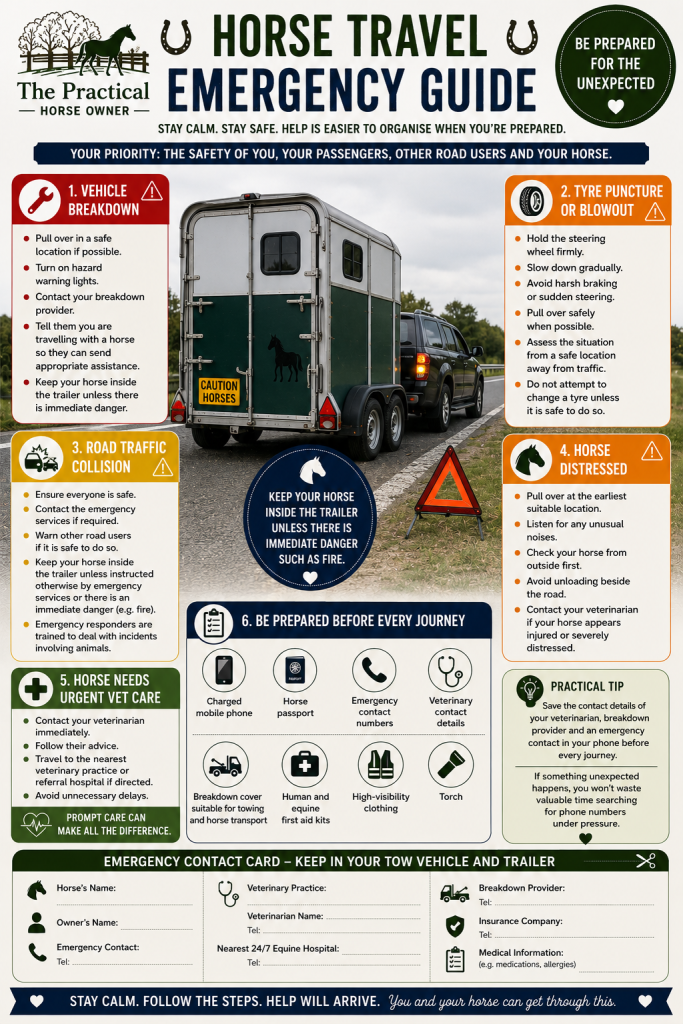
💡Practical Horse Owner Tip
Save the contact details of your veterinarian, breakdown provider and an emergency contact in your phone before every journey. If something unexpected happens, you won’t waste valuable time searching for phone numbers under pressure.
Myths VS Facts
| Myths | Facts |
|---|---|
| Every horse must wear travel boots. | Not all horses require travel boots. Some horses travel comfortably without leg protection, while others benefit from travel boots, travel bandages or overreach boots. The best choice depends on your horse’s experience, behaviour and the type of journey. Whatever equipment you choose, it should fit correctly and your horse should be familiar with wearing it before travelling. |
| Horses should always wear a rug when travelling. | Not necessarily. Trailers and horseboxes can become surprisingly warm, even on cool days. Over-rugging may increase the risk of overheating. Choose a rug based on the weather, journey length, ventilation and your individual horse’s needs. |
| Horses should never travel facing backwards. | Many horses travel comfortably when travelling rear-facing, and some research suggests that rear-facing horses may find it easier to balance during transport. The most suitable orientation depends on the type of transport available and your horse’s individual preferences. |
| If a horse loads once, the problem is solved. | Loading confidence is built over time. A horse that loads successfully today may still need regular practice to maintain confidence, particularly if they have previously had negative experiences. Consistent, calm handling is far more effective than assuming one successful journey has permanently solved the problem. |
| A horse that sweats during travel is always too hot. | Not always. Sweating may occur because of: Warm weather. Stress or anxiety. Poor ventilation. Long journeys. Physical effort required to maintain balance. Consider the whole picture before assuming overheating is the only cause. |
| Travelling is only stressful for nervous horses. | Every horse works to maintain balance during transport. Even experienced travellers use considerable muscle effort throughout a journey. Smooth driving, good ventilation and careful planning benefit every horse—not just those that appear anxious. |
| Travelling sedated makes transport safer. | Sedation should only be used under veterinary advice. Sedated horses often have reduced balance and coordination, which may actually make travelling more difficult and increase the risk of injury. |
Frequently Asked Questions
How often should I travel my horse?
There is no set limit on how often a horse can travel. Many competition horses travel regularly without problems. The key is to ensure your horse is fit to travel, journeys are well planned, and they have adequate time to rest and recover between trips.
Should I feed my horse before travelling?
Yes. Horses should have access to forage before and, where appropriate, during travel. Chewing forage encourages saliva production, which may help protect the stomach. However, avoid feeding large concentrate meals immediately before travelling.
Should my horse have access to hay during the journey?
For many journeys, providing forage can help keep horses occupied and encourage natural chewing behaviour. Ensure haynets are tied securely at a safe height and regularly checked during longer journeys when it is safe to do so.
How long can a horse safely travel?
This depends on the individual horse, the type of transport and the journey conditions. Longer journeys require careful planning, regular monitoring and appropriate rest. If you are undertaking extended transport, seek veterinary advice if you have any concerns.
How often should I stop on a long journey?
Plan suitable stopping points so you can safely check your horse, assess their wellbeing and offer water when appropriate. Always stop in safe locations designed for larger vehicles where possible.
Is it normal for horses to sweat during travel?
A small amount of sweating can be normal, particularly in warm weather or if a horse is anxious. Excessive sweating, however, may indicate stress, poor ventilation or another problem that should be investigated.
My horse won’t drink away from home. What should I do?
Some horses dislike unfamiliar water. Bringing water from home or gradually introducing different water sources before travelling can sometimes encourage drinking.
Should I use travel boots or bandages?
Either may be appropriate depending on your horse. The most important consideration is that the equipment fits correctly and your horse is comfortable wearing it before travelling.
Should every horse wear a rug?
Not necessarily. Choose rugs according to the weather, trailer temperature, journey length and your horse’s individual needs. Avoid over-rugging.
Is it safe to sedate a horse for travelling?
Sedation should only be used under the advice of your veterinarian. Sedated horses may have reduced balance and coordination, which can increase the risk of injury during transport.
My horse refuses to load. What should I do?
Stay calm and avoid using force. Break the process into smaller steps, reward calm behaviour and practise loading regularly without travelling. If problems persist, seek help from a qualified trainer or behaviourist.
What should I do if my horse becomes distressed during a journey?
Pull over at the first safe opportunity, assess the situation and contact your veterinarian if necessary. Avoid unloading beside a busy road unless there is an immediate danger.
Should I unload my horse if my vehicle breaks down?
In most situations, no. Horses are usually safer remaining inside the trailer or horsebox until assistance arrives. Only unload if there is an immediate danger, such as fire, or if instructed by the emergency services.
Can horses travel alone?
Yes. Many horses travel perfectly happily on their own, while others feel more confident with a travelling companion. Every horse is different.
How do I know if my horse has travelled well?
After unloading, check your horse for cuts, swelling, rubbing from travel equipment, excessive sweating, stiffness or signs of discomfort. Monitor them over the following hours for any changes in behaviour or health.
What documents should I take when travelling?
In the UK, horses must generally travel with their passport. Depending on your journey, you may also need competition information, insurance details or veterinary referral documents.
Can I travel a horse with an injury?
This depends on the nature of the injury. Routine travel should usually be postponed if a horse is injured. However, if your veterinarian advises transport to a veterinary hospital or referral centre, their advice should always be followed.
How can I make travelling less stressful?
Preparation is key. Keep routines calm, allow plenty of time, drive smoothly and practise loading regularly so travelling becomes a familiar experience.
Why do horses scramble during travel?
Scrambling may occur because of sudden driving movements, poor balance, ill-fitting partitions, lack of experience or underlying discomfort. If the behaviour persists, consult your veterinarian.
Should I clean my trailer after every journey?
Yes. Regular cleaning helps maintain hygiene, reduces the spread of disease and allows you to inspect the trailer for damage or worn equipment before your next journey.
How can I reduce the risk of disease when travelling?
Avoid sharing equipment, use your own water buckets, clean and disinfect your trailer regularly and monitor your horse for signs of illness after returning home.
Is it safe to travel in hot weather?
It can be, provided suitable precautions are taken. Travel during cooler parts of the day where possible, ensure good ventilation and monitor your horse closely for signs of overheating or dehydration.
What should I keep in my trailer at all times?
Many owners keep a basic travel kit permanently stored in their trailer or horsebox. This may include a first aid kit, spare headcollar and lead rope, torch, high-visibility clothing, basic tools, water bucket and emergency contact details.
How do I prepare a young horse for travelling?
Introduce the trailer or horsebox gradually, allowing your horse to investigate it calmly. Practise loading without travelling and build confidence through short, positive sessions.
Can travelling make a horse ill?
Most horses travel without problems, but long journeys may increase the risk of dehydration, fatigue and transport-associated respiratory disease. Contact your veterinarian if your horse develops a fever, cough, nasal discharge or seems unusually unwell after travelling.
Glossary
Biosecurity – Measures taken to reduce the risk of spreading infectious diseases between horses, people and premises.
Breakaway Cable – A safety cable that connects a trailer to the towing vehicle. If the trailer becomes detached, the cable applies the trailer brakes to help bring it to a stop.
Coronary Band – The soft band of tissue located just above the hoof wall, responsible for producing new hoof growth.
Equine Referral Hospital – A specialist veterinary hospital that provides advanced diagnostics, surgery and treatment for horses requiring more complex care.
Horsebox – A motor vehicle specifically designed to transport horses.
Loading – The process of asking a horse to enter a trailer or horsebox before transport.
Overreach Boots – Protective boots worn around the horse’s heel bulbs and coronary band to help prevent injuries caused by overreaching.
Partition – An internal divider within a trailer or horsebox that separates horses and helps provide support during transport.
Poll Guard – Protective padding fitted over the horse’s poll to help reduce the risk of injury if they strike their head during loading or transport.
Referral – When a veterinarian recommends that a horse is examined or treated by a specialist veterinary hospital.
Shipping Fever – A term commonly used to describe transport-associated respiratory disease that can develop after prolonged journeys.
Tow Vehicle – The vehicle used to pull a horse trailer.
Trailer Coupling – mechanism that securely connects the trailer to the towing vehicle’s tow ball.
Trailer – A non-powered vehicle designed to be towed behind another vehicle for transporting horses.
Travel Bandages – Bandages applied to a horse’s legs to provide protection during transport. They should only be used by those confident in applying them correctly.
Travel Boots – Protective boots designed specifically for travelling. They usually extend from below the knee or hock to the hoof, protecting the lower limbs during transport.
Travel Protection – A collective term for equipment used to help protect a horse during transport, including travel boots, travel bandages, tail guards, poll guards and overreach boots.
Ventilation – The movement of fresh air through a trailer or horsebox to help maintain a comfortable environment and reduce the risk of overheating or respiratory problems.
Veterinary Referral – The process of transferring a horse from a primary veterinary practice to a specialist hospital for further investigation or treatment.
Weight Distribution – The way a horse’s weight is balanced within a trailer or horsebox, helping to maintain vehicle stability during transport.
References
- The Highway Code (UK Government) – Guidance on safe driving, towing and road safety.
- The Horse Passports Regulations 2009 (as amended).
- The Welfare of Animals (Transport) (England) Order 2006 (and equivalent legislation in Scotland, Wales and Northern Ireland where applicable).
- British Horse Society (BHS)
- Fédération Équestre Internationale (FEI)
- National Equine Welfare Council (NEWC)
- Blue Cross
- Redwings Horse Sanctuary
Disclaimer:
The information provided in this article is intended for educational purposes only and should not be considered a substitute for professional veterinary advice, diagnosis or treatment.
Every horse is an individual, and management decisions should always consider your horse’s age, health, workload and individual needs. If your horse is unwell, or you have any concerns about their health or welfare, contact your veterinary surgeon without delay.
While every effort has been made to ensure the information in this guide is accurate and up to date at the time of publication, recommendations and best practice may change as new research becomes available.