
In This Guide
- At a Glance
- Introduction
- Why Feeding Matters
- The Golden Rule: Forage Comes First
- How Much Forage Does a Horse Need?
- Does Every Horse Need Hard Feed?
- Understanding Common Feed Types
– Chaff
– Cubes & Nuts
– Mixes
– Beet Pulp/ Sugar Beet
– Balancers
– Mash
– Oil
– Common Supplements - Which Feed Does My Horse Need?
- Common Feeding Mistakes
- Myths VS Facts
- Frequently Asked Questions
- Glossary
- References
At a Glance
✔ Forage should form the foundation of every horses diet, with most horses needing at least 1.5%-2% of their body weight in forage each day (on a dry matter basis).
✔ Not every horse needs hard feed. Many horses in light work can maintain a healthy weight on forage alone, alongside a suitable vitamin and mineral balancer if required.
✔ Choose feed based on your individual horse, considering factors such as age, workload, body condition, health and access to grazing.
✔ Introduce any new feed gradually over 7-14 days to help reduce risk of digestive upset.
✔ Fresh, clean water should always be available, as hydration is essential for digestion, overall health and performance.
✔ Weigh your horses feed whenever possible rather than relying on scoops, as different feeds vary greatly in weight.
✔ Avoid making sudden changes to your horse’s diet, as this can increase the risk of digestive disturbances, including colic.
✔ Supplements are not always necessary. Many horses receive all the nutrients they need from a balanced diet, while others may benefit from targeted supplementation based on veterinary or nutritional advice.
✔ Regularly assess your horse’s body condition and adjust their diet according to changes in weight, workload and the seasons.
✔ If you’re unsure what to feed, seek advice from your veterinarian or a qualified equine nutritionist
Introduction
Feeding horses is one of the most important aspects of horse ownership, but it is also one of the most confusing. Walk into any feed store and you’ll be faced with shelves of cubes, mixes, chaffs, fibres, balancers, supplements and oils—all promising different benefits for your horse.
It’s easy to feel overwhelmed.
The good news is that feeding your horse doesn’t have to be complicated. In fact, many horses thrive on a much simpler diet than owners often expect. Understanding the role of forage, knowing when hard feed is actually needed and recognising what different feed types are designed to do will help you make informed decisions without relying on clever marketing or guesswork.
Every horse is an individual. Their nutritional needs will vary depending on factors such as age, workload, body condition, breed, health and access to grazing. A retired pony living out all year has very different requirements from a competition horse in full work, which is why there is no single feeding plan that suits every horse.
In this guide, we’ll explain the different types of horse feed, what each one is used for, when supplements may be beneficial and how to build a balanced diet that meets your horse’s individual needs. Whether you’re feeding your first pony or simply looking to better understand equine nutrition, this practical guide will help you make confident, informed feeding decisions.
Why Feeding Matters
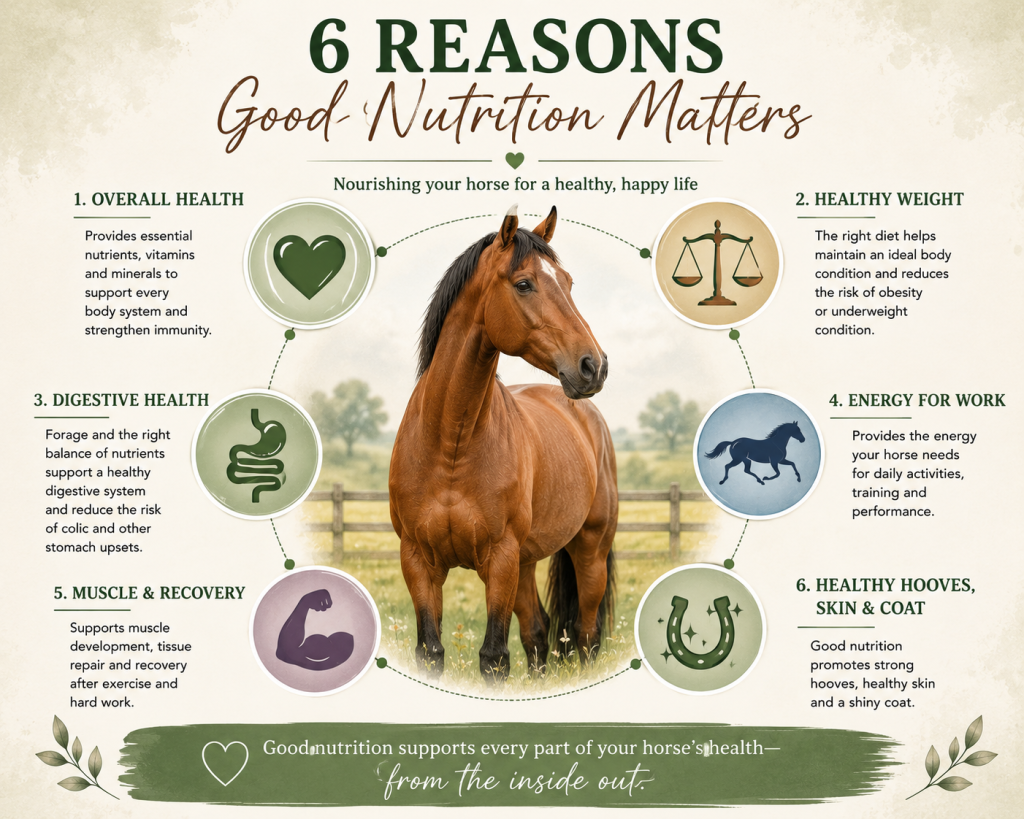
A balanced diet is one of the most important factors in keeping your horse healthy, happy and performing at their best. Just like people, horses rely on the right nutrients to support every part of their body, from maintaining a healthy weight to supporting their immune system, muscles and digestive health.
Feeding isn’t simply about keeping your horse full—it’s about providing the nutrients they need to thrive. Understanding how diet affects your horse can help prevent health problems, improve wellbeing and ensure they’re receiving appropriate nutrition for their individual needs.
Supporting Overall Health
A well-balanced diet provides the energy, protein, vitamins and minerals your horse needs to support normal body functions. Good nutrition contributes to healthy organs, strong bones, a resilient immune system and overall wellbeing.
Maintaining a Healthy Weight
Feeding the correct amount is just as important as choosing the right type of feed.
Overfeeding can lead to obesity, increasing the risk of conditions such as laminitis, insulin dysregulation and joint problems. Underfeeding may result in weight loss, poor condition and reduced energy levels.
Regularly assessing your horse’s body condition allows you to adjust their diet before small changes become bigger problems.
Supporting Digestive Health
A horse’s digestive system is designed to process small amounts of fibre almost continuously throughout the day. Providing plenty of forage helps keep the digestive system functioning normally and reduces the risk of digestive disturbances.
Sudden changes to your horse’s diet should always be avoided, as these can increase the risk of colic and other gastrointestinal problems.
Providing Energy for Work
Different horses have different energy requirements.
A retired companion pony has very different nutritional needs compared to an event horse competing several times each month. Feeding should always reflect your horse’s workload rather than simply their size or breed.
Providing too much energy can lead to unnecessary weight gain or increased excitability, while too little may leave your horse lacking the energy needed for work and recovery.
Supporting Growth, Muscle and Recovery
Young horses, breeding stock and horses in regular work require adequate protein and other nutrients to support growth, muscle maintenance and tissue repair.
Providing the correct balance of nutrients helps your horse recover after exercise and maintain healthy muscle condition throughout the year.
Healthy Hooves, Coat and Skin
Nutrition plays an important role in hoof quality, coat condition and healthy skin.
While no feed can instantly solve poor hoof growth or coat problems, providing a balanced diet that meets your horse’s nutritional requirements gives them the best foundation for healthy growth and overall condition.
💡Practical Horse Owner Tip
The best diet isn’t necessarily the most expensive or the one with the longest list of ingredients—it’s the one that meets your horse’s individual nutritional needs. Many horses do exceptionally well on a simple, forage-based diet with only minimal additional feeding.
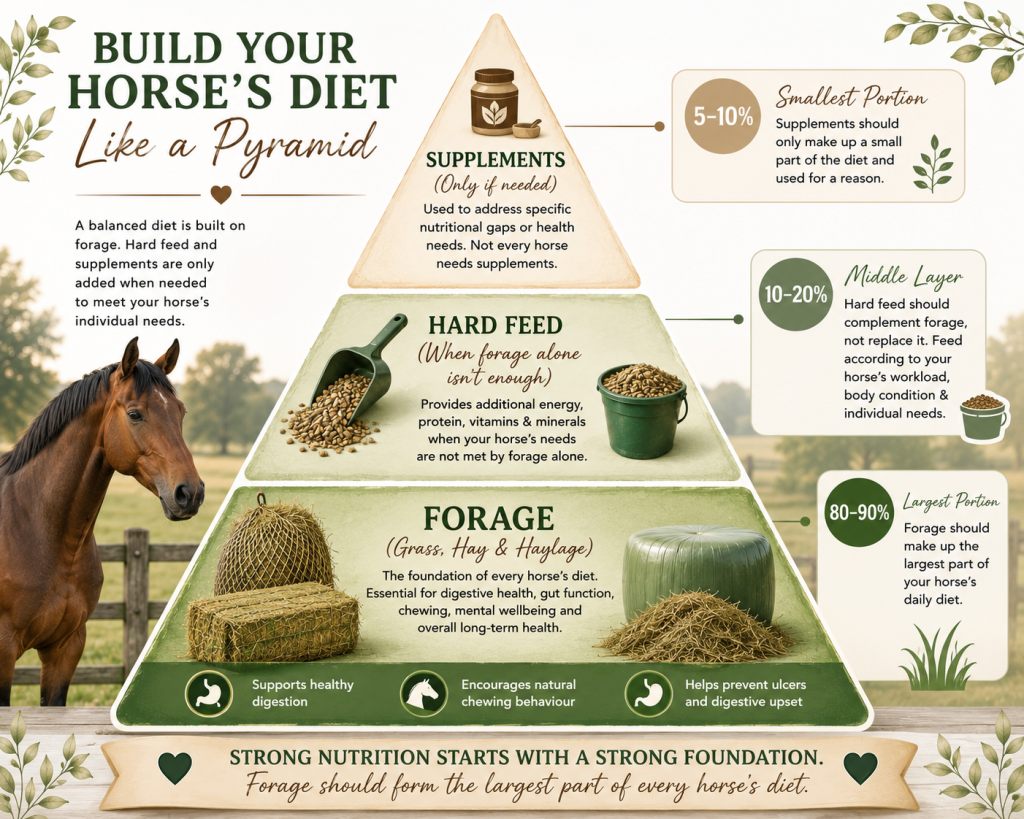
The Golden Rule: Forage Comes First
If there’s one principle every horse owner should understand, it’s this:
Forage should always form the foundation of your horse’s diet.
Horses are natural grazers, designed to eat small amounts of fibre almost continuously throughout the day. In the wild, they spend up to 16–18 hours a day grazing, and their digestive system has evolved to process a steady supply of forage rather than a few large meals.
Whether your horse lives at grass, eats hay or is fed haylage, forage provides the fibre needed to support healthy digestion, maintain normal gut function and encourage natural chewing behaviour.
For most horses, forage should make up the vast majority of their daily diet. Hard feed should only be used when forage alone cannot meet their nutritional or energy requirements.
Types of Forage:
🌱 Grass
For horses with access to good-quality grazing, grass can provide a significant proportion—or even all—of their forage requirements during the growing season.
However, the nutritional value of grass changes throughout the year depending on weather, soil conditions and grass growth. Rich spring and autumn grass can contain high levels of sugars, making careful grazing management important for horses prone to obesity or laminitis.
🌾 Hay
Hay is dried grass that provides an excellent source of fibre when grazing is limited or unavailable.
Its nutritional value varies depending on when it was cut, the grasses it contains and how it has been stored. Some hay is suitable for horses needing to gain weight, while more mature hay may be better suited to good doers that require fewer calories.
🌿 Haylage
Haylage is grass that has been partially dried before being wrapped to ferment naturally.
It is generally higher in moisture than hay and is often more palatable, making it a popular choice for horses that struggle to maintain weight or have respiratory conditions that benefit from reduced dust.
Because haylage can vary considerably in its nutritional value, it’s important to feed it according to your horse’s individual needs rather than assuming all haylage is the same.
How Much Forage Does a Horse Need?
As a general guide, horses should receive at least 1.5–2% of their body weight in forage each day (on a dry matter basis) unless advised otherwise by a veterinarian or equine nutritionist.
For example:
- A 500 kg horse typically requires the equivalent of 7.5–10 kg of dry forage per day as a minimum.
- Many horses will benefit from having access to forage for much of the day to support healthy digestive function and reduce boredom.
Restricting forage too severely can increase the risk of digestive problems, gastric ulcers and unwanted behaviours such as crib biting or wood chewing.
💡Practical Horse Owner Tip
Think of hard feed as a supplement to forage—not a replacement for it. Before adding cubes, mixes or supplements, ask yourself whether your horse is already receiving enough good-quality forage. In many cases, that’s where the biggest nutritional gains can be made.
Does Every Horse Need Hard Feed?
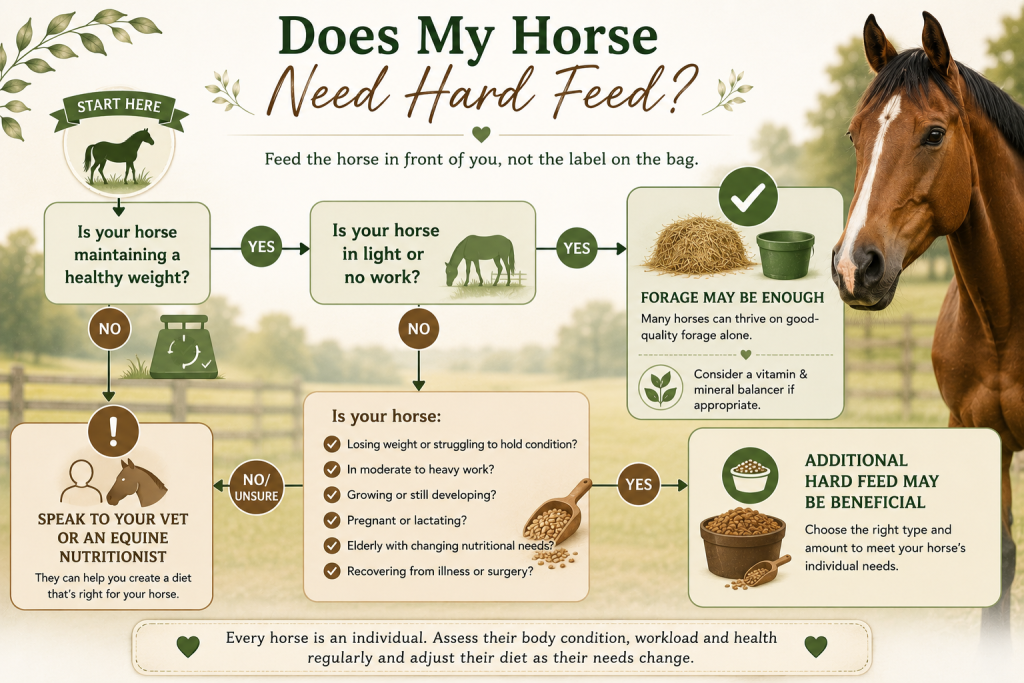
One of the biggest misconceptions in horse ownership is that every horse needs a bucket of hard feed each day. In reality, many horses can maintain excellent health, body condition and energy levels on a forage-based diet alone.
Hard feed should never be given simply because it’s part of a routine or because other horses on the yard receive it. Instead, it should be fed when your horse’s nutritional or energy requirements cannot be met through forage alone.
Horses That May Not Need Hard Feed
Many horses can thrive without hard feed, particularly if they:
- Are in light or no work.
- Maintain a healthy body condition on forage alone.
- Have access to good-quality grazing or adequate hay/haylage.
- Have no additional nutritional or medical requirements.
In these situations, a vitamin and mineral balancer may be all that’s needed to ensure your horse receives essential nutrients without unnecessary calories.
When Hard Feed May Be Beneficial
Some horses have higher nutritional demands and may benefit from additional feed alongside forage.
This may include horses that are:
- In moderate to heavy work.
- Struggling to maintain weight.
- Growing or still developing.
- Pregnant or lactating mares.
- Recovering from illness or surgery.
- Senior horses with reduced chewing ability or changing nutritional needs.
The type and amount of hard feed should always be chosen to suit your horse’s individual circumstances rather than following a one-size-fits-all approach.
Feed the Horse in Front of You
It’s easy to compare your horse with others at the yard, but every horse is different.
Two horses of the same breed, age and height may have completely different nutritional requirements depending on their workload, metabolism, grazing, health and body condition.
Rather than asking:
“What does everyone else feed?”
Ask yourself:
“What does my horse actually need?”
Making feeding decisions based on your own horse’s condition is one of the best ways to support their long-term health and wellbeing.
💡Practical Horse Owner Tip
If your horse is maintaining a healthy weight, has plenty of energy for the work you ask of them and is receiving a balanced diet, adding extra feed won’t necessarily make them healthier. More feed isn’t always better—feeding appropriately is what matters.
Understanding Common Feed Types
Walk into any feed store and you’ll be greeted by rows of colourful feed bags labelled with terms like chaff, cubes, mixes, balancers and beet pulp. For new horse owners, it can be difficult to know what each one is, what it does and whether their horse actually needs it.
The good news is that each type of feed has a specific purpose. Understanding these differences will help you choose the right feed for your horse and avoid spending money on products they may not need.
Let’s start with one of the most common feeds you’ll find in almost every feed room.
Chaff
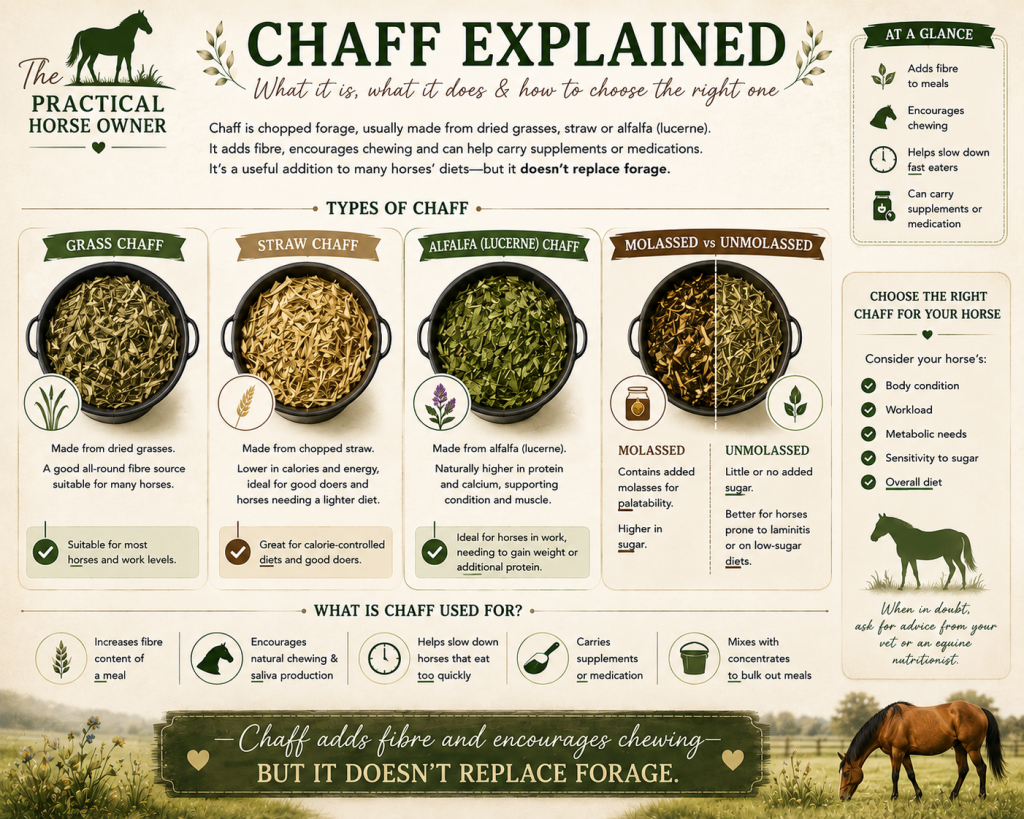
Chaff is chopped forage, usually made from dried grasses, straw or alfalfa (lucerne). Some products also contain added oil, herbs or flavourings, while others are completely unmolassed and designed for horses that require a low-sugar diet.
Although it may look like a simple filler, chaff plays an important role in many horses’ diets.
What Is Chaff Used For?
Chaff is commonly used to:
- Increase the fibre content of a meal.
- Encourage horses to chew for longer.
- Slow down horses that eat too quickly.
- Carry supplements or medications.
- Mix with concentrates to create a larger, more satisfying feed.
Because horses naturally spend many hours grazing each day, encouraging chewing helps support normal digestive function and saliva production.
Does Every Horse Need Chaff?
Not necessarily.
If your horse receives plenty of forage and doesn’t require a bucket feed, they may not need chaff at all.
However, chaff can be useful for horses receiving hard feed, supplements or medication, as it adds bulk and encourages slower eating.
Types of Chaff
There are several different types available, including:
- Grass chaff – made from dried grasses and suitable for many horses.
- Straw chaff – lower in calories, often used for good doers.
- Alfalfa (lucerne) chaff – naturally higher in protein and calcium, making it popular for horses in work or those needing additional condition.
- Molassed chaff – contains added molasses to improve palatability but is generally less suitable for horses requiring a low-sugar diet.
- Unmolassed chaff – contains little or no added sugar and is often chosen for horses prone to laminitis or those on calorie-controlled diets.
Choosing the Right Chaff
The best choice depends on your horse’s individual needs.
For example:
- A good doer may benefit from a lower-calorie straw-based or unmolassed chaff.
- A horse needing to gain weight may suit a higher-energy grass or alfalfa-based product.
- Horses prone to laminitis or metabolic conditions are often better suited to low-sugar, unmolassed options.
As with all feeds, always read the manufacturer’s feeding guidelines and introduce any new product gradually over 7–14 days.
💡Practical Horse Owner Tip
Chaff isn’t designed to replace forage. Think of it as an addition to a bucket feed rather than an alternative to hay, haylage or grazing. Long-stem forage should always remain the foundation of your horse’s diet.
Cubes & Nuts
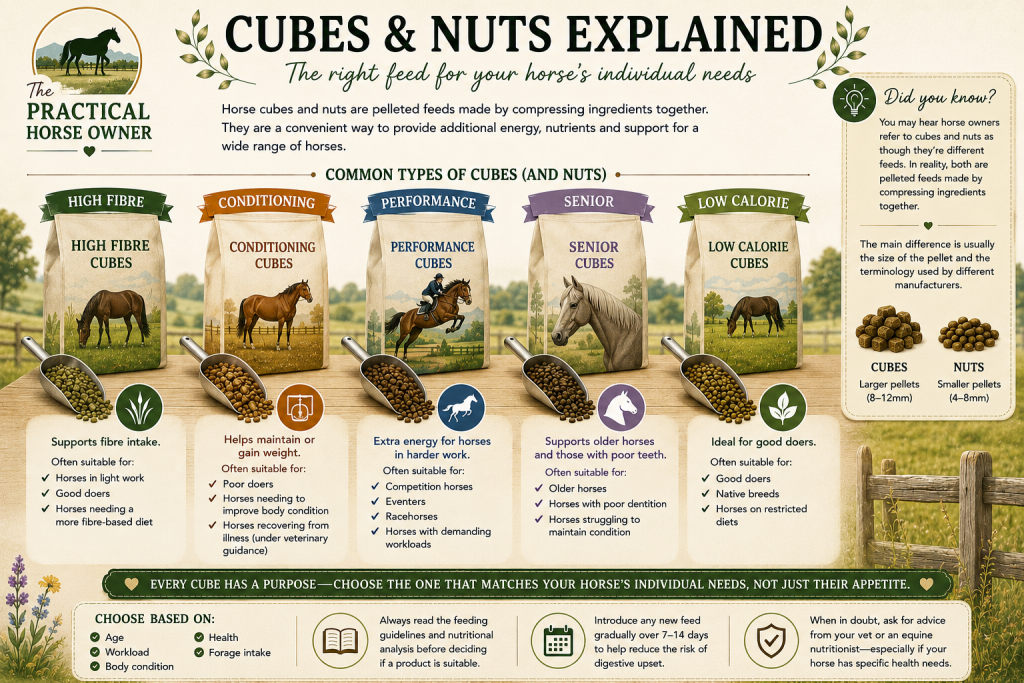
Horse cubes (or nuts) are one of the most commonly fed types of hard feed. Unlike mixes, cubes are made by compressing ingredients into small, uniform pellets, ensuring that every mouthful contains the same balance of nutrients.
They are available in a wide range of formulations, each designed to meet different nutritional needs, from horses in light work to elite competition horses.
Did you know?
You may hear horse owners refer to cubes and nuts as though they’re different feeds. In reality, both are pelleted feeds made by compressing ingredients together. The main difference is usually the size of the pellet and the terminology used by different manufacturers.
What Are Cubes Used For?
Cubes are commonly fed to:
- Provide additional energy when forage alone isn’t enough.
- Support horses in work.
- Help maintain or improve body condition.
- Deliver vitamins and minerals as part of a balanced diet.
- Meet the nutritional needs of specific groups, such as senior horses or youngstock.
Because every pellet contains the same ingredients, cubes help prevent selective feeding, where horses pick out their favourite parts of a feed and leave the rest behind.
Common Types of Cubes
There are many different types available, but some of the most common include:
🌾 High-Fibre Cubes
Designed for horses that require additional fibre without excessive energy.
Often suitable for:
- Horses in light work.
- Good doers.
- Horses requiring a more fibre-based diet.
⚡ Conditioning Cubes
Higher in calories to help horses gain or maintain weight.
Often suitable for:
- Poor doers.
- Horses needing to improve body condition.
- Horses recovering from illness (under veterinary guidance).
🏇 Performance Cubes
Formulated to provide additional energy for horses in moderate to heavy work.
Often suitable for:
- Competition horses.
- Eventers.
- Racehorses.
- Horses with demanding workloads.
👴 Senior Cubes
Designed to be easier to chew and digest while supporting the changing nutritional needs of older horses.
Often suitable for:
- Older horses.
- Horses with poor dentition.
- Horses struggling to maintain condition.
🌿 Low-Calorie or Lite Cubes
Lower in calories while still providing essential nutrients.
Often suitable for:
- Good doers.
- Native breeds.
- Horses on restricted diets.
Choosing the Right Cubes
Not all cubes are the same.
The best choice depends on your horse’s:
- Age.
- Workload.
- Body condition.
- Health.
- Forage intake.
It’s important not to choose a feed simply because it’s popular or recommended by someone else. Instead, select a product that matches your horse’s individual nutritional requirements.
Whenever changing feeds, introduce the new cubes gradually over 7–14 days to help reduce the risk of digestive upset.
💡Practical Horse Owner Tip
Don’t judge a feed by its name alone. Two bags labelled “conditioning cubes” may have very different nutritional profiles. Always read the feeding information and nutritional analysis before deciding if a product is suitable for your horse.
Mixes
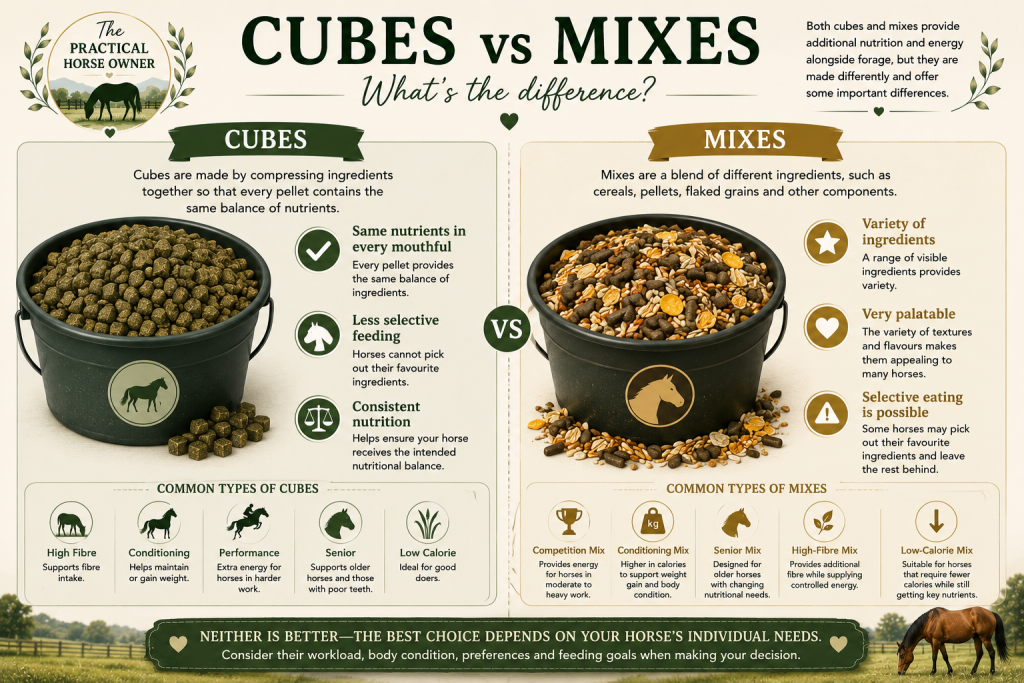
Horse mixes are made from a blend of different ingredients, such as cereals, pellets, flaked grains and other components. Unlike cubes, where every pellet contains the same ingredients, mixes allow you to see the different parts of the feed.
Mixes are available in many different formulations, each designed to suit horses with varying nutritional requirements, from leisure horses to high-performance competition horses.
What Are Mixes Used For?
Mixes are commonly fed to:
- Provide additional energy alongside forage.
- Support horses in work.
- Help maintain or improve body condition.
- Supply vitamins and minerals as part of a balanced diet.
- Increase palatability for fussy eaters.
Some horses enjoy the variety of textures found in a mix, making them a popular choice for horses that are reluctant to eat other feeds.
Common Types of Mixes
Some of the most common include:
🏇 Competition Mix
Designed to provide additional energy for horses in moderate to heavy work.
⚖️ Conditioning Mix
Higher in calories to support weight gain and body condition.
👴 Senior Mix
Designed for older horses with changing nutritional needs.
🌾 High-Fibre Mix
Provides additional fibre while supplying controlled energy.
🌿 Low-Calorie Mix
Suitable for horses that require fewer calories while still receiving essential nutrients.
Cubes vs Mixes
Although both are designed to provide additional nutrition, there are some important differences.
Cubes
✔ Every pellet contains the same balance of nutrients.
✔ Reduces selective feeding.
✔ Nutrients are consumed more consistently.
Mixes
✔ A variety of visible ingredients.
✔ Often very palatable.
✔ Some horses may pick out their favourite ingredients and leave the rest, meaning they don’t always receive the intended nutritional balance.
Which Is Better?
Neither cubes nor mixes are inherently better than the other.
The right choice depends on:
- Your horse’s nutritional requirements.
- Whether they are prone to selective feeding.
- Their personal preference.
- Your feeding goals.
Many owners choose cubes because every mouthful provides a consistent nutritional balance, while others prefer mixes because their horse finds them more appetising.
💡Practical Horse Owner Tip
If your horse regularly leaves certain ingredients behind, they may not be receiving the balanced diet the manufacturer intended. In these situations, cubes are often the more consistent option.
Beet Pulp/Sugar Beet
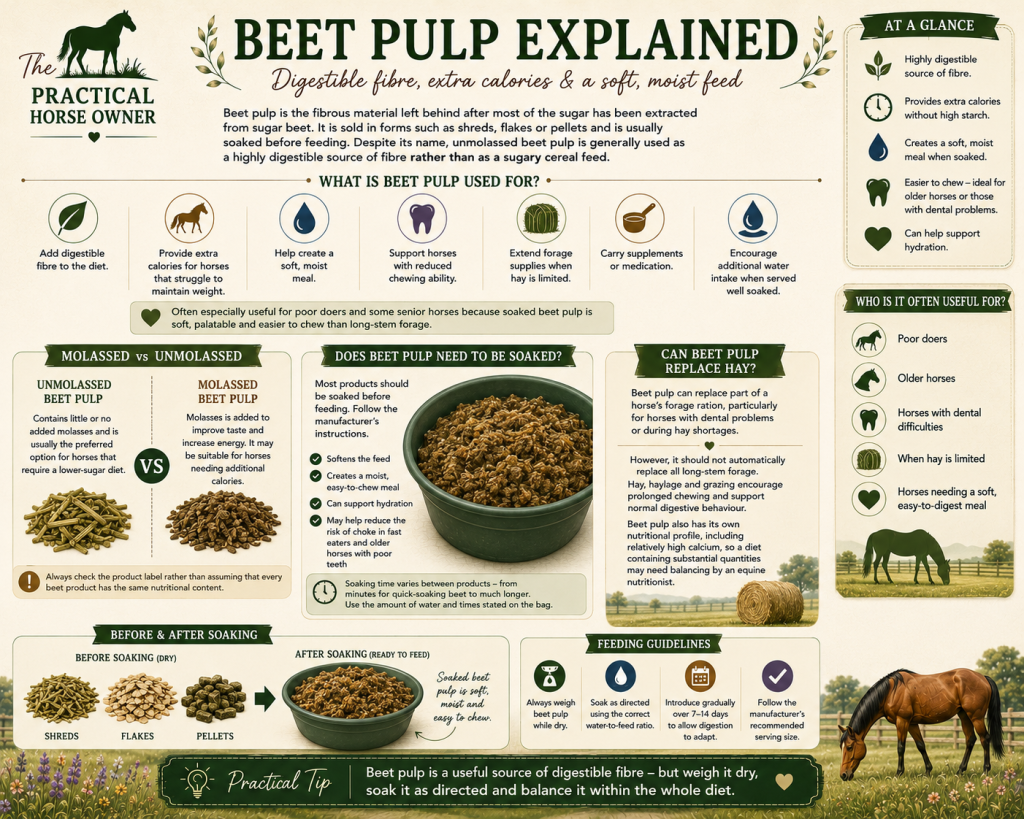
Beet pulp is the fibrous material left behind after most of the sugar has been extracted from sugar beet. It is sold in forms such as shreds, flakes or pellets and is usually soaked before feeding.
Despite its name, unmolassed beet pulp is generally used as a highly digestible source of fibre rather than as a sugary cereal feed. It can provide more calories than many traditional forages while remaining fibre-based, making it useful for horses that need additional condition without relying heavily on grain.
What Is Beet Pulp Used For?
Beet pulp may be fed to:
- Add digestible fibre to the diet.
- Provide extra calories for horses that struggle to maintain weight.
- Help create a soft, moist meal.
- Support horses with reduced chewing ability.
- Extend forage supplies when hay is limited.
- Carry supplements or medication.
- Encourage additional water intake when served well soaked.
It is often especially useful for poor doers and some senior horses because soaked beet pulp is soft, palatable and easier to chew than long-stem forage.
Molassed and Unmolassed Beet Pulp
Beet pulp is available in two main forms.
Unmolassed beet pulp
This contains little or no added molasses and is usually the preferred option for horses that require a lower-sugar diet.
Molassed beet pulp
Molasses is added to improve taste and increase energy. It may be suitable for horses needing additional calories but is less appropriate for those whose sugar intake must be carefully controlled.
Always check the product label rather than assuming that every beet product has the same nutritional content.
Does Beet Pulp Need to Be Soaked?
Many manufacturers instruct owners to soak beet pulp before feeding, and those instructions should always be followed.
Soaking:
- Softens the feed.
- Creates a moist, easy-to-chew meal.
- Can support hydration.
- May be particularly helpful for fast eaters, older horses and those with poor teeth.
The required soaking time varies considerably between products. Quick-soaking beet may be ready within minutes, while some traditional products take much longer. Use the amount of water and soaking time stated on the bag.
Although beet pulp itself is not uniquely responsible for choke, the AAEP advises soaking feeds such as beet pulp where appropriate to reduce risk, particularly when horses eat rapidly or chew inadequately.
Can Beet Pulp Replace Hay?
Beet pulp can sometimes replace part of a horse’s forage ration, particularly for horses with dental problems or during hay shortages. However, it should not automatically replace all long-stem forage.
Hay, haylage and grazing encourage prolonged chewing and support normal digestive behaviour. Beet pulp also has its own nutritional profile, including relatively high calcium, so a diet containing substantial quantities may need balancing by an equine nutritionist.
Is Beet Pulp Suitable for Every Horse?
Not every horse needs it.
A good doer maintaining weight easily may gain unnecessary calories from beet pulp. It should be selected according to the horse’s body condition, workload, health and overall ration.
Introduce it gradually over approximately 7–14 days, weigh it while dry, and follow the manufacturer’s recommended serving size.
💡Practical Horse Owner Tip
Always measure beet pulp before soaking. Water makes the finished feed much heavier and bulkier, but it does not increase the amount of dry feed your horse is receiving.
Balancers
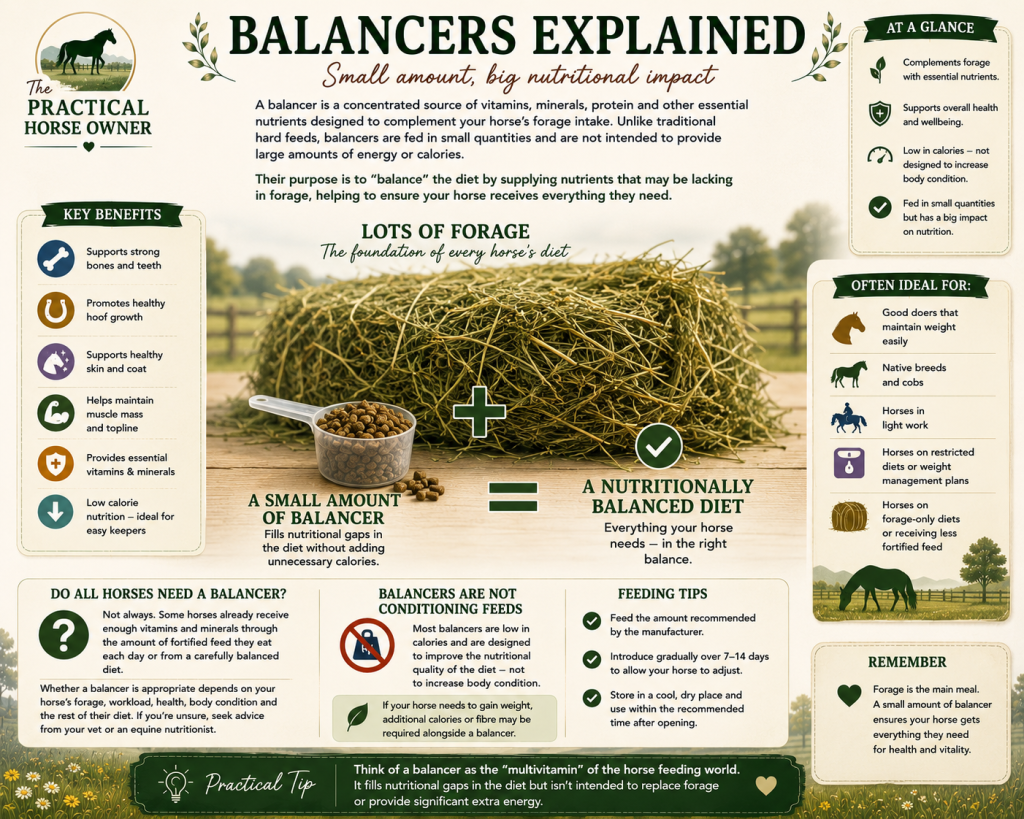
A balancer is a concentrated source of vitamins, minerals, protein and other essential nutrients designed to complement your horse’s forage intake. Unlike traditional hard feeds, balancers are fed in relatively small quantities and are not intended to provide large amounts of energy or calories.
Their purpose is to “balance” the diet by supplying nutrients that may be lacking in forage, helping to ensure your horse receives everything they need without unnecessary calories.
What Is a Balancer Used For?
Balancers are commonly used to:
- Provide essential vitamins and minerals.
- Support healthy hoof growth, skin and coat condition.
- Supply high-quality protein to help maintain muscle.
- Complement forage-based diets.
- Help ensure nutritional requirements are met without feeding large bucket feeds.
Because they are highly concentrated, balancers are usually fed in much smaller amounts than cubes or mixes.
Which Horses Benefit from a Balancer?
Balancers can be particularly useful for:
- Horses that maintain weight easily on forage alone.
- Good doers that don’t require extra calories.
- Native breeds.
- Horses in light work.
- Horses on restricted diets due to weight management.
- Horses receiving less than the recommended amount of a fortified hard feed.
In many cases, a horse receiving only forage may benefit more from a balancer than from adding unnecessary hard feed.
Do All Horses Need a Balancer?
Not always.
Some horses already receive enough vitamins and minerals through the amount of fortified feed they eat each day. Others may obtain sufficient nutrients from a carefully balanced diet.
Whether a balancer is appropriate depends on your horse’s forage, workload, health, body condition and the rest of their diet.
If you’re unsure, your veterinarian or an equine nutritionist can help assess whether a balancer is likely to be beneficial.
Balancers Are Not Conditioning Feeds
One of the most common misunderstandings is that a balancer will help a horse gain weight.
In reality, most balancers are low in calories and are designed to improve the nutritional quality of the diet rather than increase body condition.
If a horse needs to gain weight, additional fibre or calories may be required alongside a balancer rather than replacing it.
💡Practical Horse Owner Tip
Think of a balancer as the “multivitamin” of the horse feeding world. It fills nutritional gaps in the diet but isn’t intended to replace forage or provide significant extra energy.
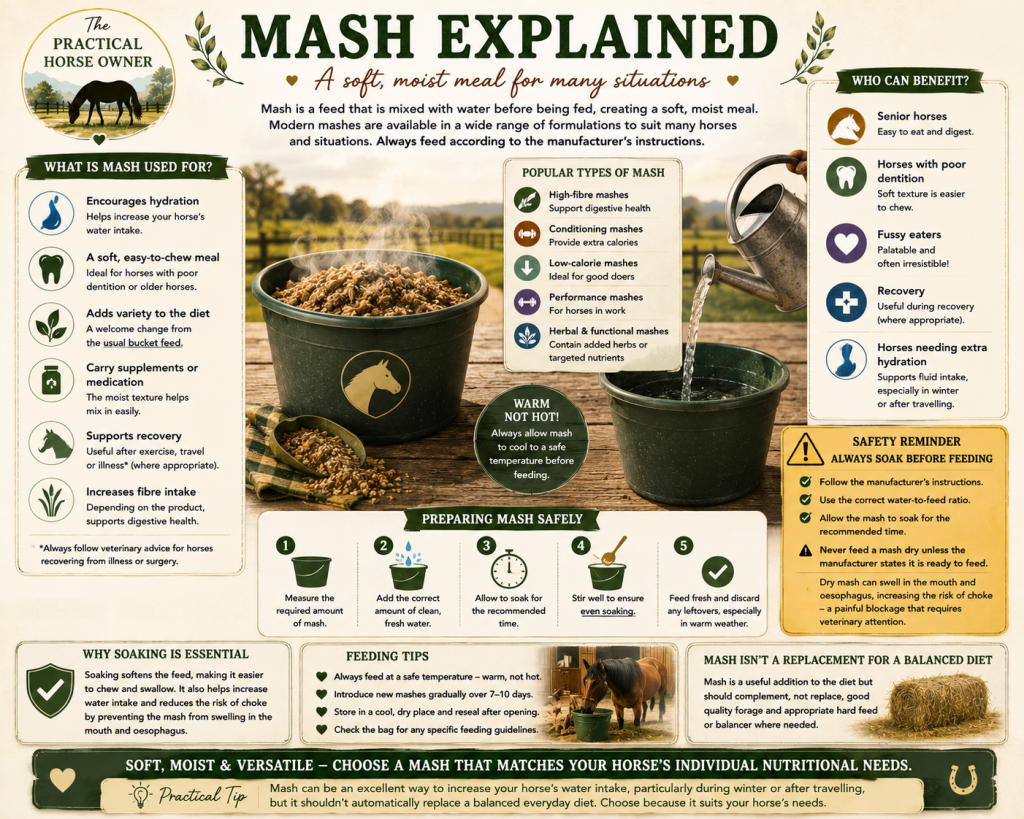
Mash
Mash is a feed that is mixed with water before being fed, creating a soft, moist meal. Modern horse mashes are available in a wide range of formulations and can be suitable for everything from leisure horses to competition horses.
Unlike traditional bran mashes, which were once commonly fed as an occasional treat, today’s commercial mashes are carefully formulated to provide balanced nutrition and should always be fed according to the manufacturer’s instructions.
What Is Mash Used For?
Mash may be fed to:
- Encourage horses to drink more water.
- Provide a soft, easy-to-chew meal.
- Support horses with poor dentition.
- Add variety to the diet.
- Carry supplements or medication.
- Support recovery after exercise, travel or illness (where appropriate).
- Increase fibre intake, depending on the product.
Many owners enjoy feeding a warm mash during colder weather, although it should never be served hot.
Which Horses Benefit from Mash?
Mash can be particularly useful for:
- Senior horses.
- Horses with worn or missing teeth.
- Horses recovering from illness or surgery (following veterinary advice).
- Fussy eaters.
- Horses that need encouragement to increase their water intake.
- Competition horses after exercise or travelling.
However, healthy horses don’t necessarily need mash simply because it’s popular.
Not All Mashes Are the Same
There are many different types available, including:
- High-fibre mashes.
- Conditioning mashes.
- Low-calorie mashes.
- Performance mashes.
- Mash products containing added herbs or supplements.
Some products provide significant calories, while others are designed mainly as a fibre source. Always read the nutritional information rather than assuming all mashes have the same purpose.
Preparing Mash Safely
Mash must be soaked before feeding. Some mashes are ready within a few minutes, while others require a longer soaking time.
Always:
- Follow the manufacturer’s preparation instructions.
- Use the recommended amount of water.
- Allow the mash to soak for the correct length of time.
- Feed it fresh and discard any leftovers that have been sitting for long periods, particularly in warm weather.
Never assume different mash products are prepared in the same way.
Feeding a mash dry can be dangerous. Dry mash may swell when it comes into contact with moisture in your horse’s mouth and oesophagus, increasing the risk of choke—a blockage of the oesophagus that prevents food from passing normally to the stomach.
💡Practical Horse Owner Tip
Mash can be an excellent way to increase your horse’s water intake, particularly during winter or after travelling, but it shouldn’t automatically replace a balanced everyday diet. Choose a mash because it suits your horse’s needs—not simply because it’s fashionable.
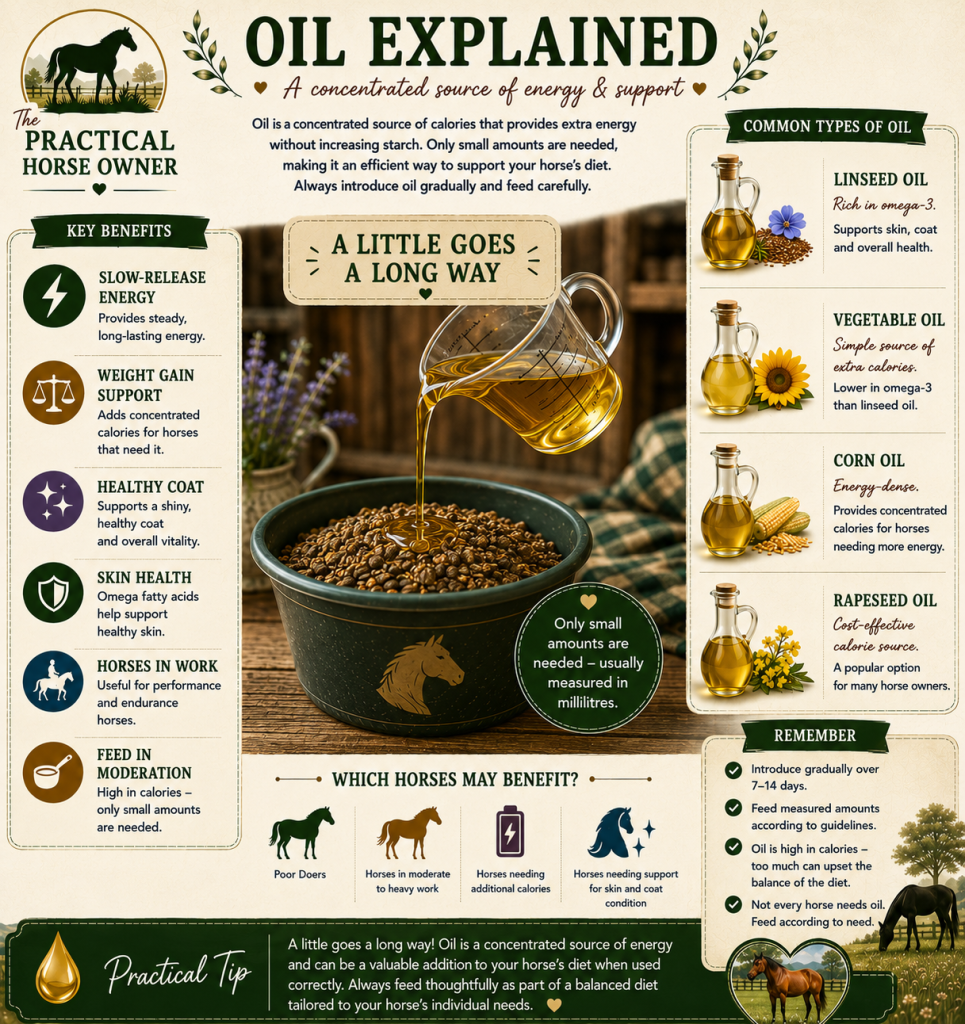
Oil
Oil is a concentrated source of calories that can be added to a horse’s diet to provide extra energy without increasing the amount of cereal or starch they consume. It is commonly used to support weight gain, provide slow-release energy and help maintain healthy skin and coat condition.
Because oil is so energy-dense, only small amounts are usually needed, and it should always be introduced gradually to allow your horse’s digestive system to adapt.
What Is Oil Used For?
Oil may be added to your horse’s diet to:
- Increase calorie intake.
- Support horses that struggle to maintain weight.
- Provide slow-release energy for horses in work.
- Promote healthy skin and a glossy coat.
- Help reduce the reliance on high-starch feeds.
Unlike cereals, oil provides calories without causing rapid spikes in blood sugar, making it a useful energy source for many horses.
Common Types of Oil
Several oils are suitable for horses, with each offering slightly different nutritional benefits.
🌿 Linseed Oil
One of the most popular choices.
Rich in omega-3 fatty acids and commonly fed to support skin, coat and overall health.
🌻 Vegetable Oil
A readily available source of additional calories.
Often used to increase dietary energy but generally contains lower levels of omega-3 than linseed oil.
🌽 Corn Oil
Provides a concentrated source of calories.
More commonly used for horses requiring additional energy, although it contains a different balance of fatty acids compared to linseed oil.
🌾 Rapeseed Oil
Another commonly used oil that provides extra calories and is often considered a cost-effective option.
Which Horses May Benefit from Oil?
Oil can be particularly useful for:
- Poor doers.
- Horses in moderate to heavy work.
- Horses needing additional calories.
- Horses requiring slow-release energy.
- Horses needing support for skin and coat condition.
Many horses maintaining a healthy weight on forage alone do not need additional oil.
Feeding Oil Safely
Because oil is very energy-dense, it should always be introduced slowly over several weeks.
Adding large amounts too quickly may reduce feed palatability and can upset the balance of the diet.
Always follow the manufacturer’s guidance or seek advice from your veterinarian or an equine nutritionist if feeding larger quantities.
💡Practical Horse Owner Tip
Oil provides concentrated calories, but it isn’t a substitute for good-quality forage or a balanced diet. Think of it as an addition when your horse genuinely needs more energy—not as something every horse should receive.
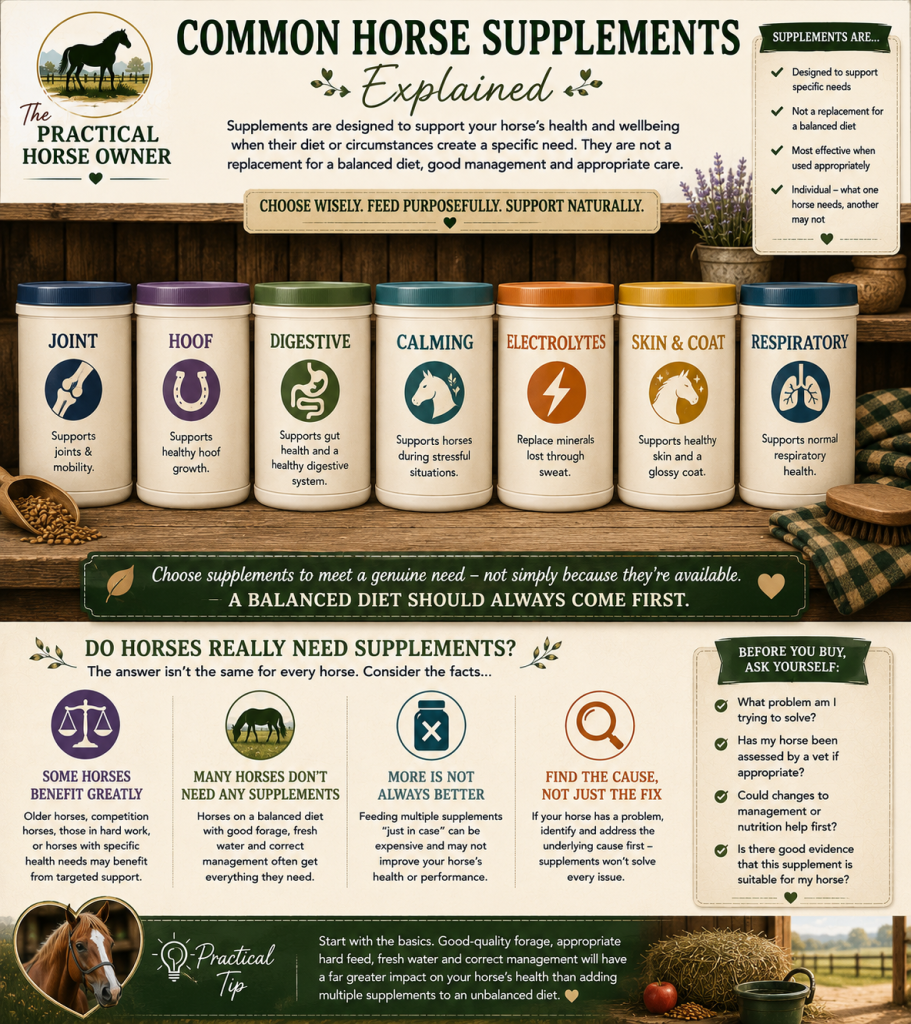
Understanding Common Horse Supplements
Walk into any tack shop or browse online and you’ll find hundreds of different horse supplements, all claiming to improve your horse’s health, performance or wellbeing.
From joint powders to calming supplements, digestive support and hoof products, the choice can feel overwhelming.
The important thing to remember is that supplements are designed to supplement a balanced diet—not replace one. Many horses receiving appropriate nutrition may not need additional supplements at all, while others may benefit from targeted support based on their age, workload or health.
Before adding any supplement, it’s worth asking whether your horse actually needs it and whether any underlying management or feeding changes could achieve the same result.
Common Types of Supplements
🦴 Joint Supplements
Designed to support healthy joints and mobility.
These are commonly fed to:
- Older horses.
- Competition horses.
- Horses in regular work.
- Horses with increased wear on their joints.
Common ingredients may include glucosamine, chondroitin, MSM and hyaluronic acid.
🦶 Hoof Supplements
Designed to support healthy hoof growth and hoof quality.
Often fed to horses with:
- Brittle hooves.
- Slow hoof growth.
- Poor hoof quality.
Common ingredients include biotin, methionine, zinc and copper.
🌿 Digestive Supplements
Formulated to support the digestive system and maintain a healthy gut environment.
May be useful for:
- Horses undergoing management changes.
- Horses experiencing digestive stress.
- Horses recovering after illness (where appropriate).
Common ingredients include prebiotics, probiotics and live yeast cultures.
😌 Calming Supplements
Designed to support horses that become anxious or excitable in certain situations.
Some owners use these for:
- Travelling.
- Competitions.
- New environments.
- Changes in routine.
Results can vary considerably between individual horses, and calming supplements should never be used as a substitute for appropriate training, management or investigation of underlying discomfort.
⚡ Electrolytes
Electrolytes help replace minerals lost through sweat.
They are commonly used for:
- Competition horses.
- Horses in hard work.
- Horses travelling in hot weather.
- Endurance horses.
Fresh, clean water should always be available when feeding electrolytes.
✨ Skin & Coat Supplements
Designed to support skin health and promote a healthy, shiny coat.
These often contain:
- Omega-3 fatty acids.
- Oils.
- Vitamins.
- Trace minerals.
🌬️ Respiratory Supplements
Marketed to support normal respiratory function.
Some products contain herbs or ingredients intended to help maintain healthy airways, particularly during periods of increased dust exposure.
However, supplements should never replace appropriate veterinary investigation if your horse develops a cough or breathing problems.
Does Every Horse Need Supplements?
No.
Many horses receiving a balanced diet that meets their nutritional requirements do not require additional supplementation.
Adding multiple supplements “just in case” can become expensive and may not provide any additional benefit.
Before purchasing a supplement, ask yourself:
- What problem am I trying to solve?
- Has my horse been assessed by a veterinarian if appropriate?
- Could changes to management or nutrition help first?
- Is there good evidence that this supplement is suitable for my horse?
Choosing supplements thoughtfully is usually more effective than feeding several products without a clear reason.
💡Practical Horse Owner Tip
Start with the basics. Good-quality forage, appropriate hard feed, fresh water and correct management will have a far greater impact on your horse’s health than adding multiple supplements to an unbalanced diet.
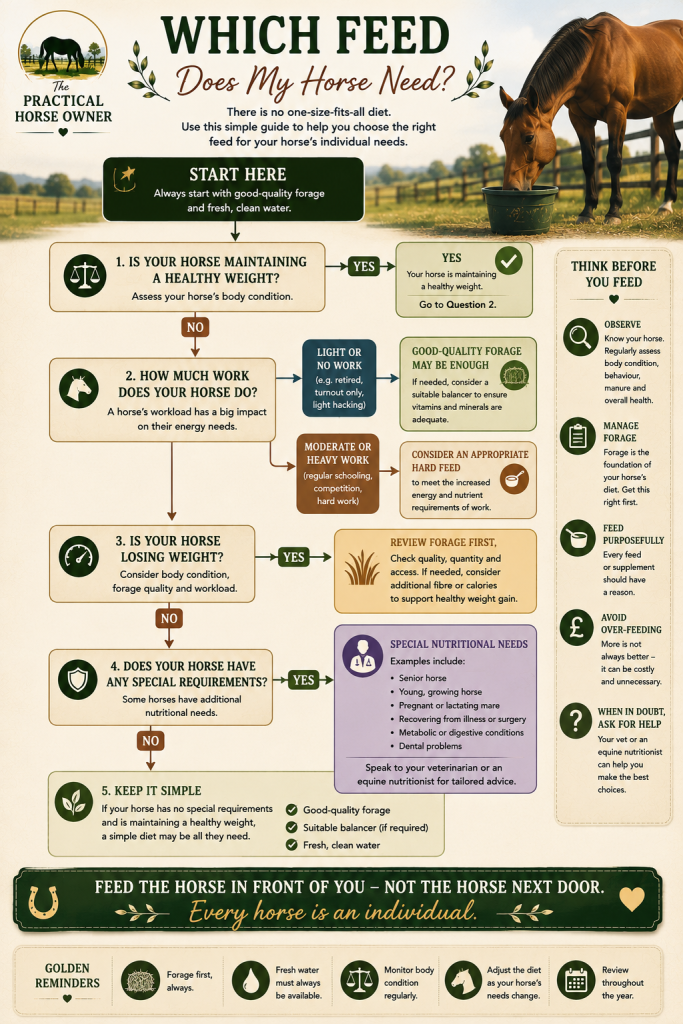
Which Feed Does My Horse Need?
One of the biggest mistakes new horse owners make is choosing feed based on what someone else at the yard is using. In reality, there is no single feed that is right for every horse.
The best diet is one that meets your horse’s individual nutritional needs, taking into account their age, workload, body condition, health and access to forage.
Before buying a new feed, ask yourself a few simple questions.
1. Is My Horse Maintaining a Healthy Weight?
Start by assessing your horse’s body condition.
- If they maintain a healthy weight on forage alone, they may not need additional hard feed.
- If they are losing weight, they may benefit from additional fibre or calories.
- If they are overweight, reducing calorie intake and reviewing grazing management may be more appropriate than adding extra feed.
Your horse’s body condition should always guide your feeding decisions.
2. How Much Work Does My Horse Do?
A horse’s workload has a significant impact on their energy requirements.
A retired pony or horse in light hacking has very different nutritional needs from a horse competing every weekend.
Always feed according to the work your horse is actually doing—not the work you hope they will do.
3. What Forage Is Available?
Forage should always be the starting point.
Consider:
- Grazing quality.
- Hay or haylage.
- How much forage your horse eats each day.
Only once forage has been optimised should you consider whether additional feed is needed.
4. Does My Horse Have Any Special Requirements?
Some horses have additional nutritional needs.
These may include:
- Young, growing horses.
- Senior horses.
- Pregnant or lactating mares.
- Horses recovering from illness.
- Horses with metabolic conditions.
- Horses with dental problems.
These horses may require more specialised feeding plans, often with guidance from a veterinarian or equine nutritionist.
5. Keep It Simple
One of the easiest traps to fall into is believing that more products automatically mean a healthier horse.
In many cases, a simple diet consisting of:
- Good-quality forage
- A suitable balancer (if required)
- Fresh, clean water
is all many horses need.
Only add additional feeds or supplements when they serve a clear purpose.
💡Practical Horse Owner Tip
Every bag in the feed room should have a reason for being there. If you can’t explain why you’re feeding something, it may be worth reviewing whether your horse actually needs it.
Common Feeding Mistakes
Feeding horses doesn’t have to be complicated, but a few common mistakes can affect your horse’s health, body condition and digestive system. The good news is that most of these are easy to avoid once you understand the basics.
Remember that every horse is an individual. The best feeding plan is one that is regularly reviewed and adjusted to suit your horse’s changing needs.
1. Feeding Too Much Hard Feed
One of the most common mistakes is assuming every horse needs a large bucket of hard feed.
In reality, many horses maintain excellent condition on good-quality forage alone or with only a small amount of additional feed.
Providing more calories than your horse needs can lead to obesity and increase the risk of health problems such as laminitis and metabolic disorders.
2. Not Feeding Enough Forage
Forage should always form the foundation of your horse’s diet.
Restricting forage unnecessarily can increase the risk of digestive disturbances, gastric ulcers and boredom-related behaviours such as crib biting or wood chewing.
Whenever possible, aim to provide consistent access to suitable forage throughout the day.
3. Changing Feed Too Quickly
A horse’s digestive system adapts gradually to dietary changes.
Introducing a new feed suddenly can upset the delicate balance of microbes in the hindgut and increase the risk of digestive upset or colic.
Whenever possible, introduce new feeds gradually over 7–14 days.
4. Feeding by Scoop Instead of Weight
Different feeds have very different densities.
A scoop filled with cubes weighs very differently from the same scoop filled with chaff or beet pulp.
Whenever possible, weigh feeds rather than relying on scoop measurements to ensure your horse receives the correct amount.
5. Giving Supplements Without a Clear Purpose
Supplements can be beneficial when they address a genuine nutritional need.
However, feeding multiple supplements “just in case” can become expensive and may not provide any additional benefit.
Always consider whether your horse actually needs the supplement before adding it to their diet.
6. Forgetting Fresh Water
Fresh, clean water is just as important as feed.
Even the best diet cannot support your horse properly if they are dehydrated.
Check water supplies daily and ensure buckets, troughs and drinkers remain clean and functioning correctly.
7. Ignoring Body Condition
Your horse’s nutritional needs will change throughout the year.
Regularly assess their body condition and adjust their diet if they begin to gain or lose weight.
Don’t continue feeding the same ration simply because “that’s what they’ve always had.”
8. Feeding Too Many Treats
Treats can be a lovely way to reward your horse, but they should be given in moderation.
Too many treats can contribute unnecessary calories and may upset the balance of an otherwise well-managed diet.
Always consider treats as part of your horse’s overall daily intake.
💡Practical Horse Owner Tip
Review your horse’s diet every few months—or whenever their workload, body condition, health or grazing changes. Small adjustments made early are often much easier than correcting larger problems later.
Myths VS Facts
| Myth | Fact |
|---|---|
| Every horse needs hard feed. | Many horses maintain a healthy weight and receive all the nutrients they need from good-quality forage, with a balancer if required. Hard feed should only be added when forage alone cannot meet a horse’s nutritional needs. |
| More feed means a healthier horse. | Overfeeding can lead to obesity and increase the risk of health problems such as laminitis and metabolic disorders. Feeding the right amount is far more important than feeding more. |
| Horses should always have a bran mash once a week. | Modern research has shown there is no nutritional need for a traditional weekly bran mash. In fact, sudden dietary changes may upset the digestive system. Modern fibre-based mashes can be useful when fed as part of a balanced diet, but they shouldn’t replace regular feeding routines. |
| A shiny coat means a horse has a perfect diet. | A healthy coat is influenced by many factors, including nutrition, grooming, genetics, overall health and the time of year. While good nutrition supports coat condition, it isn’t the only factor. |
| All horses need supplements. | Many horses receive everything they need from a balanced diet. Supplements should only be used to address a genuine nutritional need or on the advice of a veterinarian or equine nutritionist. |
| Haylage is always richer than hay. | Not necessarily. The nutritional value of both hay and haylage depends on factors such as the type of grass, stage of growth and how they were produced. One isn’t automatically “better” or “richer” than the other. |
| Horses should be fed by the scoop. | Scoops measure volume, not weight. Different feeds have different densities, so weighing feed is the most accurate way to ensure your horse receives the correct amount. |
| If a horse looks hungry, it needs more hard feed. | Horses are naturally designed to spend many hours eating forage. A horse that appears hungry may simply need more suitable forage or more time spent eating, rather than additional hard feed. |
Frequently Asked Questions
Does every horse need hard feed?
No. Many horses maintain a healthy weight and receive all the energy they need from good-quality forage alone. Hard feed should only be added if forage cannot meet your horse’s nutritional or energy requirements.
What should form the largest part of a horse’s diet?
Forage should always be the foundation of your horse’s diet. Grass, hay and haylage provide the fibre needed to support healthy digestion and natural grazing behaviour.
How often should I feed my horse?
Horses are designed to eat little and often. Whenever possible, they should have regular access to suitable forage throughout the day to support normal digestive function.
Is hay better than haylage?
Neither is inherently better. The right choice depends on your horse’s nutritional needs, body condition, health and management. Both can provide excellent sources of forage when fed appropriately.
Do horses need supplements?
Not always. Many horses receiving a balanced diet do not require additional supplements. Supplements should only be fed when they address a genuine nutritional need or are recommended by your veterinarian or equine nutritionist.
Should I weigh my horse’s feed?
Yes. Different feeds vary greatly in weight, even if they fill the same scoop. Weighing feed is the most accurate way to ensure your horse receives the correct amount.
How quickly can I change my horse’s feed?
New feeds should usually be introduced gradually over 7–14 days to allow your horse’s digestive system to adapt and help reduce the risk of digestive upset.
Can horses survive on grass alone?
Some horses can meet their nutritional needs from good-quality grazing during parts of the year, particularly if they are good doers and in light work. Others may require additional forage, a balancer or hard feed depending on their individual requirements.
What is the difference between cubes and mixes?
Cubes are compressed pellets that provide the same balance of nutrients in every mouthful. Mixes contain visible ingredients such as cereals and pellets, meaning some horses may selectively eat certain components.
How often should I review my horse’s diet?
Your horse’s diet should be reviewed regularly, particularly if their workload, body condition, grazing, age or health changes. Small adjustments made early are often easier than correcting larger problems later.
Glossary
Balancer – A concentrated feed providing vitamins, minerals and protein without significant calories
Body Condition Score (BCS) – A method of assessing whether a horse is underweight, overweight or maintaining an ideal body condition.
Chaff – Chopped forage used to increase fibre intake and encourage chewing.
Concentrate Feed – Feeds such as cubes, mixes or pellets that provide additional nutrients and energy alongside forage.
Digestible Fibre – Fibre that is broken down by microbes in the horse’s hindgut to provide a valuable source of energy.
Electrolytes – Minerals such as sodium, potassium and chloride that are lost through sweat and help maintain normal body function.
Forage – Grass, hay and haylage that form the foundation of a horse’s diet.
Hard Feed – Concentrated feeds given in addition to forage, including cubes, mixes and some fibre-based products.
Haylage – Grass that has been partially dried and naturally fermented before being wrapped.
Mash – A feed mixed with water before feeding to create a soft, moist meal.
Metabolism – The chemical processes that convert nutrients into energy and maintain normal body functions.
Poor Doer – A horse that struggles to maintain weight despite receiving an appropriate diet.
Good Doer – A horse that maintains or gains weight easily and often requires careful calorie management.
Prebiotic – A substance that supports the growth of beneficial bacteria in the digestive tract.
Probiotic – Live microorganisms intended to support a healthy balance of gut bacteria.
Ration – Everything a horse eats over a 24-hour period.
References
- British Horse Society (BHS)
- World Horse Welfare
- American Association of Equine Practitioners (AAEP)
- Kentucky Equine Research (KER)
- University of Minnesota Extension
- SPILLERS™ Feeding Advice
- Dengie Horse Feeds
- TopSpec Nutrition
Disclaimer:
The information provided in this article is intended for educational purposes only and should not be considered a substitute for professional veterinary advice, diagnosis or treatment.
Every horse is an individual, and management decisions should always consider your horse’s age, health, workload and individual needs. If your horse is unwell, or you have any concerns about their health or welfare, contact your veterinary surgeon without delay.
While every effort has been made to ensure the information in this guide is accurate and up to date at the time of publication, recommendations and best practice may change as new research becomes available.