Published: 4th July 2026
Last Edited: 4th July 2026
Category: Health & Wellbeing
In This Guide:
- At a glance
- Introduction
- Why worm control is important
- Why has worming advice changed?
- Understanding the parasites
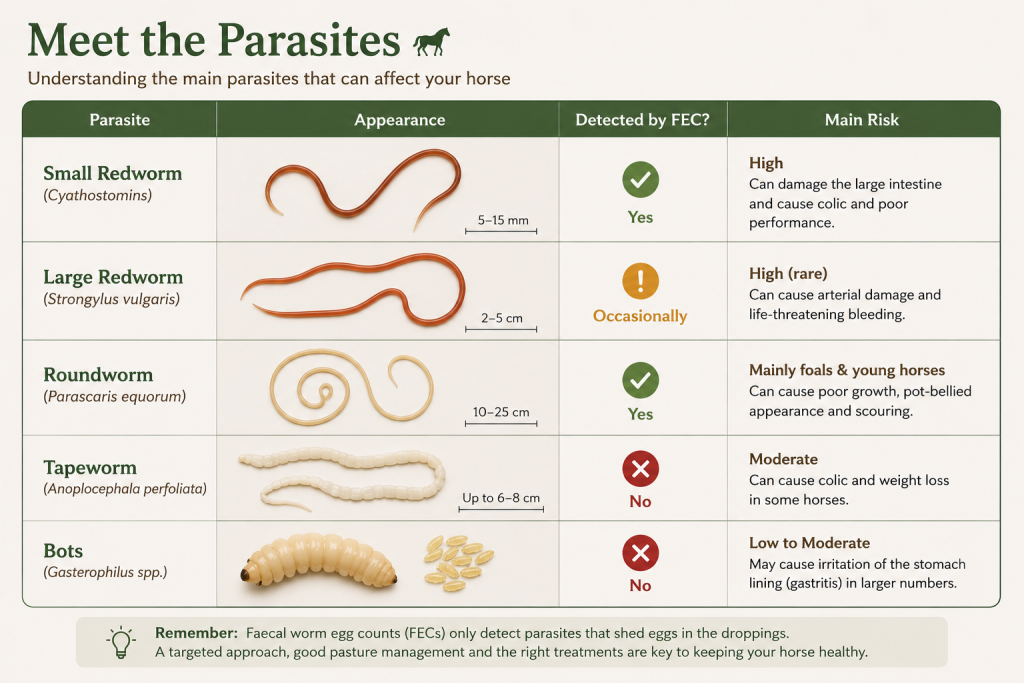
- The parasites in a snapshot
- How does a faecal egg count work?
- What can’t a faecal egg count detect?
- Other tests your horse may need
- A targeted approach
- Common Worming Mistakes
- When should I contact my vet?
- Myths VS Facts
- Frequently Asked Questions (FAQ’s)
- In Conclusion
- Glossary
- References
- Disclaimer
This Article at a glance
✔ Advice for worming horses has changed a lot over the years, now advising testing rather than routinely worm where appropriate.
✔ Perform faecal egg counts every 8–12 weeks during the grazing season.
✔ Tapeworm testing is generally recommended every six months.
✔ Consider seasonal treatment for encysted small redworm based on veterinary or SQP advice.
✔ Good pasture management is an essential part of parasite control.
Introduction
For many years, routine worming every few months was considered the standard approach to parasite control in horses. However, our understanding of equine parasites has changed significantly. Today, we know that regularly administering wormers without evidence of a parasite burden can contribute to anthelmintic resistance, making some wormers less effective over time.
Worming horses in the modern world is now about using the right treatment, at the right time, for the right horse. By combining faecal egg counts, targeted testing, good pasture management and strategic use of wormers, horse owners can protect their horses while helping to preserve the effectiveness of the worming products available.
This guide explains the principles of worming horses today, with modern parasite control and provides practical advice to help you make informed decisions about your horse’s worming programme.
Why worm control is important
Internal parasites are a normal part of a horse’s environment, but if left unmanaged they can affect health, welfare and performance. Most horses carry small numbers of worms without any obvious signs of illness. Problems arise when parasite burdens become high or when particular parasites cause damage during their life cycle.
Poor parasite control can lead to:
- Weight loss or poor condition
- Dull coat
- Diarrhoea
- Colic
- Reduced performance
- Poor growth in young horses
- In severe cases, life-threatening illness
The aim of modern worm control is not to eliminate every worm, but to keep parasite burdens low enough that they do not cause disease.
Why has worming advice changed?
For many years, horse owners were encouraged to worm their horses routinely every 8–12 weeks. While this approach was well intentioned, we now understand that worming horses frequently and unnecessarily has contributed to a growing problem known as anthelmintic resistance.
Anthelmintic resistance occurs when parasites become less sensitive to the active ingredients found in worming products. Over time, this means some wormers become less effective, making it increasingly difficult to control parasite burdens.
As a result, the approach to worm control has changed significantly. Rather than treating every horse at regular intervals, modern parasite control aims to treat only when necessary, using diagnostic testing alongside good pasture management and targeted worming.
This strategy helps to:
- Reduce unnecessary use of wormers.
- Slow the development of wormer resistance.
- Maintain effective parasite control.
- Protect the long-term health of horses.
Understanding the parasites
Not all internal parasites behave in the same way, which is why there is no single worming programme suitable for every horse.
The parasites of greatest concern in adult horses include:
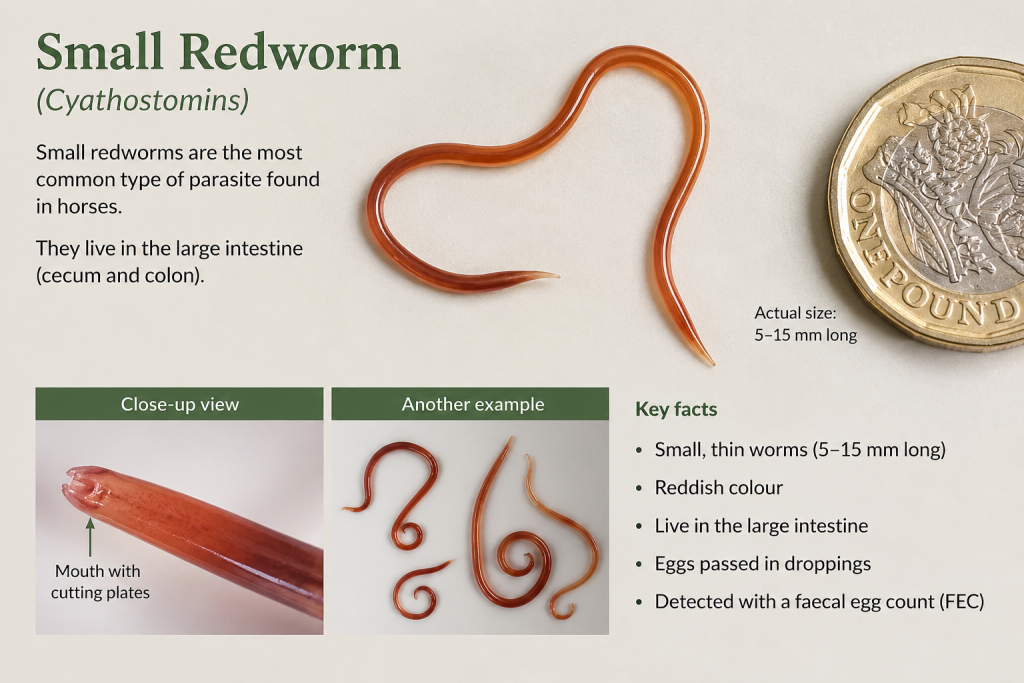
Small Redworm (Cyathostomins)
Small redworm are the most significant internal parasites affecting adult horses in the UK. While adult worms live in the large intestine, immature larvae can become encysted within the wall of the intestine, where they may remain dormant for many months.
When large numbers of larvae emerge simultaneously, they can cause severe inflammation of the intestine, leading to larval cyathostominosis—a potentially life-threatening condition.
Because encysted larvae are not detected by faecal egg counts, additional seasonal treatment may still be recommended depending on your horse’s individual risk, which usually involves worming horses with Moxidectin or Fenbendazole (5-day course) once a year.
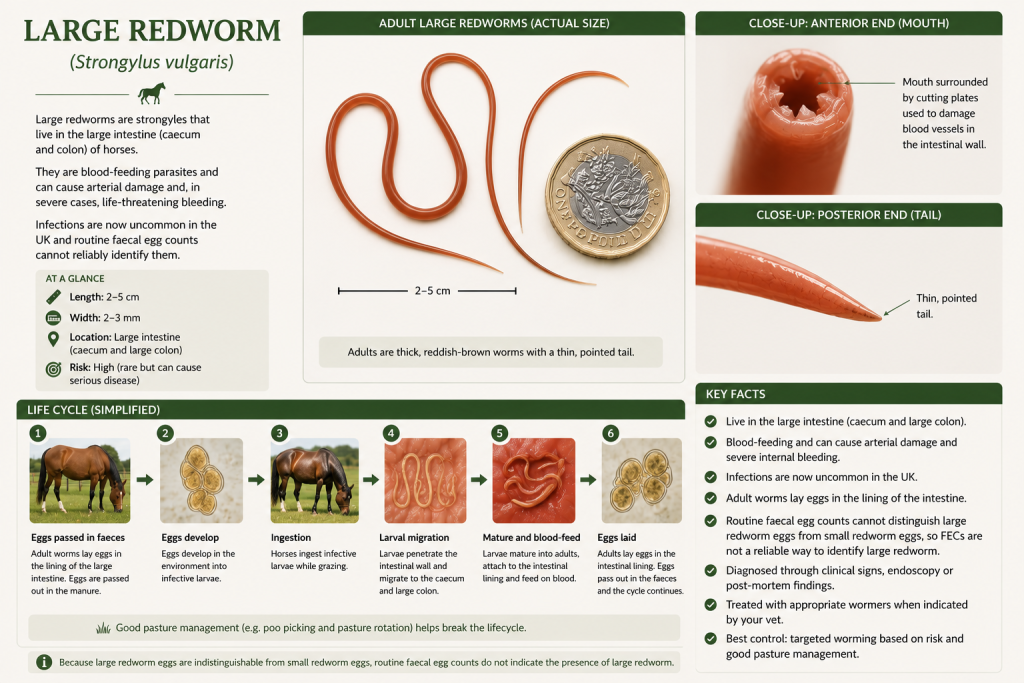
Large Redworm
Once considered one of the most dangerous equine parasites, large redworm has become far less common thanks to effective parasite control.
Although uncommon today, it remains important because migrating larvae can damage blood vessels supplying the intestines, potentially resulting in severe colic.
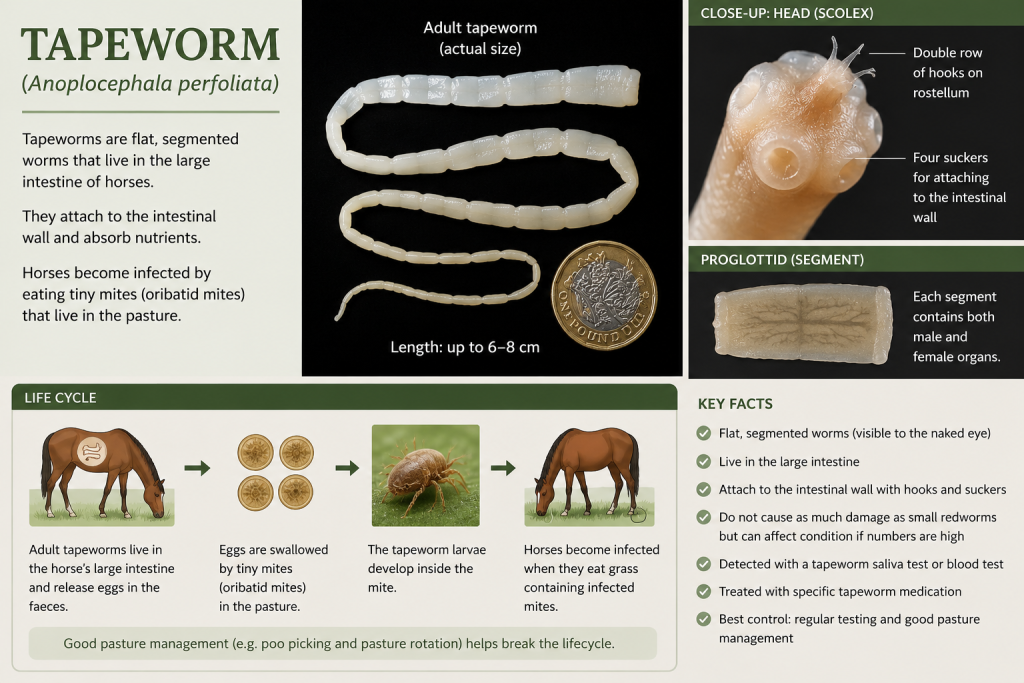
Tapeworm
Tapeworms are associated with certain types of colic, particularly around the junction between the small intestine and caecum.
Unlike many other parasites, tapeworm eggs are not reliably detected during routine faecal egg counts. Instead, saliva or blood tests are commonly used to assess exposure, allowing treatment to be targeted where appropriate.
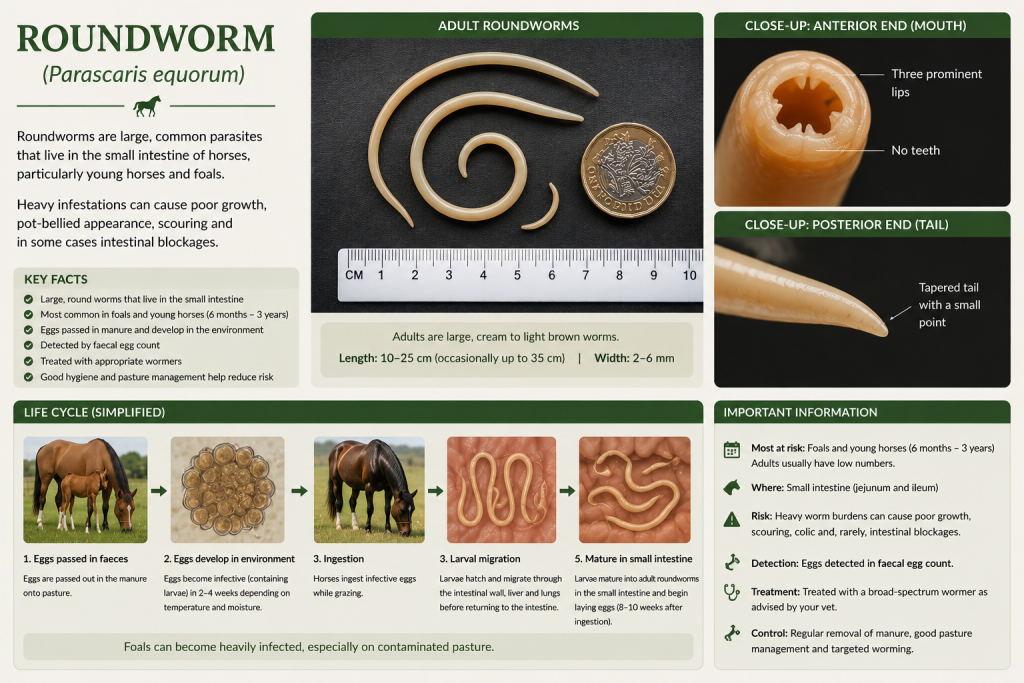
Roundworm (Ascarids)
Roundworms are primarily a concern in foals and young horses.
Adult horses usually develop good natural immunity, making significant roundworm burdens uncommon after the first few years of life.
Young horses should therefore have parasite control programmes tailored specifically to their age and management.
Bots (Gasterophilus spp.)
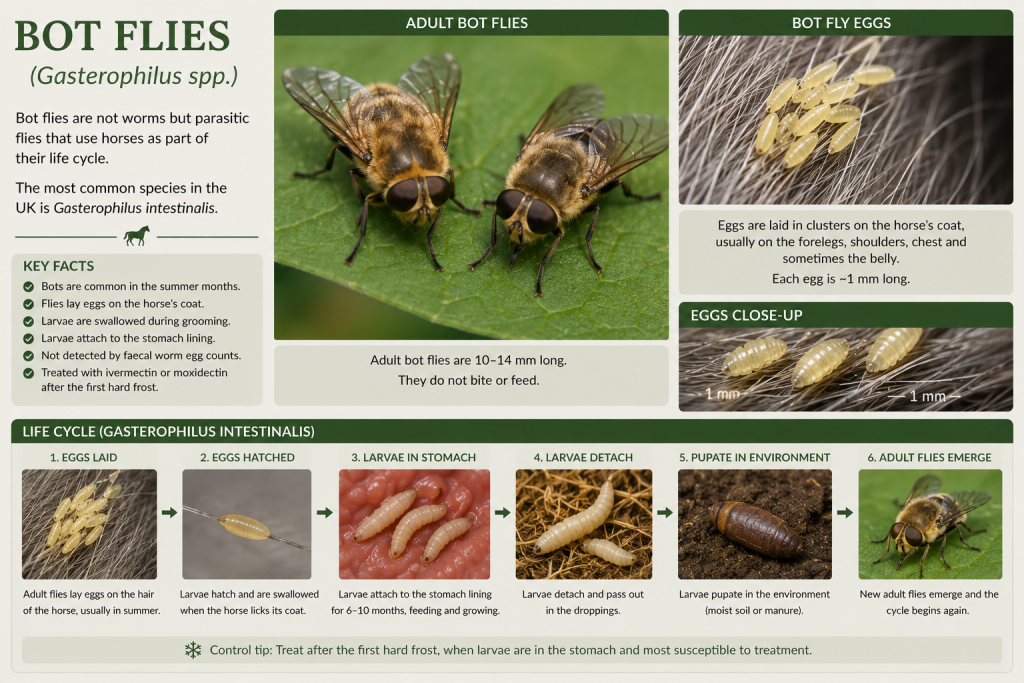
Bot flies are not worms but parasitic flies that use horses as part of their life cycle. During the summer, adult bot flies lay small yellow eggs on the horse’s coat, most commonly on the forelegs, shoulders and chest. When the horse licks these areas, the eggs hatch and the larvae enter the mouth before eventually passing into the stomach, where they attach to the stomach lining.
Most horses with a small number of bots show few or no obvious signs. However, larger burdens may contribute to irritation of the stomach lining (gastritis), mouth ulcers while the larvae are migrating, and, in rare cases, digestive problems.
The parasites in a snapshot
How does a faecal worm egg count work?
A faecal egg count (FEC) is one of the most valuable tools in modern parasite control. Rather than looking for worms themselves, the test measures the number of parasite eggs present in a small sample of your horse’s droppings.
Adult female small redworms (cyathostomins) living in the horse’s large intestine lay microscopic eggs, which pass out of the body in the faeces. The laboratory counts these eggs and reports the result as eggs per gram (EPG) of faeces.
The higher the egg count, the greater the number of egg-producing adult worms your horse is likely to be carrying. This information helps your vet or SQP decide whether worming is necessary.
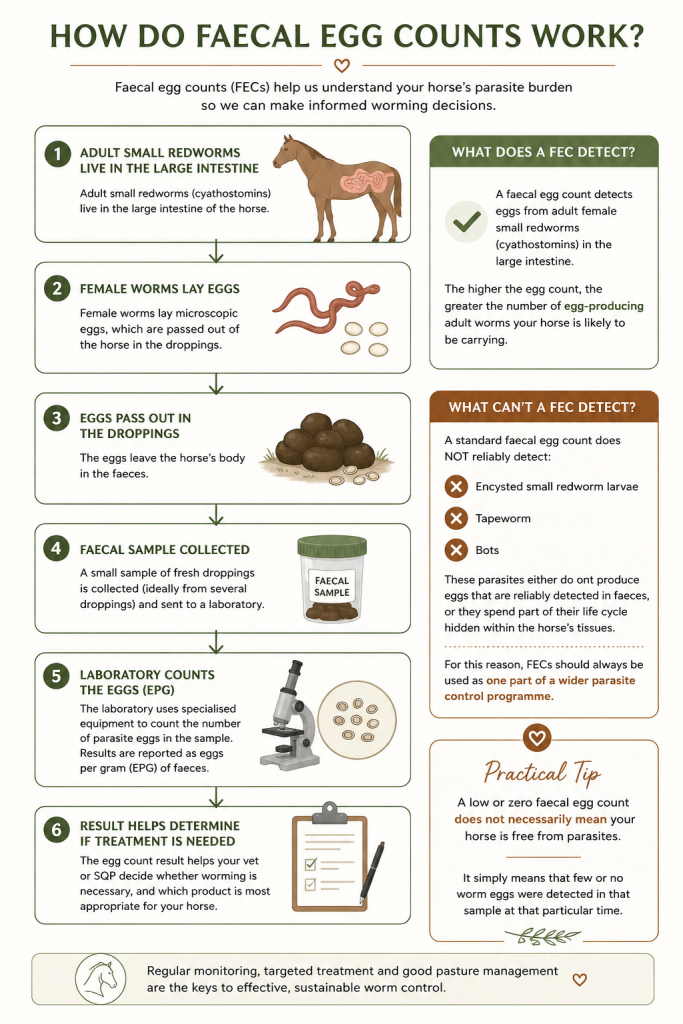
🐴 Practical Horse Owner Tip – A low or zero faecal egg count does not necessarily mean your horse is free from parasites.
It simply means that few or no worm eggs were detected in that sample at that particular time. Some important parasites, including encysted small redworm and tapeworm, require different testing or treatment strategies.
The higher the egg count, the greater the number of egg-producing adult worms your horse is likely to be carrying. This information helps vets or SQPs decide whether worming horses is necessary.
What can’t a faecal worm egg count detect?
Although faecal egg counts are extremely useful, they do have important limitations.
A standard faecal egg count does not reliably detect:
- Encysted small redworm larvae
- Tapeworm
- Bots
This is because these parasites either do not produce eggs that are reliably detected in faeces, or they spend part of their life cycle hidden within the horse’s tissues rather than in the intestine.
For this reason, faecal egg counts should always be used as one part of a wider parasite control programme, rather than as the only method of monitoring parasite risk.
Other tests your horse may need
While faecal worm egg counts are an excellent way to monitor small redworm and roundworm egg shedding, they don’t detect every type of parasite. Some parasites require different tests because of their unique life cycles.
Understanding these additional tests can help you build a more effective, targeted parasite control programme.
Tapeworm testing
Tapeworm is one of the most important parasites that cannot be reliably detected using a standard faecal worm egg count.
This is because tapeworm eggs are released intermittently, rather than continuously, meaning they are often absent from a faecal sample even when a horse is infected.
Instead, tapeworm is usually monitored using either:
- A blood test, performed by your vet.
- A saliva test, which horse owners can often carry out themselves before sending the sample to a laboratory.
These tests measure your horse’s immune response to tapeworm exposure rather than looking directly for parasite eggs.
The results can help determine whether treatment is needed, reducing unnecessary use of wormers while ensuring horses with significant tapeworm burdens receive appropriate treatment.
Encysted small redworm
One of the biggest limitations of faecal egg counts is that they cannot detect encysted small redworm larvae.
After being swallowed on pasture, small redworm larvae can burrow into the lining of the horse’s large intestine, where they become encysted. During this stage they are immature, do not lay eggs and therefore remain invisible to faecal egg counts.
Large numbers of encysted larvae can emerge from the gut wall simultaneously, particularly during late winter or early spring. This mass emergence can cause severe inflammation of the intestine, known as larval cyathostominosis, which can be life-threatening.
Unfortunately, there is currently no routine diagnostic test capable of accurately measuring the number of encysted larvae present in an individual horse.
For this reason, your vet or SQP may recommend a targeted seasonal treatment for encysted small redworm based on your horse’s age, management, grazing history and previous parasite monitoring results. This is usually involves worming horses at the end of winter – January/February time.
Bots
Bot flies lay their eggs on a horse’s coat during the warmer months. As the horse grooms, the larvae enter the mouth before eventually attaching to the stomach lining.
Although bots rarely cause serious disease in healthy adult horses, heavy burdens may contribute to gastric irritation.
Faecal worm egg counts do not detect bots because the larvae develop inside the stomach rather than producing eggs that pass into the faeces.
Bot eggs are often visible on the horse’s coat, particularly on the forelegs, shoulders and chest, and can be removed using a bot knife, grooming stone or warm water before they are ingested.
Where appropriate, your vet or SQP may recommend treatment after the first hard frost, when adult bot fly activity has finished for the season, usually worming horses with Ivermectin or Moxidectin.
🐴 Practical Horse Owner Tip – No single test detects every parasite.
Think of parasite control as putting together pieces of a puzzle. Faecal egg counts, tapeworm testing, seasonal risk assessment and good pasture management each provide part of the picture, helping you make informed decisions about when treatment is genuinely needed.
A targeted approach
Modern parasite control is no longer about routinely worming horses several times a year.
Instead, it combines:
- Regular faecal worm egg counts to monitor small redworm and roundworm egg shedding.
- Tapeworm testing when appropriate.
- Seasonal assessment of encysted small redworm risk.
- Good pasture management and dung removal.
- Advice from your vet or SQP.
By using the right combination of monitoring and treatment, horse owners can reduce unnecessary wormer use while helping to slow the development of wormer resistance.
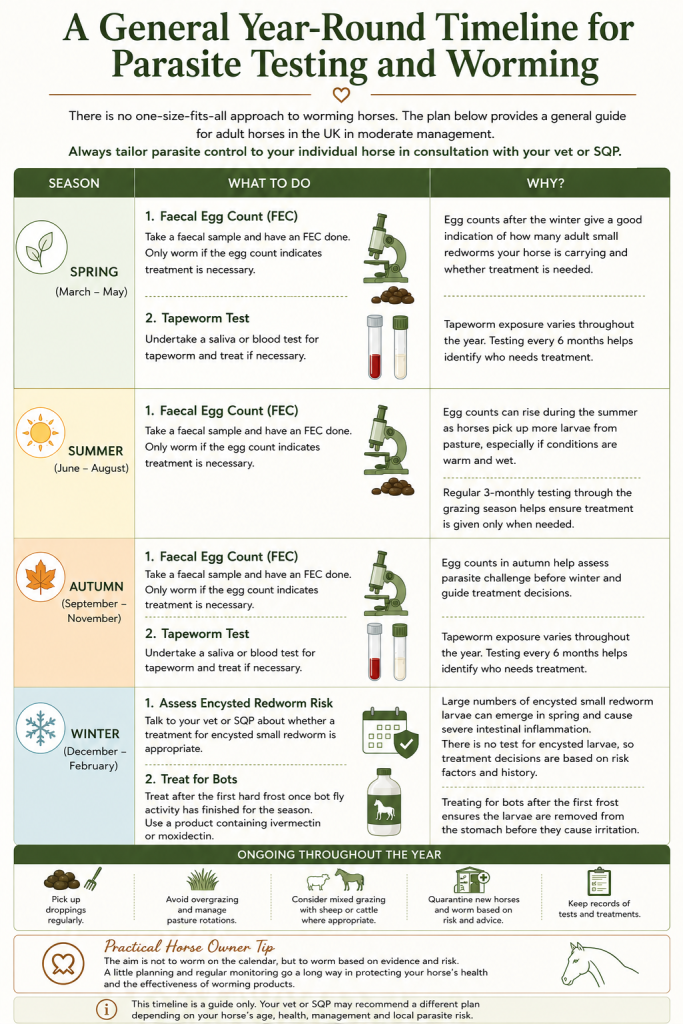
See the image below for a good, general annual worming routine:
Common Worming Mistakes
❌ Worming horses on a fixed calendar without testing.
❌ Assuming a zero egg count means no parasites are present.
❌ Forgetting to test for tapeworm.
❌ Leaving manure in paddocks for long periods.
❌ Introducing new horses without quarantine or parasite assessment.
❌ Worming horses with the same wormer repeatedly without professional advice.
When should I contact my vet?
Seek veterinary advice promptly if your horse develops:
- Severe or persistent diarrhoea
- Recurrent colic (see our article on ‘Colic’ for more information)
- Rapid weight loss
- Poor condition despite adequate feeding
- A dull demeanour or reduced appetite
- Signs of illness following worming treatment
Myths VS Facts
| Myth | Fact |
|---|---|
| “Worming horses should be done every three months.” | False. Modern parasite control is based on testing and risk assessment rather than routine treatment. |
| “A zero egg count means my horse has no worms.” | False. Some parasites, such as encysted small redworm and tapeworm, are not detected by a standard faecal egg count. |
| “Wormer resistance is becoming more common.” | True. Responsible, targeted worming helps preserve the effectiveness of the medicines we have available |
Frequently Asked Questions (FAQ’s)
How often should I worm my horse?
There is no single schedule that suits every horse. Modern parasite control relies on faecal egg counts, tapeworm testing, seasonal risk assessment and advice from your vet or SQP.
Can a horse have worms with a zero faecal egg count?
Yes. A zero faecal egg count means no worm eggs were detected in that sample. It does not rule out parasites such as encysted small redworm, tapeworm or bots.
How often should I perform a faecal worm egg count?
For most adult horses, faecal egg counts are recommended every 8–12 weeks during the grazing season. Your vet or SQP may recommend a different schedule depending on your horse’s age, management and individual risk.
What does a high faecal egg count mean?
A high egg count suggests your horse is shedding larger numbers of parasite eggs and may require treatment. Your vet or SQP can help interpret the result and recommend the most appropriate wormer if treatment is necessary.
Should I worm if my horse has a low egg count?
Not necessarily. One of the aims of targeted parasite control is to avoid unnecessarily worming horses. Always discuss your results with your vet or SQP before deciding whether treatment is needed.
Can I rely on faecal egg counts alone?
No. Faecal egg counts are an important part of parasite control, but they do not detect tapeworm, encysted small redworm or bots. A complete parasite control programme combines regular monitoring with seasonal risk assessment and appropriate testing.
Why shouldn’t I worm my horse routinely?
Routinely worming horses without testing can contribute to anthelmintic resistance, where worms become less responsive to the medicines used to treat them. Targeted treatment helps preserve the effectiveness of available wormers for the future.
Do all horses in a field need treating if one horse has a high egg count?
Not always. Horses vary greatly in the number of parasite eggs they shed. Your vet or SQP can advise whether individual treatment or yard-wide management is most appropriate based on the circumstances.
What is an SQP?
An SQP (Suitably Qualified Person) is a trained and registered professional who is qualified to provide advice on parasite control and supply certain worming medications. Many horse owners work with an SQP alongside their veterinary surgeon to develop an appropriate parasite control programme.
Are young horses wormed differently from adult horses?
Yes. Foals and young horses are generally more susceptible to parasites and often require a different monitoring and treatment programme. Always seek advice from your vet or SQP to develop an age-appropriate parasite control plan.
Can good pasture management reduce the need for worming?
Yes. Regular removal of droppings, avoiding overstocking, rotating grazing where possible and quarantining new horses all help reduce parasite burdens on pasture. Good management is an essential part of modern parasite control.
What should I do before introducing a new horse to the yard?
New horses should be managed carefully to reduce the risk of introducing resistant parasites. Your vet or SQP may recommend quarantine, testing and, where appropriate, targeted treatment before the horse joins the resident herd.
Still have questions?
Parasite control should always be tailored to the individual horse. If you’re unsure about your horse’s worming programme or test results, speak to your vet or SQP for personalised advice.
In Conclusion
Modern parasite control is no longer about routinely worming horses—it is about understanding your horse’s individual risk, monitoring parasite burdens, and using treatments responsibly. By combining regular testing with good pasture management and veterinary advice, horse owners can protect their horses while helping preserve the effectiveness of wormers for the future.
Glossary
Anthelmintic – A medicine used to treat worm infections.
Encysted larvae – Immature small redworm larvae that become dormant within the wall of the large intestine.
EPG (Eggs Per Gram) – The number of parasite eggs found in one gram of faeces during a faecal worm egg count.
FEC (Faecal Egg Count) – A laboratory test that estimates the number of egg-producing worms by counting parasite eggs in a manure sample.
Resistance – When worms become less susceptible to the medicines used to treat them.
SQP – A Suitably Qualified Person who is trained to advise on parasite control and supply certain worming medicines.
🎁 Free Printable
Did you find this guide helpful?
Download your FREE Annual Worming Timeline to print, laminate and keep at your yard so you can always refer back to the information!
Simply enter your email below and we’ll send it straight to your inbox 👇

References
- Westgate Labs. Educational resources on faecal worm egg counts, tapeworm testing and sustainable parasite control.
- The British Horse Society. Charity aimed in educating horse owners
- CANTER Initiative. Organisation dedicated to controlling antiparasitic resistance in equines.
- Moredun Research Institute. Research and educational resources on equine parasites.
- American Association of Equine Practitioners. Internal Parasite Control Guidance.
- World Association for the Advancement of Veterinary Parasitology. Guidelines for evaluating the efficacy of equine anthelmintics.
Note: Many of the above resources do deal with multiple species, but all do contain research/studies on equine parasite control and worming horses.
Disclaimer
This guide is intended for educational purposes and should not replace advice from your veterinary surgeon or Suitably Qualified Person (SQP). Parasite control should always be tailored to your individual horse, management system and local parasite risk.
Evidence & Editorial Standards – This article has been written using current evidence-based guidance and educational resources from recognised organisations within the equine industry. Every effort is made to ensure information is accurate and up to date at the time of publication. Articles are reviewed periodically and updated as recommendations evolve.